AI Detector By Originality.ai™ Has 99%+ Accuracy: Originality.ai Study
We believe that it is crucial for AI content detectors reported accuracy to be open, transparent, and accountable. The reality is, each person seeking AI-detection services deserves to know which detector is the most accurate for their specific use case.
The world needs reliable AI detection tools; however, no AI detection tool is ever going to be 100% perfect.
It’s important to understand their limitations so that you can use them responsibly.
What does this mean for developers of AI detectors? They should be as transparent as possible about the capabilities and limitations of their detectors.
At Originality.ai, we believe that transparency is a top priority.
So, below we’ve included our analysis of Originality.ai’s AI detector efficacy, including accuracy data and false positive rates.
Here’s what you’ll find in this guide:
Originality.ai AI Detector model release history
Originality.ai AI Detector accuracy tests
Why is it important for AI detectors to release studies?
How do AI detectors check for accuracy? (learn about confusion matrices)
How AI detection (and the Originality.ai AI Detector works)
Our view: AI detectors in academia and false positives in general
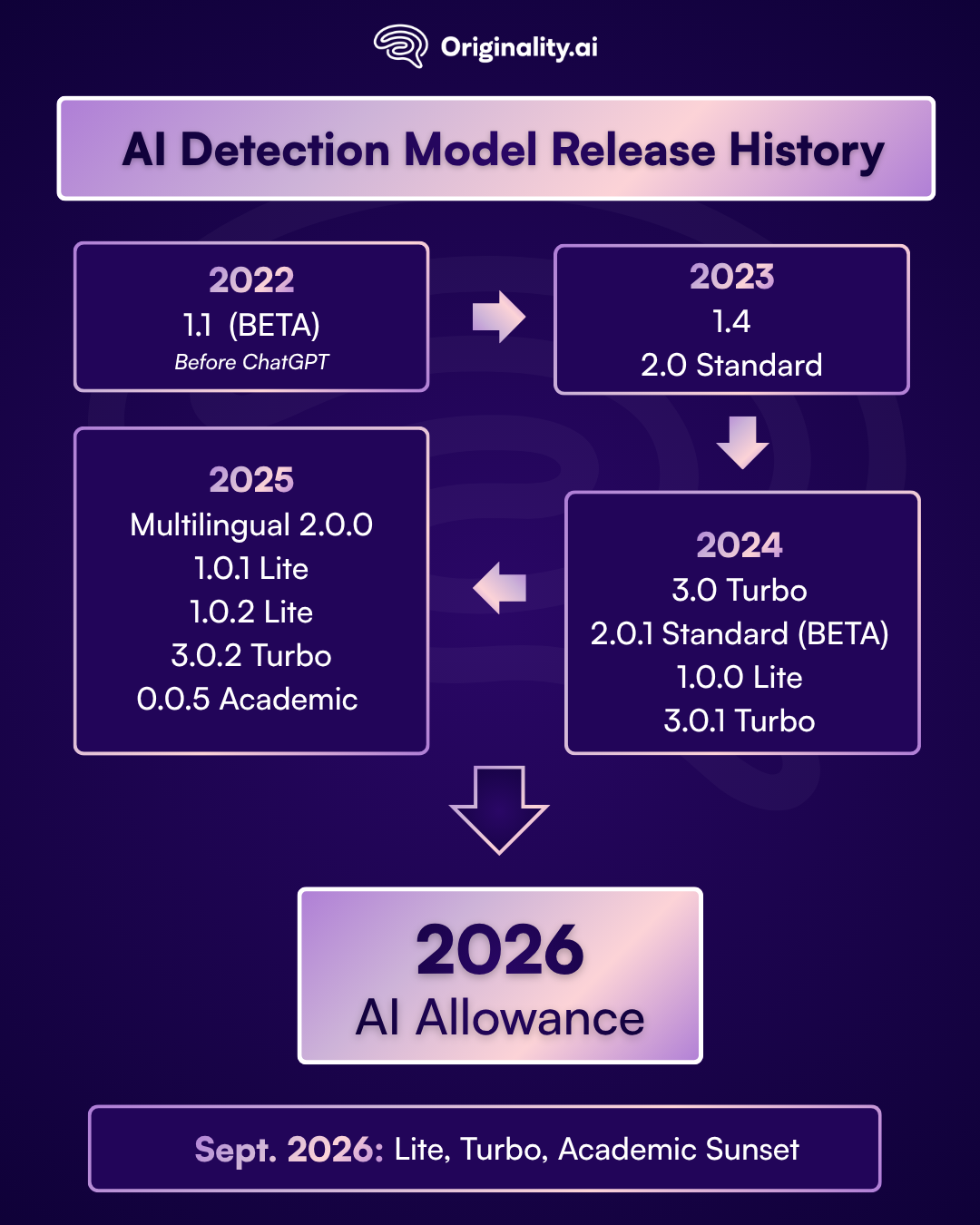
In September 2026, we sunset the classic models: Lite, Turbo, and Academic.
In 2026, binary classification is outdated. Most content isn’t purely human or purely AI; it’s hybrid. That’s why we launched AI Allowance, and since its release, it’s become the overwhelming user favorite, so we’re retiring Lite, Turbo, and Academic.
Multi-Language AI Detector expands to 30 Languages - May 2025: Learn more about our Multilingual AI Detector.
Multi-Language continues to be available.
Originality.ai AI Detection Model Release History:
At Originality.ai, our team is always innovating to provide you with the best-in-class AI detection.
Check out our AI detection model release history below:
GPT-2, GPT-NEO, GPT-J, and GPT-3 accurate detection. But was able to be “tricked” with Paraphrasing
First GPT-3 trained detector
First commercially available AI detector
1.4 – Apr 2023
Improved ChatGPT detection
Accurate on GPT4-generated content
Only tool capable of accurately detecting paraphrased content.
Reduced the number of false positives with increased training on human-generated content
2.0 Standard — Aug 2023
Reduced False Positives
Improved Accuracy on the Hardest to Detect AI Content (GPT4, ChatGPT & Paraphrased)
Release of Open Source Benchmark Dataset.
Release of Open Source AI Detection Efficacy Testing Tool(s).
Between 1.4 and 2.0, our team built many models, which slightly increased AI detection capabilities, but we weren’t going to release a model until it materially reduced false positives.
September 2024 Update: This model has been retired from our platform. Sign up to try our latest model!
3.0 Turbo — Feb 2024
Trained on the newest LLMs (Grok, Mixtral, GPT-4 Turbo, Gemini, Claude 2)
Accuracy increased on our toughest testing dataset from 90.2% to 98.8%
False Positives have been slightly improved from 2.9% to 2.8%
2.0.1 Standard (BETA) — July 2024
Improved version of the flagship 2.0.0 Standard model (BETA).
September 2024 Update: Thank you for your feedback! BETA testing has now concluded, and with Lite being your top choice, this model has been retired.
1.0.0 Lite — July 2024
Highly accurate with 98% accuracy (under 1% false positive rate).
Allows for lightly AI-edited content (like Grammarly’s grammar and spelling suggestions) while still differentiating between light AI editing and fully generated AI content.
This model has retired: September 2026
3.0.1 Turbo — October 2024
99%+ accuracy in detecting AI content (under 3% false positive rate).
Best for use cases where there’s a0 tolerance policy for AI content.
Robust against bypassing methods — extremely challenging to bypass.
Multilingual 2.0.0 — May 2025
The Originality.ai Multi Language 2.0.0 model now supports 30 languages!
Notable improvements with an overall accuracy of 97.8%
Reduced false negatives to 1.99% and lowered false positive rate to 2.4%
Classic models, Lite, Turbo, and Academic are sunset, with AI Allowance becoming the most innovative way to check for hybrid content in 2026 and the overwhelming user favorite.
Originality.ai AI Detector Accuracy Tests
AI Allowance
Is AI Allowance an accurate way to check for AI? To answer that question, our machine learning engineers provided a technical breakdown below!
How Do You Measure the Accuracy of "Allowance"?
Measuring the accuracy of AI Allowance requires a fundamentally different approach than traditional AI detection.
To be fully transparent, we evaluate AI Allowance across different types of datasets to understand its performance. It’s important to understand the difference between classic binary models and the new AI Allowance model.
Binary Models (Turbo & Lite): These models ask one question: "Is this AI or Human?" They produce one consistent label per sample. (now retired)
AI Allowance (Threshold Model): This model asks: "How much of this is AI?" It measures the content on a spectrum and applies your chosen threshold to make a decision.
Because they do different jobs, comparing them isn't about proving which model is "better" - it's about providing a relative baseline so you can choose the right tool for your specific needs.
The True Test: The Threshold Benchmark
To accurately test AI Allowance, we built an entirely new Internal Combined Benchmark (167,980 samples) containing spectrum data.
In a traditional dataset, a text is either "Human" or "AI." But in our Threshold Benchmark, the "correct" label of a single sample actually flips depending on the threshold you choose.
Here is how that works in practice:
Imagine a 1,000-word human-written article where the writer used AI to generate 100 words (10% AI).
If you select 5% AI Allowance: The correct label for this text is Likely AI, because 10% exceeds your strict 5% limit.
If you select 15% AI Allowance: The exact same text's correct label flips to Likely Original, because 10% is safely within your moderate 15% limit.
On this specialized spectrum benchmark, AI Allowance excels at dynamically identifying the degree of AI used, achieving 96.53% overall accuracy at the strict 5% boundary with highly balanced precision and recall.
Understanding Our Traditional Dataset (Benchmark V6)
We also tested AI Allowance against our massive Benchmark V6 dataset (specifically, a 456,872-sample slice of modern flagship models like GPT-5, Claude 4.5, and Gemini 2.0).
It is crucial to note that Benchmark V6 is a traditional binary dataset. In V6, whether a text was 5% AI-generated or 40% AI-generated, it was simply labeled as "AI-generated."
When you look at the V6 accuracy table below, you will see the highest overall accuracy at the 15% threshold. This does not mean 15% is a "better" threshold than 5% or 25%. It simply means that 15% AI Allowance is the boundary that most closely aligns with how "AI-generated" content was historically defined and labeled in traditional datasets.
Here is how AI Allowance performs on the V6 dataset alongside our classic models as a relative baseline:
Model / Threshold
Overall Accuracy
Precision (Trust in the AI flag)
What This Means
AI Allowance (5%)
98.0%
91.1%
Highly sensitive. Will flag even minor AI edits.
AI Allowance (15%)
99.4%
98.5%
Aligns best with traditional definitions of AI content.
AI Allowance (25%)
95.8%
99.7%
Highly precise; only flags heavy AI usage.
AI Allowance (40%)
88.7%
99.8%
Extremely lenient; near-zero false positives.
Lite 1.0.2 (Binary)
99.3%
97.0%
Excellent lightweight baseline for strict binary detection.
Turbo 3.0.2 (Binary)
98.3%
91.8%
Aggressive recall for catching older and newer AI models alike.
The Takeaway: AI Allowance is flexible to your use case; most use cases can benefit from selecting 15% AI Allowance.
If you have a zero-tolerance policy, use 5% AI Allowance. But if you want to allow for light AI grammar edits and brainstorming while still catching heavily AI-generated essays or articles, 15% AI Allowance provides incredible precision and flexibility for the modern hybrid-writing era.
September 2026 update: Since we first published the accuracy data for AI Allowance, leading AI companies have continued to release new LLMs.
Check out the accuracy of AI Allowance on the latest AI models:
So, now you’ve read the metrics for Originality.ai’s accuracy, but how do AI detectors check for accuracy? Here’s a bit more information for background context.
Below are the best practices and methods used to evaluate the effectiveness of AI classifiers (i.e., AI content detectors).
One single number related to a detector's effectiveness without additional context is useless!
Don’t trust a SINGLE “accuracy” number without additional context.
Here are the metrics we look at to evaluate a detector's efficacy…
Confusion Matrix
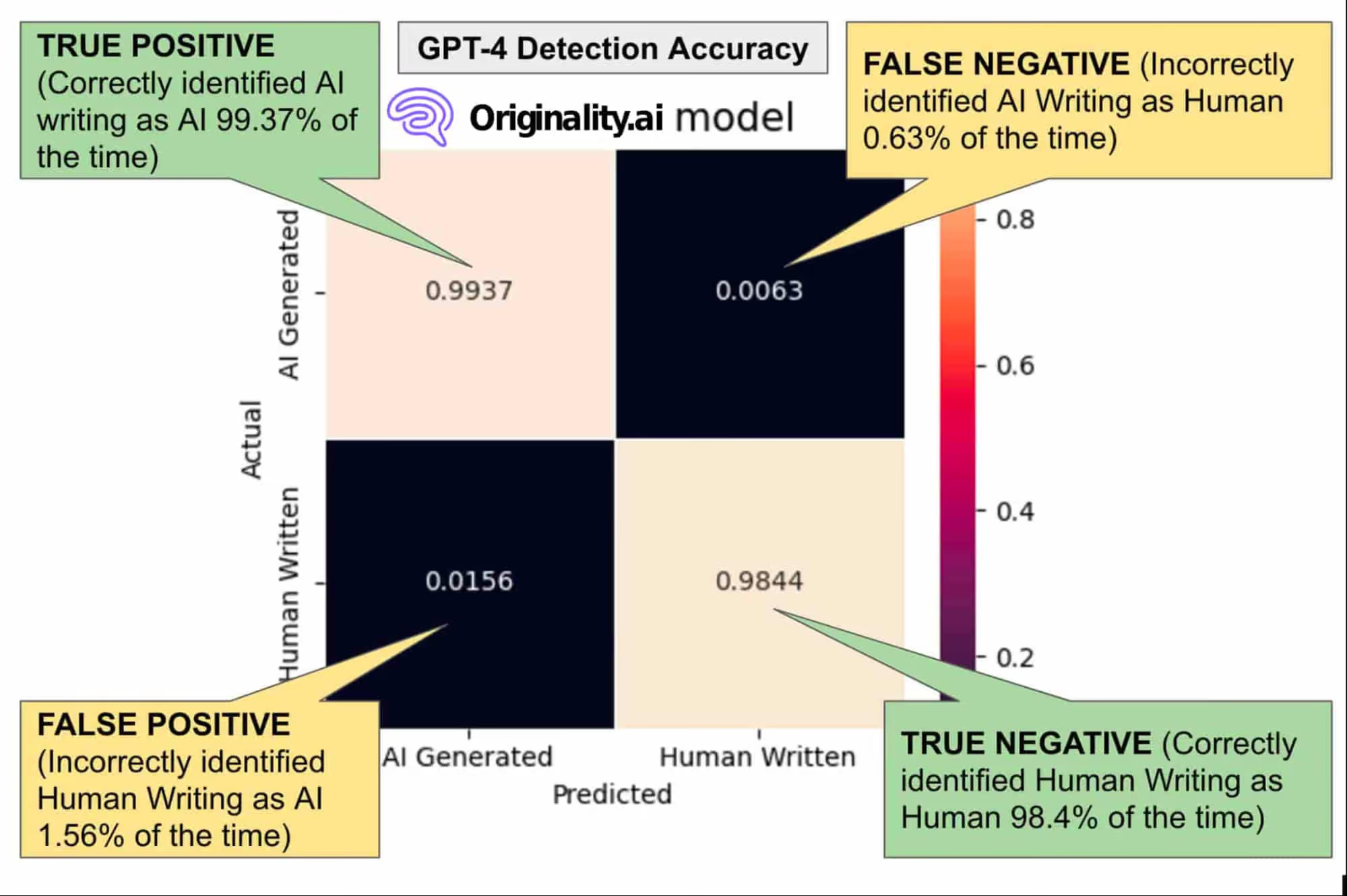
The confusion matrix and the F1 (more on it later) together are the most important measures we look at. In one image, you can quickly see the ability of an AI model to correctly identify both Original and AI-generated content.
True Positive (TP): AI detector correctly identified AI content as AI.
False Negative (FN): AI detector incorrectly identified AI content as human.
False Positive (FP): AI detector incorrectly identified human content as AI.
True Negative (TN): AI detector correctly identified human content as human.
Version 1.4 Confusion Matrix on a GPT-4 & Human Dataset Test
True Positive Rate — AI Text Detection Capabilities
Identifies AI content correctly x% of the time. True Positive Rate TPR (also known as sensitivity, hit rate or recall).
Identifies human content correctly x% of the time. True Negative Rate TNR (also known as specificity or selectivity).
True Negative Rate TNR = TN / (TN & FP) = 1- FPR
Accuracy:
What % of your predictions were correct? Accuracy alone can provide a misleading number. This is in part why you should be skeptical of AI detectors' claimed “accuracy” numbers if they do not provide additional details for their accuracy numbers. The following metric is what we use to measure accuracy.
Combines Recall and Precision to create one measure to rank all detectors, often used when ranking multiple models. It calculates the harmonic mean of precision and sensitivity.
F1 = 2 x (PPV x TPR) / (PPV + TPR) where Precision (PPV) = TP / (TP + FP)
Metrics Considered but Not Used:
ROC & AUROC: Not used since we can't adjust the sensitivity of other tools and some tools do not provide a percentage.
Precision: PPV = TP / (TP + FP) - Not used
Why Is It Important for AI Detectors to Release Studies?
FTC Addresses Unsupported AI Detection Accuracy Claims
Claimed accuracy rates with no supporting studies are clearly a problem.
We hope the days of AI detection tools claiming 99%+ accuracy with no data to support it are over. A single number is not good enough in the face of the societal problems AI content can produce, and the important role AI content detectors have to play.
The FTC has come out on multiple occasions to warn against tools claiming AI detection accuracy or unsubstantiated AI efficacy.
In 2025, the FTC addressed misleading accuracy claims from one company offering AI detection without the data to back it up:
“The order settles allegations that Workado [Content at Scale now BrandWell] promoted its AI Content Detector as “98 percent” accurate in detecting whether text was written by AI or human. But independent testing showed the accuracy rate on general-purpose content was just 53 percent, according to the FTC’s administrative complaint. The FTC alleges that Workado violated the FTC Act because the “98 percent” claim was false, misleading, or non-substantiated.” - Source: FTC
So, we created this guide and tools, because we believe…
In the transparent and accountable development and use of AI.
That AI detectors have a role to play in supporting AI transparency across industries
AI detection tools' “accuracy” should be communicated with the same transparency and accountability that we want to see in AI’s development and use. Our hope is that this study will move us all closer to that ideal.
At Originality.ai, we aren’t for or against AI-generated content… but believe in transparency and accountability in its development, use, and detection.
Originality.ai helps ensure there is trust in the originality of the content being produced by writers, students, job applicants, or journalists.
Pro Tip: Scanning high volumes of content for AI? Check out our Bulk Scan feature.
How AI Detection (and the Originality.ai AI Detector Works)
Our AI detector works by leveraging supervised learning of a carefully fine-tuned large AI language model.
We use a large language model (LLM) and then feed this model millions of carefully selected records of known AI and known human content. It has learned to recognize patterns between the two. More details on our AI content detection.
Below is a brief summary of the 3 general approaches that an AI detector (or called in Machine Learning speak a “classifier”) can use to distinguish between AI-generated and human-generated text.
1. Feature-Based Approach:
The feature-based approach uses the fact that there can potentially be consistently identifiable and known differences that exist in all text generated by an LLM like ChatGPT when compared to human text. Some of these features that tools look to use are explained below.
Burstiness
Burstiness in text refers to the tendency of certain words to appear in clusters or "bursts" rather than being evenly distributed throughout a document.
AI-generated text can potentially have more predictability (less burstiness) since AI models tend to reuse certain words or phrases more often than a human writer would.
Some tools attempt to identify AI text using burstiness (more burstiness = human, less burstiness = AI).
Perplexity
Perplexity is a measure of how well a probability model predicts the next word. In the context of text analysis, it quantifies the uncertainty of a language model by calculating the likelihood of the model producing a given text.
Lower perplexity means that the model is less surprised by the text, indicating the text was more likely AI-generated. High perplexity scores can indicate human-generated text.
Frequency Features
Frequency features refer to the count of how often certain words, phrases, or types of words (like nouns, verbs, etc.) appear in a text. For example, AI might overuse certain words, underuse others, or use certain types of words at rates that are inconsistent with human writing. These features might be able to help detect AI-generated text.
Studies have shown that earlier (ie 2019) LLMs would generate text that has similar readability scores.
Punctuation
This pertains to the use and distribution of various punctuation marks in a text. AI-generated text often exhibits correct and potentially predictable use of punctuation.
For instance, it might use certain types of punctuation more often than a human writer would, or it might use punctuation in ways that are grammatically correct but stylistically unusual. By analyzing punctuation patterns, someone might attempt to create a detector that can predict AI-generated content.
Advantages vs. Disadvantages
Advantages: Once patterns are identified, they can be repeatedly identified in a very cost-effective and fast manner.
Disadvantages: Modern LLMs such as ChatGPT4 and Bard can produce varied enough content that these detectors can be bypassed with clever ChatGPT prompts.
A zero-shot approach uses a pre-trained language model to identify text generated by a model similar to itself. Basically, asking itself how likely the content the AI is seeing was generated by a similar version of itself (note: don’t try asking ChatGPT… it doesn’t work like that).
Advantages: Easier to build and does not require supervised training
A fine-tuning AI model approach uses a large language model such as BERT or RoBERTa and trains on a set of human and AI-generated text. It learns to identify the differences between the two in order to predict if the content is AI or Original.
Advantages: Can produce the most effective detection
Disadvantages: These can be more expensive to train and operate. They can also lag behind in detection capabilities for the newest AI tools until their training is updated.
The test below looks at the performance of multiple detectors using all of the strategies identified above.
Our View: AI Detectors in Academia & False Positives in General
We do not believe that AI detection scores alone should be used for academic honesty purposes and disciplinary action.
The rate of false positives (even if low) is still too high to be relied upon for disciplinary action.
Here is a guide we created to help writers or students reduce false positives in AI content detector usage.
~Plus, we created an Originality.ai Extensions (Chrome, Google Docs, and Firefox) to help writers, editors, students, and teachers visualize the creation process and prove originality.
That means helping to maintain AI transparency in content marketing, journalism, education, and more.
Consider a student submitting an assignment. They want to know they can confidently submit that essay or paper and have their hard work recognized.
Both students and teachers benefit from accurate AI detection. Students can be confident that they can prove their work is original, and teachers can have clarity on AI use.
The same is true for writers and editors. A writer submitting a blog post or article wants peace of mind that authentic, human-written work will be recognized, while editors need clarity on the writing process for submitted work.
Here’s how accurate AI detection can benefit you:
Academic Integrity
Students can prove their work is original, such as with our Extension
Teachers get clarity on AI use, like with our Moodle Plugin
Authentic Content, Blogs, and Articles
Writers can align AI use with AI policy for each publication, using AI Allowance
Integrity in University, Scholarship, and Job Applications
Whether you’re writing or reviewing an application, confidently show (or find out) the origins of a document and check if AI usage matches your standards.
Support for SEOs and Marketers Publishing People-First Content
AI content also has SEO implications. We studied possible Google AI Penalties and found that publishing AI content can carry risks.
In 2025, Google released updated Search Quality Rater Guidelinesstating: “The Lowest rating applies if all or almost all of the MC on the page (including text, images, audio, videos, etc) is copied, paraphrased, embedded, auto or AI generated, or reposted from other sources with little to no effort, little to no originality, and little to no added value for visitors to the website.” - Google
Across 4 LLMs (ChatGPT, DeepSeek, Gemini, and Grok) and human-written samples, Originality.ai had perfect accuracy (100%), precision, recall, and F1-Score.
Turnitin, ZeroGPT, Detecting-AI.com, GPTZero, QuillBot, Grammarly, Sapling, Copyleaks, and Originality.ai
Among the clearly commercial detectors in the paper’s principal comparison table (Table 10), Originality.ai achieved the highest reported accuracy, precision, recall, and F1 score.
28 detectors noted in Table 10 of the study, including a mix of research tools and commercial AI detectors
The end result?
Across both internal testing and third-party studies, we continue to outperform competitors as the Most Accurate AI Detector.
Why Is Our Model Accurate?
Below are a few of the main reasons we suspect Originality.ai’s AI detection performance and overall AI detector accuracy are significantly better than alternatives…
Larger Model: We suspect (can’t confirm) that we use a much larger model… there is no way we could offer a free or ad-supported option given our models' compute cost per scan.
Train on the Latest LLMs: New AI models are continuously being released. We train our AI detector to identify the latest LLMs.
Train on Harder Datasets: The datasets we continue to create and train our AI on focus on increasingly adversarial detection bypassing methods. The better our AI gets, the more clever the prompt engineering or playground settings need to be to bypass us, and then we train on that new, more challenging dataset.
Final Thoughts
The AI/ML team and core product team at Originality.ai have worked relentlessly to build and improve on the most effective AI content detector!
The Results…
Originality.ai offers highly accurate AI detection options in 2026:
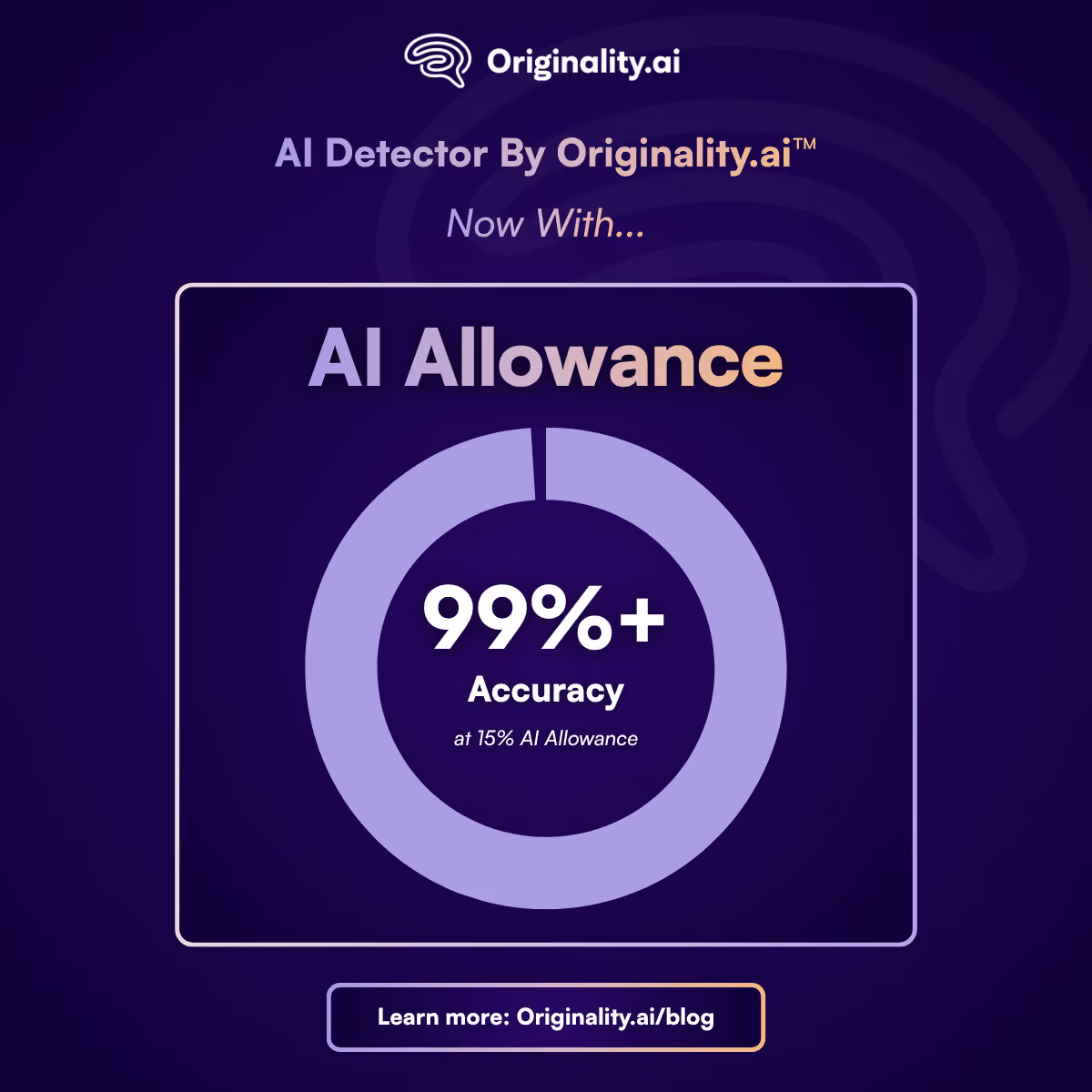
AI Allowance: 99%+ accurate at 15% AI Allowed
Multi Language: Overall accuracy of 97.8%
If you have any questions on whether Originality.ai would be the right solution for your organization, please contact us.
If you are looking to run your own tests, please contact us. We are always happy to support any study (academic, journalist, or curious mind).
We hope this helps establish clarity and transparency around AI detection and AI detection accuracy, and that other AI detectors will also share their accuracy results to further establish transparency in the industry.
Jonathan Gillham is an engineer, inventor, and entrepreneur. He is the founder and CEO of Originality.ai, an AI content integrity platform that launched the first commercial AI detector in November 2022, just three days before ChatGPT launched. Before founding Originality.ai, Jon worked as an engineer, built and exited two companies. His early work with generative AI in 2020 and 2021 gave him a firsthand view of the coming wave of AI-generated content and the need for technology that could bring transparency and trust to written content. Today, he leads Originality.ai’s work in AI detection and content integrity and is a named inventor on two U.S. patents covering AI detection technology. Jon’s expertise and research have been featured in WIRED, Business Insider, The Register, Global News, The Guardian, Entrepreneur, and The Washington Post, among others.