Turnitin Review: What Schools Should Know About Its AI Detector
Read a comparative review of Turnitin's strengths and limitations, as well as an overview of independent research on Turnitin, and our own 300-document comparison.
Turnitin is one of the most well-known institutional systems for checking student writing against prior submissions, publications, and web sources.
Should students, teachers, or schools choose Turnitin for AI detection?
We conduct a comprehensive review of Turnitin for AI detection, with a comparative analysis of Originality.ai AI Allowance settings across 300 students' essays.
Keep reading to find out whether Turnitin is the best fit for your school’s AI detection use case.
Key Takeaways (TL;DR)
What use case is Turnitin best for? Its similarity database (for plagiarism checking) and academic institutional workflow.
What is the AI Writing Report best for? Use it as a check that prompts additional review (e.g., the student’s draft, prior work, sources, and assignment context).
What limitations does Turnitin’s AI Writing Report have? Its ability to accurately detect fully AI-written content.
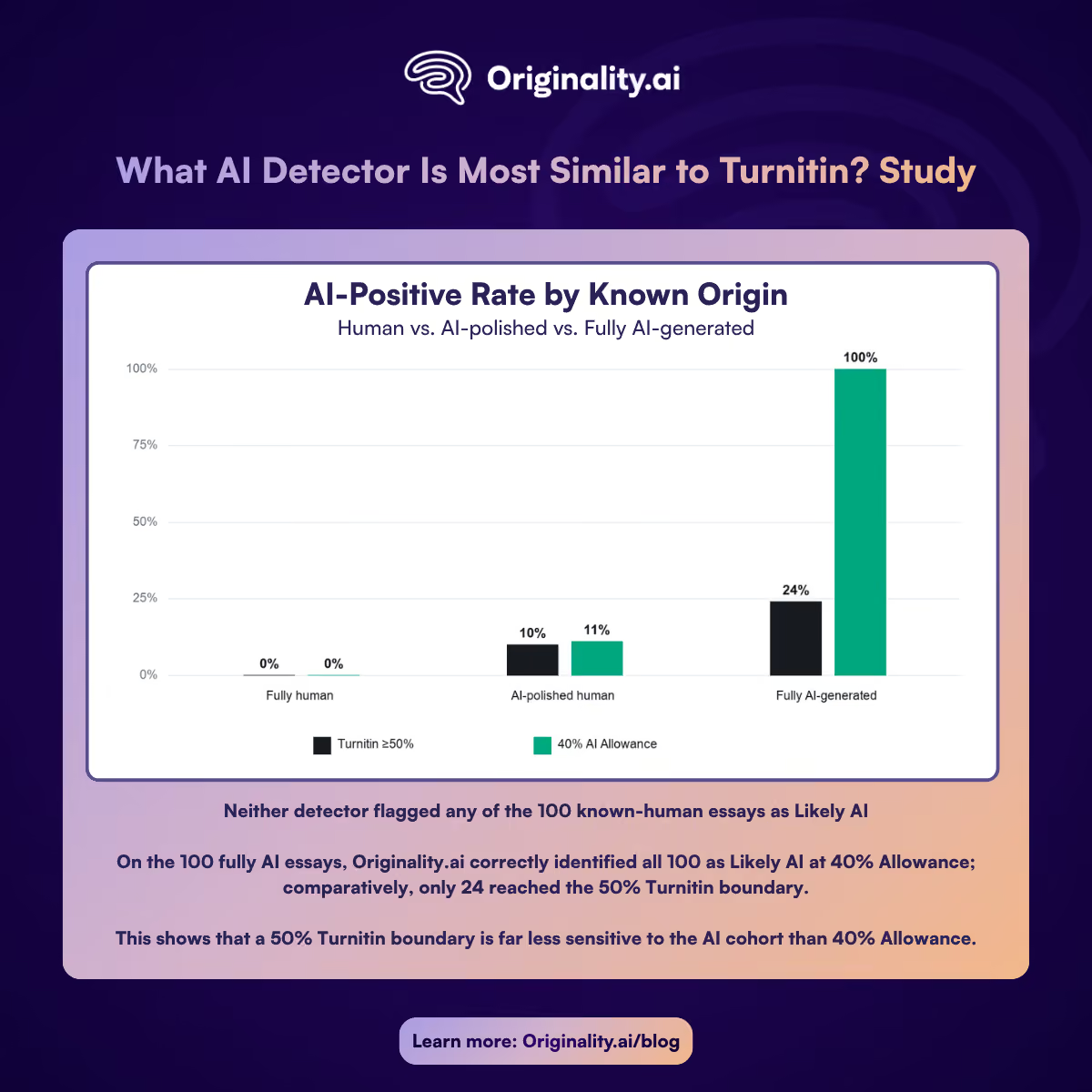
In our study, only 24% of the 100 completely AI-written samples were identified by Turnitin as over 50% AI-generated.
Originality.ai correctly identified 100% of the AI samples as Likely AI
What does the AI writing report accept? 300 to 30,000 words of long-form prose. It also supports English, Spanish, and Japanese. However, tables, bullet points, code, scripts, and other unconventional text are outside its reliable scope.
Do universities use Turnitin? While some keep the AI report with cautions, others have switched off only the AI feature while retaining Turnitin's text-matching service.
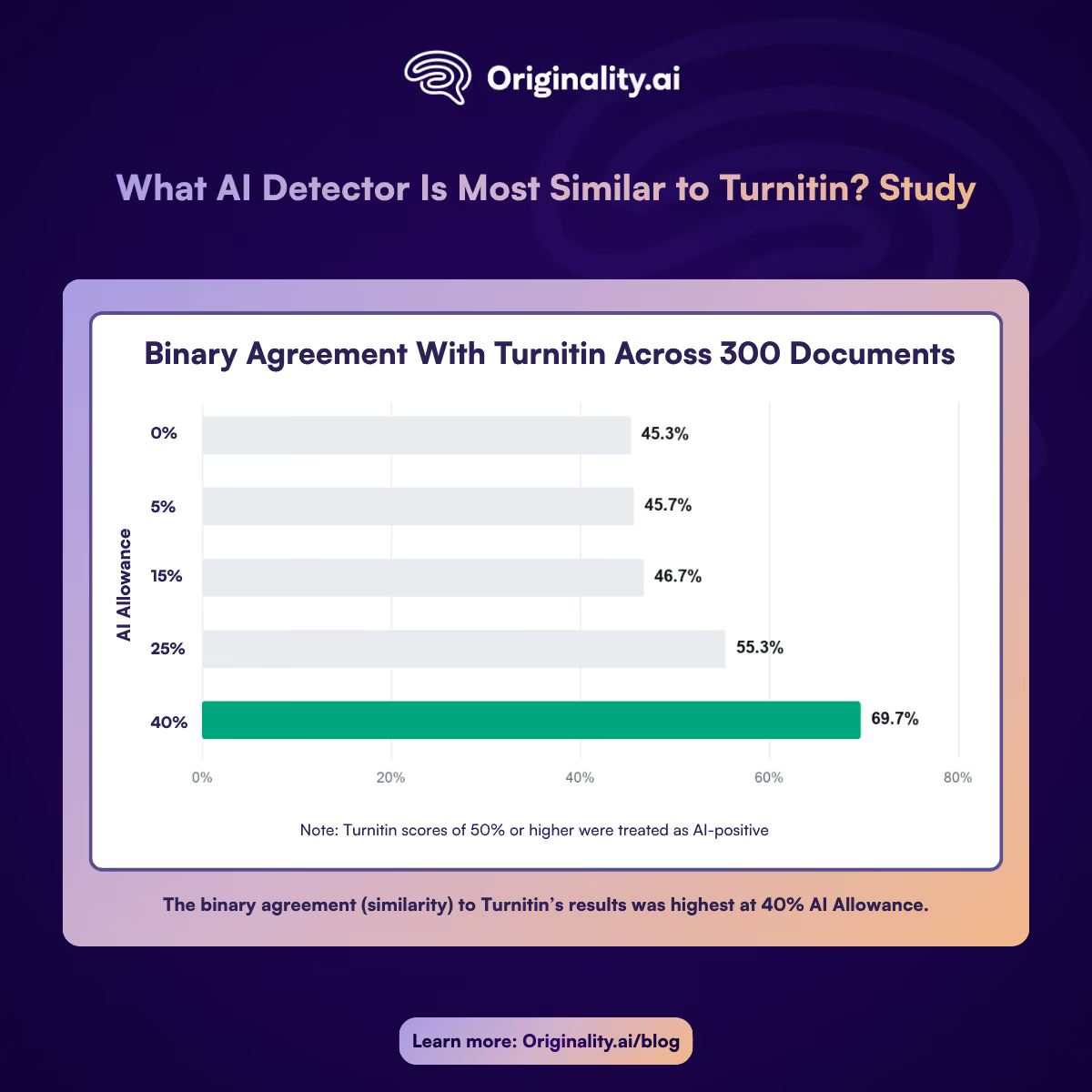
What AI detector is most similar to Turnitin? At a study-defined 50% Turnitin boundary, Originality.ai's 40% AI Allowance was most similar to Turnitin, with 69.7% agreement across 300 documents.
Turnitin vs. Originality.ai: Quick Comparison
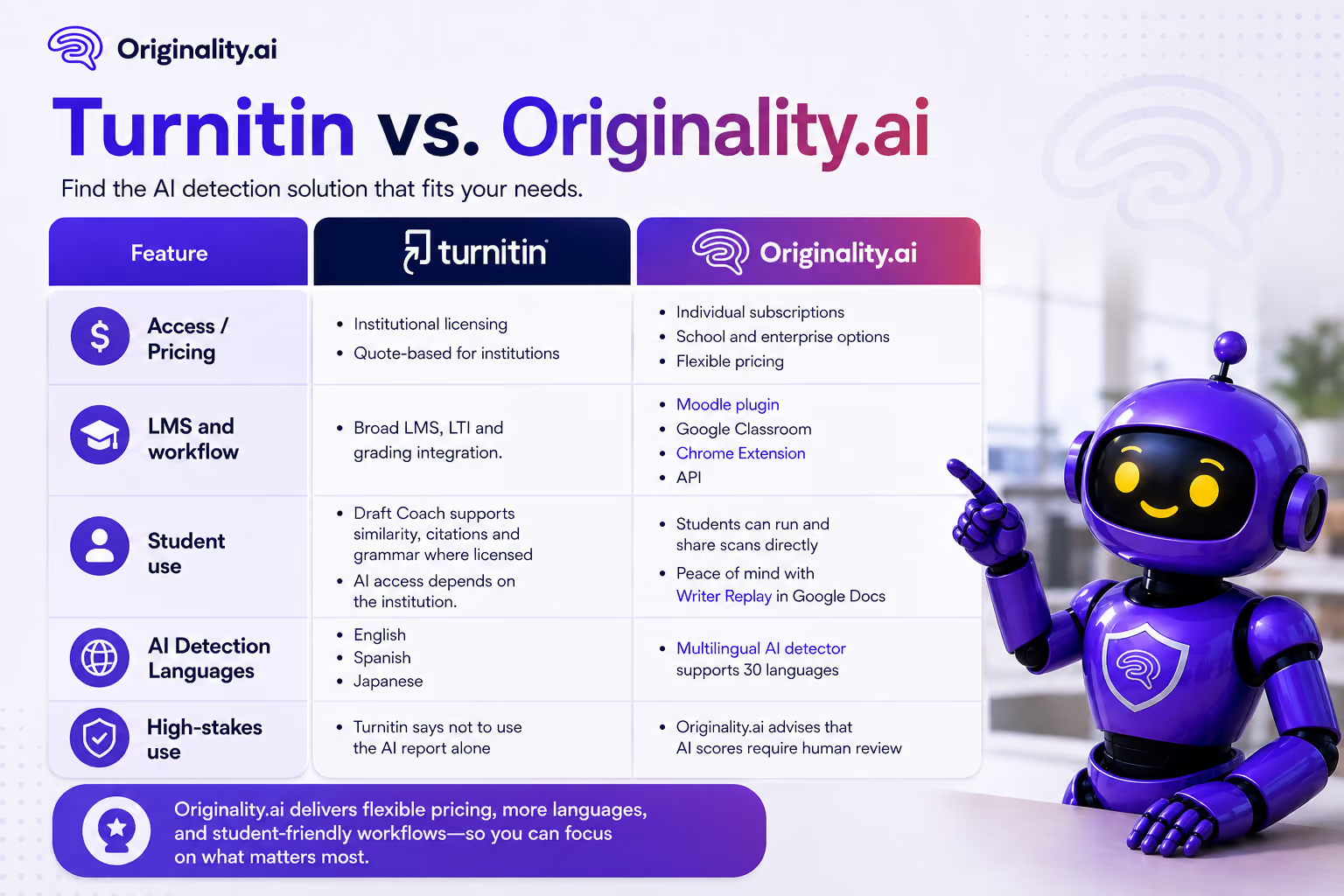
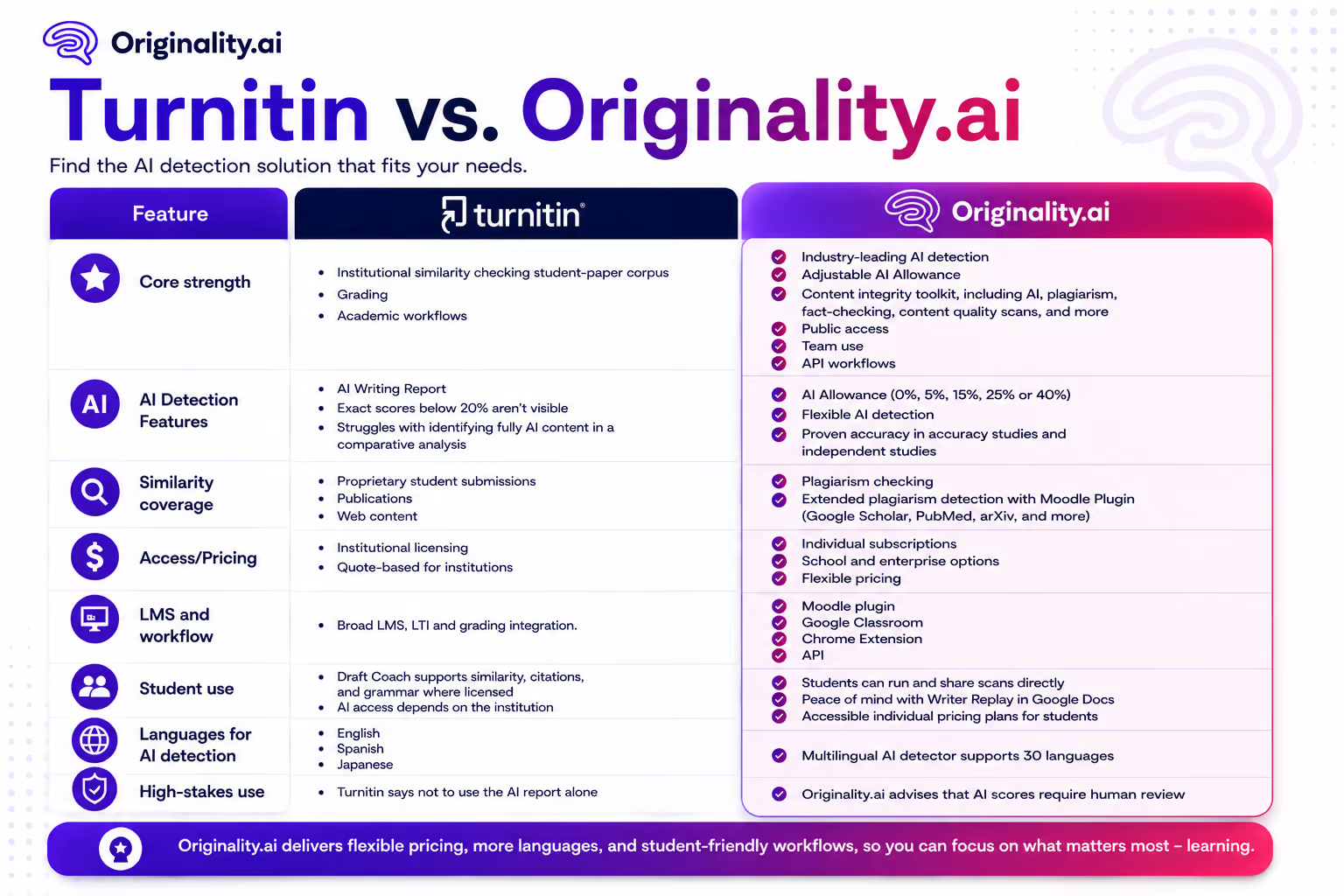
Here’s a quick comparison table of Turnitin vs. Originality.ai; continue reading for more in-depth results, including an expanded comparison table.
Feature
Turnitin
Originality.ai
Access/Pricing
- Institutional licensing
- Quote-based for institutions
- Individual subscriptions
- School and enterprise options
- Flexible pricing
Strong: its repository and source-linked report remain its clearest advantage.
Institutional workflow
Strong: LMS, grading, feedback, and administration tools are built around schools.
AI detector
Helpful as a first indicator, but struggles with fully AI-written samples (see study results later in this guide).
Student self-check
Good for similarity and citations through Draft Coach where licensed; the AI report is institution-controlled rather than a public pre-check. May be more challenging for students to access.
Price transparency
Limited. Turnitin directs institutions to sales rather than publishing standard prices.
Best fit
Schools where similarity checking is the main requirement, and LMS integrations.
What Is Turnitin? An Overview
Turnitin isn’t just one tool; it’s an entire platform. Part of that platform includes similarity reports and AI writing reports. It also offers grading features, exam integrity tools, and more.
Let’s take a closer look at similarity and AI writing reports in particular.
Similarity vs. AI Writing reports: What’s the difference?
Turnitin's Similarity Report (which checks plagiarism) and its AI Writing Report may sit near each other on the screen, but they answer different questions.
The Similarity Report compares a submission with student papers, publications, and internet material. It highlights matching passages and links them to sources. A match could be a proper quote, improper citations, or copying materials.
However, the software doesn’t specify which; that’s where a teacher’s unique expertise and familiarity with past student work comes in.
The AI Writing Report is a model estimate of the presence of AI content. It marks qualifying prose that Turnitin thinks was generated by an LLM or AI-generated and then altered by a paraphraser or bypasser.
There is no source document to inspect (unlike similarity or plagiarism checking features).
Further, the percentage is the estimated share of qualifying prose (that it interprets to be AI), not the probability that the whole paper was written by AI.
This distinction matters:
Source matching can give an instructor an evidence trail
AI detection gives an inference about probabilities around AI content
What Turnitin Does Well
1. It fits the way universities already collect and mark work
Turnitin Feedback Studio works through the web, APIs, and LTI integrations with systems including Canvas, D2L, Microsoft Teams, Moodle, and Sakai.
Instructors can use its features without moving work into a separate app:
Rubrics
Comments
QuickMarks
Grading tools
For a large institution, that administrative fit is beneficial.
2. Its similarity corpus is difficult to reproduce
Turnitin compares writing with a proprietary collection of student submissions as well as publications and web pages. That student-paper corpus helps identify reuse of materials across classes and institutions (subject to the repository and privacy choices in the school's contract).
3. It can show process, not only a final score
Turnitin Clarity is a paid add-on that records parts of the writing process, including drafting activity and pasted text. Process evidence can help students demonstrate their writing process, and typically provides more context for an AI detection score.
Then, Draft Coach also gives students similarity, citation, and grammar feedback before submission where their institution has licensed it.
4. Turnitin's own guidance is more cautious than some users
Turnitin does not present its AI report as a finding of misconduct. Its guidance says educators should use the score as one data point and apply human judgment, institutional policy, and further scrutiny.
However, while that may be Turnitin’s guidance, a limitation is that users may still choose to interpret that score differently.
Turnitin Limitations Schools Need to Consider
1. The AI report has a narrow input window
A submission must contain at least 300 words and no more than 30,000 words of long-form prose. It must be in English, Spanish, or Japanese and arrive as a supported file type.
Turnitin says it does not reliably assess:
Poetry, scripts
Code
Bullet points
Tables
Annotated bibliographies
Other short or unconventional writing
This is a limitation that excludes many assessment formats.
2. A low score is not a certificate of human authorship
Turnitin no longer shows exact scores from 1% to 19%. It displays *% because false positives are more common in that range.
So, a 0% result means the model did not identify qualifying text as likely AI-generated. It does not prove that a person wrote every word.
Likewise, 20% is the point at which Turnitin begins showing a number, not an official misconduct threshold.
3. A high score is still a model estimate
The report cannot show the original AI source. It can highlight passages, but the case still rests on context: what the assignment allowed, whether the student can explain the work, what their drafts show, whether citations exist, and whether the prose resembles earlier work.
Universities are Still Undecided on Turnitin’s AI Detection
With the education market being one of the most popular Turnitin use cases, how do universities approach Turnitin?
The reality is that most are still undecided, and there isn’t a common university position across academic institutions for its AI feature in particular.
Many still incorporate the similarity checker for plagiarism analysis.
Keeps Turnitin as its approved AI detector but instructs staff to use it cautiously.
Permits the tool with specific guidance around the potential for false positives.
So, what’s the key takeaway here? Most of the universities referenced in the table above opted out of Turnitin’s AI detection capabilities, often over the risk of false positives.
The one university listed above (University of Georgia) that kept it as its approved AI detector included guidance cautioning instructors about that concern of false positives with the tool.
Yet, in many cases, the similarity check was kept even if the AI detection was disabled, highlighting that academia continues to approach the use of plagiarism vs. AI detection separately.
Independent Research Findings on Turnitin Accuracy
AI detector studies often test different models, genres, lengths, editing methods, and thresholds.
So, when an AI detection brand only shows a single accuracy number, be sceptical.
Six detectors and 805 samples, with simple evasion techniques.
Across detectors, average accuracy fell from 39.5% on unmodified AI text to a mean of 17.4% after manipulation. For Turnitin (in table 8 of the study), non-manipulated accuracy was 50% vs. 7.9% for manipulated output.
The study was conducted using earlier AI models (GPT4, Claude 2, and Bard)
160 long academic papers: human, GPT-4o Deep Research, hybrid and humanised.
Turnitin correctly returned 0% on the fully human set, but in Table 4 of the research study, 100% of the fully AI Deep Research samples were noted as undetected.
Limited to one AI model for generation (GPT-4o Deep Research) and a modest sample size of 160.
81 constructed scripts mixing human words with ChatGPT, Copilot, Gemini, or Grammarly output.
Scores generally rose with the amount of AI text but often missed the true share; humanizers could evade detection.
Constructed scripts and a narrow sample.
The Originality.ai vs. Turnitin 300 Essay Sample Comparison
We ran a narrower study to answer a practical question: which Originality.ai AI Allowance setting makes the same binary call as Turnitin most often?
The test used 300 eligible essays from the GEDE education dataset: 100 fully human essays, 100 human essays polished by AI, and 100 essays generated from a prompt.
Each document was scanned at Originality.ai's 0%, 5%, 15%, 25%, and 40% AI Allowance levels.
We treated a Turnitin score of 50% or more as AI-positive for this comparison. That 50% line was our study boundary, not Turnitin guidance.
Figure 1. Binary agreement with Turnitin by Originality.ai AI Allowance. The 40% setting was closest overall, with 69.7% agreement.
The 40% AI Allowance was the closest of the five settings. It matched Turnitin on 209 of 300 documents.
The agreement rate rose as Originality.ai's setting became more tolerant of AI involvement:
AI Allowance Setting
Originality.ai Agreement with Turnitin
0%
45.3%
5%
45.7%
15%
46.7%
25%
55.3%
40%
69.7%
Figure 2. AI-positive rates by content type. Turnitin and 40% AI Allowance were close on human and AI-polished writing.
Content type
Turnitin >=50%
Originality 40% Allowance
Binary agreement
Fully human
0/100 (0%)
0/100 (0%)
100/100 (100%)
AI-polished human
10/100 (10%)
11/100 (11%)
85/100 (85%)
Fully AI-generated
24/100 (24%)
100/100 (100%)
24/100 (24%)
All documents
34/300 (11.3%)
111/300 (37.0%)
209/300 (69.7%)
At 40% AI Allowance, the agreements were very similar to Turnitin on fully human and AI-polished text.
However, when it came to completely AI-generated text, the results differed, with Originality.ai showing stronger AI detection accuracy.
Whereas Originality.ai correctly classified all 100 AI samples as AI, just 24 crossed the 50% Turnitin boundary.
Additional results to note:
Originality.ai classified 189 documents as Original at the 40% setting.
Turnitin scored 182 of those below our 50% boundary, or 96.3% agreement.
In the AI-polished cohort, the figure was 82 of 89, or 92.1%.
Seven documents in each calculation were exceptions.
Method limitation: the Turnitin scans were completed by a contractor with institutional access. Our audit received 159 report PDFs for 300 rows. Most delivered numeric scores reconciled, but we corrected two direct transcription errors, preserved suppressed low-score states where possible, and found incomplete evidence for many 0% claims. Three numeric scores were missing and treated as below the 50% boundary. The results should therefore be treated as directional. They are not a definitive benchmark of Turnitin's current model.
Should You Choose Turnitin or Originality.ai for Your Use Case?
Our study found that AI Allowance at 40% is the most similar to Turnitin.
Yet, the question remains: what is best for your use case, Turnitin or Originality.ai?
- Industry-leading AI detection
- Adjustable AI Allowance
- Content integrity toolkit, including AI, plagiarism, fact-checking, content quality scans, and more
- Public access
- Team use
- API workflows
AI Detection Features
- AI Writing Report
- Exact scores below 20% aren’t visible
- Struggles with identifying fully AI content in a comparative analysis
Integration with a Moodle plugin and Google Classroom.
Use both when
Turnitin is already the similarity checker, and the institution is looking for an independent AI signal for selected cases.
The second detector is used to test a finding comparatively.
Privacy, data processing, and retention have been approved for both systems.
Yet, AI detectors aren’t the final word
As an AI detection company, at Originality.ai we emphasize that an AI score should not be the only indicator of academic cheating.
AI detectors should supplement a fair review by teachers and educators, who have uniquely human insights into their students’ work and writing.
Then, complementing AI detection, schools should also:
Create a clear AI policy on what is and is not allowed
Consider the design of assessments, and their clarity on AI use
Implement fair review processes for work that is flagged as AI
Clear, transparent policies help to keep everyone on the same page, from students to teachers to administrators.
Tips for Approaching AI Detection in Education
Define permitted AI use before submission. State whether students may brainstorm, translate, correct grammar, rewrite sentences, generate passages, or none of these.
Validate on local writing. Test the AI detection tool on recent human work, AI-generated controls, multilingual writing, and the disciplines that will use it. Repeat after model updates.
Separate screening from judgment. A score may open a review. It should not decide the outcome.
Ask for process evidence. Review drafts, document history, notes, sources, earlier writing and, where appropriate, a short oral explanation.
Give the student the evidence and a right to respond. Do not ask them to rebut a hidden number.
Track false positives and false negatives. Record overturned flags, not only confirmed cases. Transparently share experiences with false positives or false negatives with colleagues.
Review privacy and retention. Use institutional accounts and signed terms. Do not paste student work into an unapproved consumer account.
Final Thoughts
Turnitin is worth considering as an institutional writing-integrity suite. Its strongest case is the one it built before generative AI: broad source matching, a student-paper repository, integration with university systems, and tools for feedback and review.
Its AI Writing Report can be useful, particularly when a high score points an instructor toward passages that deserve a conversation.
However, Turnitin does have limitations, such as the fact that the report has a 300-word floor, limited language and format coverage, no source text, and uneven results across independent studies.
✓ Originality.ai is the more flexible and accessible AI detector.
Its AI Allowance offers students and teachers flexibility to align AI scans with AI policies for individual assignments or school AI policies.
Further, our study found AI Allowance at 40% is the most similar to Turnitin on human and AI-polished student writing.
Turnitin can estimate which qualifying passages may have been generated by AI or generated and then altered. It cannot establish authorship with certainty, and Turnitin says the report should not be the sole basis for adverse action.
Is 20% an official Turnitin cheating threshold?
No. Turnitin begins surfacing exact scores at 20% because it considers the 1% to 19% range less reliable. That product display rule is not a misconduct standard.
Does 0% mean the paper is human-written?
No. It means the model did not identify qualifying prose as likely AI-generated. AI text can be missed, particularly after editing or when it comes from newer models.
Can students check their AI score before submitting?
Turnitin is sold through institutions. Draft Coach can give students similarity, citation, and grammar feedback where licensed, but the AI report is not a general public pre-check. Originality.ai offers direct student access.
Is Originality.ai more accurate than Turnitin?
In our analysis, we found that Originality.ai was more accurate at identifying fully AI-written text, with Originality.ai correctly identifying 100% of the AI-written samples, whereas Turnitin only flagged 24% as being over the 50% AI threshold.
Should a school use AI detection in misconduct cases?
It can be one signal. A fair case needs policy, context, human review, process evidence, and an opportunity for the student to respond. An AI detection should not be the only indicator of academic cheating.
Method and Sources
This review uses current Turnitin and Originality.ai product documentation, named university guidance, peer-reviewed detector studies, and the Originality.ai comparison described above. Product pages support feature claims. They are not treated as independent accuracy evidence. Older studies are identified as historical snapshots. The accompanying evidence ledger records each claim, source, and caveat.
Jonathan Gillham is an engineer, inventor, and entrepreneur. He is the founder and CEO of Originality.ai, an AI content integrity platform that launched the first commercial AI detector in November 2022, just three days before ChatGPT launched. Before founding Originality.ai, Jon worked as an engineer, built and exited two companies. His early work with generative AI in 2020 and 2021 gave him a firsthand view of the coming wave of AI-generated content and the need for technology that could bring transparency and trust to written content. Today, he leads Originality.ai’s work in AI detection and content integrity and is a named inventor on two U.S. patents covering AI detection technology. Jon’s expertise and research have been featured in WIRED, Business Insider, The Register, Global News, The Guardian, Entrepreneur, and The Washington Post, among others.