AI Checker
Plagiarism Checker
Grammar Checker
Content Quality
Guideline Checker
Readability Checker
Fact Checker

Extensions

AI detection scores: what are they, and what do they mean?
In this guide, we’ll take a look at one aspect of how AI detectors work: the AI score and what an AI score means.
In brief, an AI detection score (also known as an AI score or AI confidence score) is the score that an AI checker provides after scanning text. It indicates whether the text was Likely AI or human-written.
Keep in mind that the method for presenting (and determining) AI detection scores can vary by brand and AI detector, or type of AI detection software.
Here, we’ll focus on the industry-leading Originality.ai AI Checker and what the Originality.ai AI detector score means.
An AI Allowance Score shows the probability that content is Likely AI or Original (human-written).
Example: The score is Likely AI at 15% AI Allowance. This means AI use appears to exceed 15%. If you hover over the score, you can see the confidence in that prediction.
Take a look at the example screenshot below:
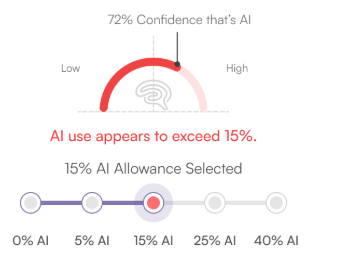
In this case, AI use appears to exceed 15%, and the model is 72% confident it’s AI.
Our AI detector provides a probability that a piece of content is AI or Original (human-written) after text is input into the checker.
This returns an AI confidence score.
Let’s break down what that could look like for AI Allowance and Multi Langauge models:
Example: AI use is 15% or less in your document, and you select 15% AI Allowance settings.
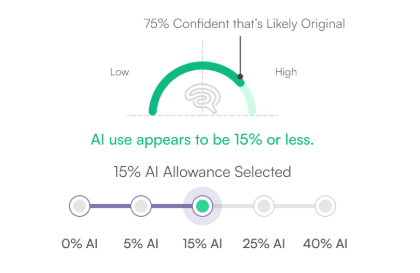
Your result would be “Likely Original” if AI use is less than the allowance.
Example of an Original AI Allowance Score
Note: 75% confidence means how confident the model is in this prediction.
Likely Original - 60% Confident means the model thinks the content is Original (human-written) and is 60% confident in its prediction.
Essentially, it is an AI score prediction.
This AI score DOES NOT mean that 60% of it was Original and 40% was AI-generated.
If you wrote 100% of the copy yourself and you receive a 60% Original score, that is not a false positive. Originality.ai’s AI detector has correctly predicted that the content was human-generated with 60% confidence.
What if the content was Likely AI?
Here’s an example of an AI score for multi-language content that’s AI-generated:
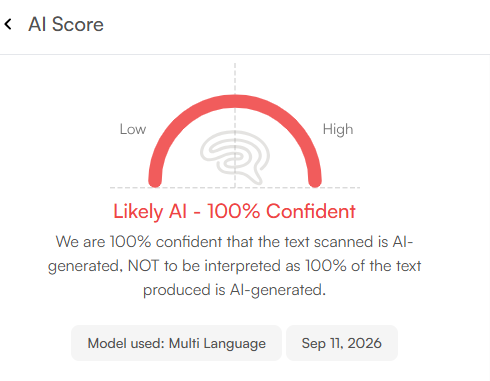
To create the example above, we input French-language text generated by ChatGPT. So the model correctly classified it as Likely AI - 100% Confident.
Once the Originality scan is complete, you can dig deeper beyond the AI score.
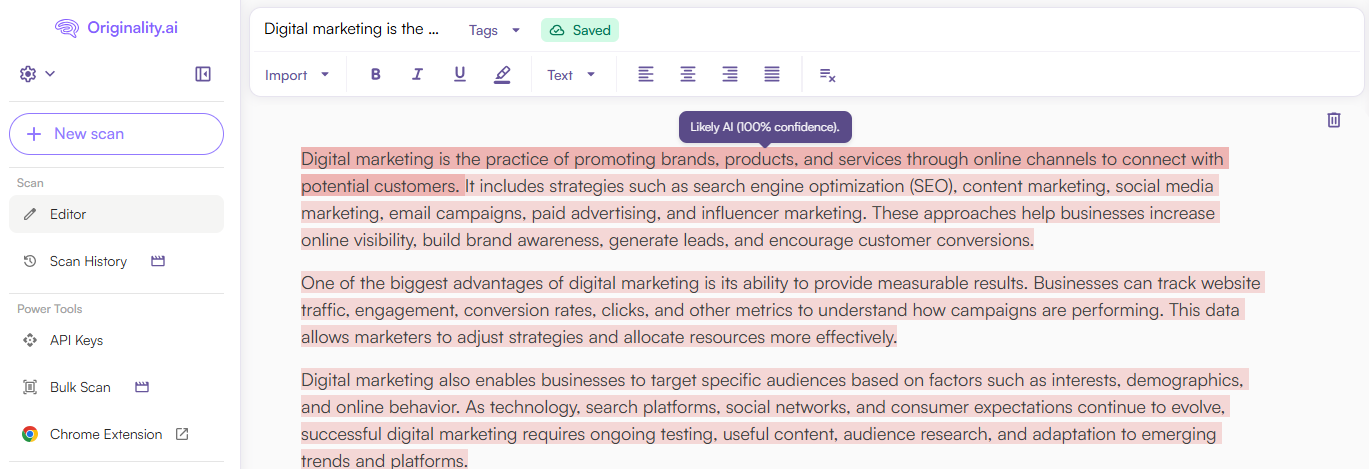
We provide sentence-level highlighting showing what parts the Originality AI Detector found were the most likely to be AI-generated.
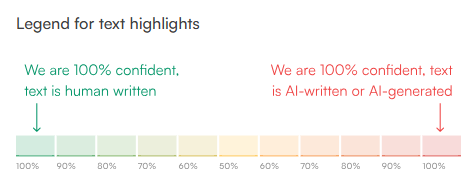
To demonstrate the in-text highlighting, we prompted ChatGPT to generate 150 words on digital marketing:
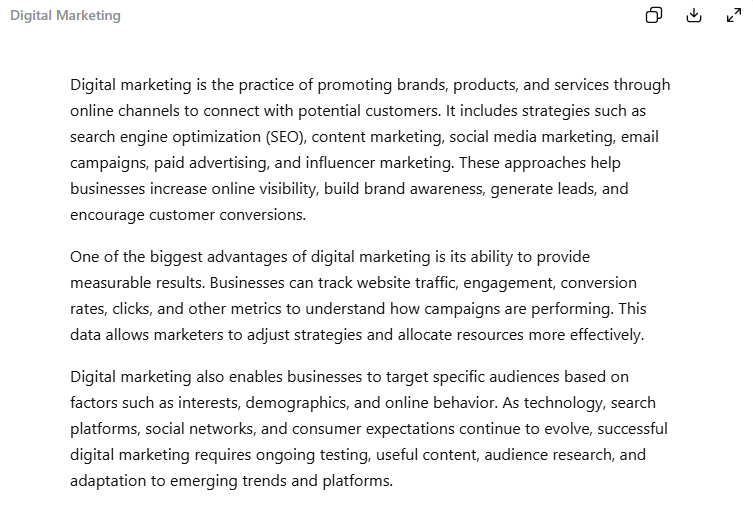
Then, when we ran that through the Originality.ai AI Detector, you can clearly see the ChatGPT-generated text highlighted in dark red to indicate that it is Likely AI.
Now, let’s compare that with some original content, written by a human from the beginning of this article.
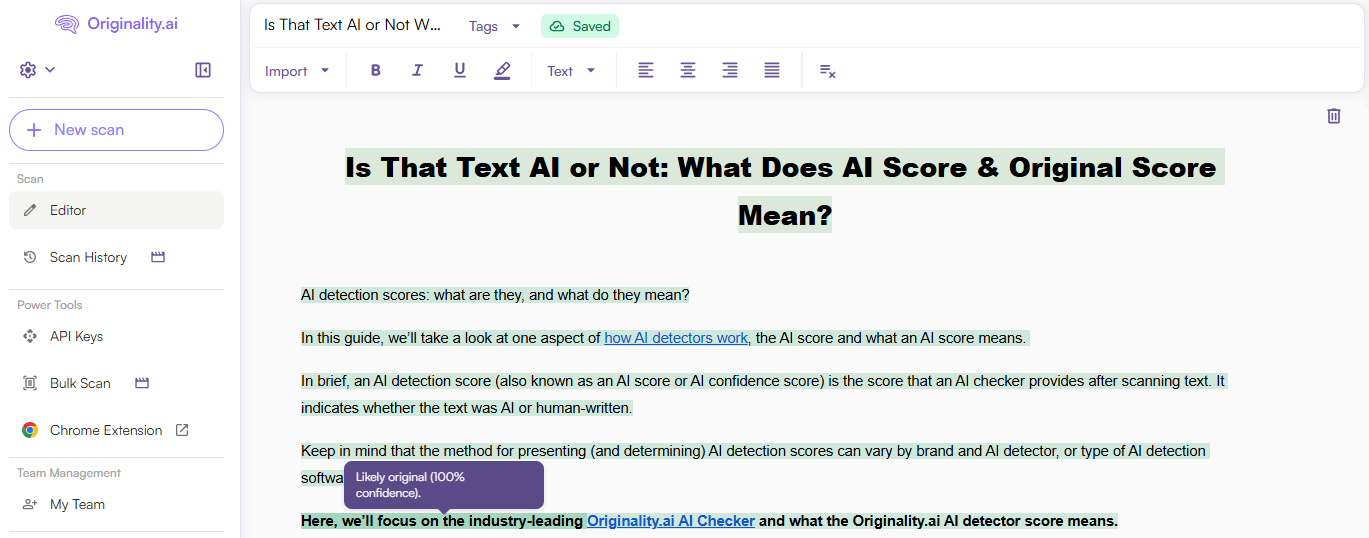
Originality.ai AI Detection Scan Highlighting the Original (human-written) Text
Note: The patterns that our AI picks up on cannot be translated into a simple list of ‘here are x reasons why your content is identified as AI-generated’.
Wondering how AI detection works? Our AI detector takes a more holistic and far more intensive approach to analyze an article to determine if it was AI-generated than anything else we have seen.
Read our in-depth article: How Does AI Content Detection Work? for more insights.
Our AI was trained on an incredible number of the most popular LLMs, including ChatGPT (such as GPT-4o and GPT-5), Claude (Claude 4 Sonnet and Opus), and Llama, and can accurately identify patterns in AI content across an entire article.
Our approach is a far more intensive/accurate way to look at an article than the way that other free AI detection tools work, which rely on either…
A linear probabilistic model: These tools use OpenAI’s model to predict what the next word would be based on the NLP model. If enough of the next words in a piece of content fit within what the model would predict, then it is likely AI. This is easy to fool by changing a few words.
Burstiness and Perplexity: “Burstiness” and “Perplexity”-based tools rely on the fact that AI content is typically consistently created without much variation. They are susceptible to being tricked, which can result in many false positives.
Yes, our AI detector has demonstrated exceptional accuracy in both internal tests and multiple 3rd-party studies:
Is the score perfect?
At Originality.ai, our machine learning engineers are always working to improve model accuracy and running tests on the latest AI models (such as GPT-6 Astra).
However, no AI detection tool is perfect. The tool can produce incorrect predictions and predict that content that was human-written is AI-generated (also known as a false positive - more on that later in this guide).
Originality.ai provides distinct models that are tuned to meet the needs of specific use cases.
The AI detection models that are currently available include:
AI Allowance
Multi Language
False positives are painful when they occur, and we are working hard to continually improve and release even better models that drive down our false positive rate.
A false positive occurs when an AI detector thinks something was AI-generated when, in fact, it was written by a human.
We offer Browser extensions to assist in transparently showing you the writing process that truly created it (whether human-written or AI-generated).
We appreciate the valid question, “Why was my article identified as AI?” Below are resources on how to prevent and reduce the risk of false positives.
The answer is no.
A Plagiarism Checker provides hard proof that plagiarism occurred, while an AI Detector provides the probability that a piece of content was AI or human-generated.
Here’s a quick look at some of the differences between plagiarism checking and AI detection:
The same approach should not be taken with Plagiarism and AI detection. For instance, a text might be AI-generated but not include plagiarism. Alternatively, a plagiarized article might be human-written.
In the example scan below, the article was both human-written and plagiarism-free:
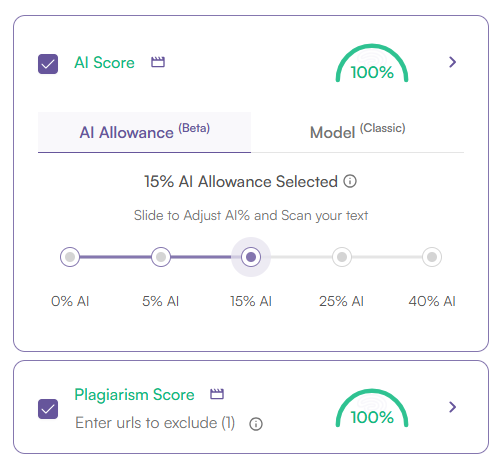
This is a complex question. AI detection and plagiarism checking are different, just as we outlined in the chart above.
The concern around AI plagiarism typically surfaces around training data issues. While AI typically generates content that is new, OpenAI is facing 50+ lawsuits, including cases involving copyright or training data.
So, it’s important to review AI-generated content carefully to make sure the copy doesn’t closely replicate existing material as a result of training data concerns.
Learn about AI Detection and AI Detection Accuracy:
Learn about the impact of AI across industries:
Even our own AI detector is not perfect, and can produce false positives. These false positives can be very painful for anyone who creates original content — whether you’re a student wrongly accused of using ChatGPT by TurnItIn or GPTZero or a writer who received a false positive from Originality.ai.

AI & Plagiarism Detector for Serious Content Publishers
Originality.ai
64 Hurontario St
Collingwood, Ontario
L9Y 2L6