AI Checker
Plagiarism Checker
Grammar Checker
Content Quality
Guideline Checker
Readability Checker
Fact & AI Hallucination Checker

Extensions
MCP

On November 18, 2026, Google introduced Gemini 4 Neon. Google describes Gemini 4 Neon as designed for “complex software engineering, knowledge work, and science workflows.”
A key thing of note for writers, editors, students, and teachers is that Gemini 4 Neon is also built for “higher-quality writing.” Google describes its writing as clear, well-structured, and with a “natural” tone, as well as having strong summarizing capabilities for dense content.
So, as with the release of other new AI models from leading AI companies (such as GPT-6.2 Astra and Sol or Claude Fable 5.2), we ran a study to find out if Gemini 4 Neon’s content is detectable.
On November 19, 2026, we tested 500 English responses from Google’s Gemini 4 Neon at Medium thinking with Originality.ai 5.0.
Yes! Content generated by Gemini 4 Neon is still highly detectable by Originality.ai.
In our test for this study, Originality.ai 5.0 classified 500 of 500 Gemini 4 Neon responses as AI (100%).
This study follows our Gemini 4 Argon benchmark.
We tested five content categories so that the overall result would reflect more than one kind of writing.
For instance, a conversational reply asks a model to sound natural and respond in context. Then, an explainer gives it room to develop an idea, while a news story calls for a different structure and tone.
For editors and publishers, the question is how a detector handles the writing these models produce on common assignments. We included requests to write from scratch as well as rewrites and requests for a more human-like style.
We started with the same 500 prompts used in the GPT-6.2 Astra and Sol benchmark. For that benchmark, we sorted the prompts in each category by length and selected every other one. That gave us a mix of short and detailed assignments in five equally sized categories.
Before scoring, we replaced 5 prompts within the original writing categories.
Responses ranged from 250 to 3,557 words, with a median of 1,002. This covered short pieces as well as longer articles where the model had more room to develop an explanation.
Every category had 100 AI verdicts out of 100 responses. See the table included below for results by category.
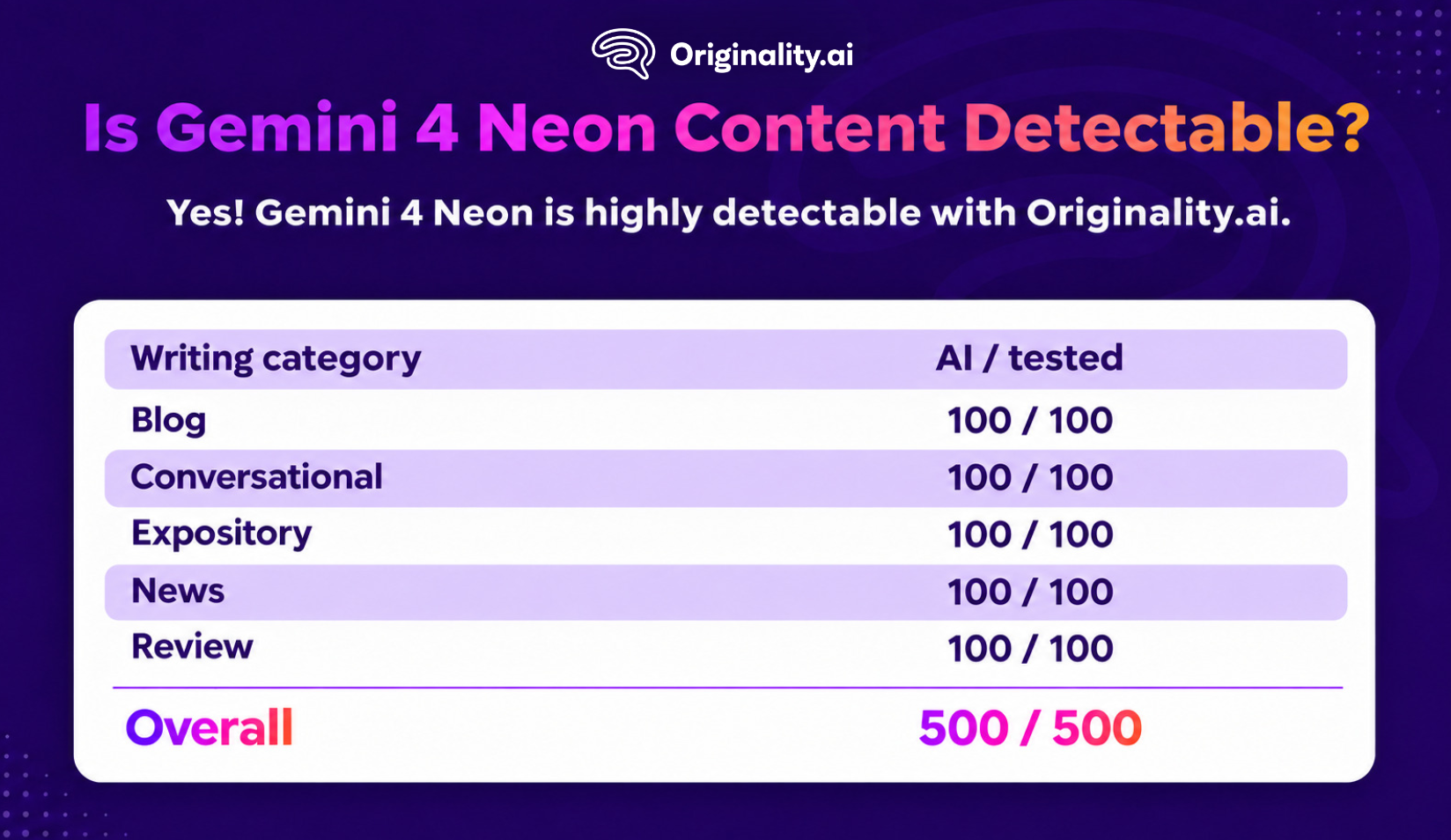
Our key finding from the above results? Originality.ai accurately identified 500/500 Gemini 4 Neon-generated samples.
LLMs are being continuously released by leading AI companies like Google, Anthropic, and OpenAI.
To maintain transparency around whether writing is likely AI-generated by a probable LLM or human-written, it’s essential for AI detectors to continue testing accuracy as new models are launched.
From writers to students to content marketing agencies, Originality.ai continues to be a highly accurate way to identify writing generated by the latest LLMs, like Gemini 4 Neon. Try the Originality.ai AI Checker today!
Further Reading:
This launch benchmark shows how standard Originality.ai 5.0 performed on known AI writing from Gemini 4 Neon at Medium thinking. It covers everyday writing assignments, from conversational replies to longer explanatory articles.
The study counted AI or Mixed as detection and also tracked the AI-only verdicts shown in the table.
We also checked longer pieces on their own and looked at the responses generated with the starting wording. Those checks show how the detector performed within two subsets of the same benchmark.
Among responses of at least 300 words, 495 of 495 received an AI verdict. On prompts that kept their starting wording, the corresponding count was 495 of 495.

AI & Plagiarism Detector for Serious Content Publishers
Originality.ai
64 Hurontario St
Collingwood, Ontario
L9Y 2L6