AI Checker
Plagiarism Checker
Grammar Checker
Content Quality
Guideline Checker
Readability Checker
Fact & AI Hallucination Checker

Extensions
MCP

We tested 1,000 English responses each from GPT-6 Astra, Luna, and Sol (as well as Sol 6.1) with the Originality.ai AI detector to find out if GPT-6 content was detectable.
We updated the original Astra study, following the release of GPT-6 Luna and Sol from OpenAI.
According to the launch announcement for GPT-6 Luna and Sol, as part of the GPT-6 family, they were trained similarly to Astra, but with “intelligence upgrades and cost efficiency.”
Then, only about a week after the release of GPT-6 Luna and Sol, OpenAI launched GPT-6.1 Sol. OpenAI notes that similar to GPT-6 Luna and Sol, 6.1 further improves on the “balance of capability and cost.”
Additionally, the original Astra study also compared length and readability with Kimi K3 and archived responses from OpenAI, Anthropic, DeepSeek, Google, and xAI on the same prompts.
Yes, in these benchmarks. Originality.ai AI Allowance 15% classified nearly all tested responses from GPT-6 Astra, Luna, and Sol, as well as GPT-6.1 Sol, as Likely AI.
Essentially, Originality.ai detected 99%+ of the AI samples generated by the GPT-6 family of models (Astra, Luna, and Sol), and the latest release, GPT-6.1 Sol.
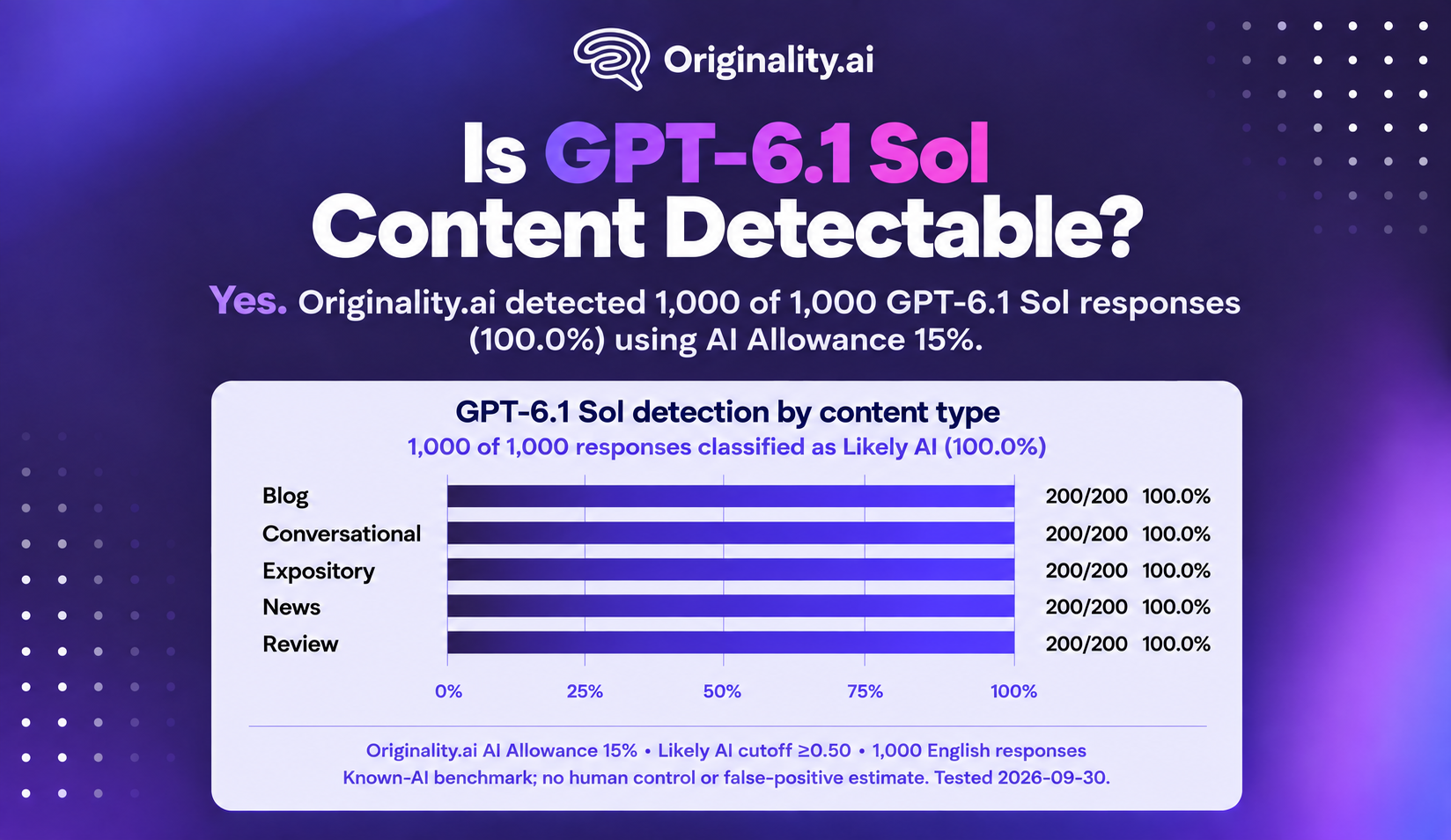
We generated and scanned 1,000 English responses from GPT-6.1 Sol on Sep 30, 2026, using the same initial prompt cohort and generation settings as the earlier Luna and Sol extension.
Originality.ai detected 1,000/1,000 (100.0%) using AI Allowance 15%.
The sample included 200 responses in each of five categories (blog, conversational, expository, news, review) inherited from the prompt bank. All 1,000 final scans succeeded.
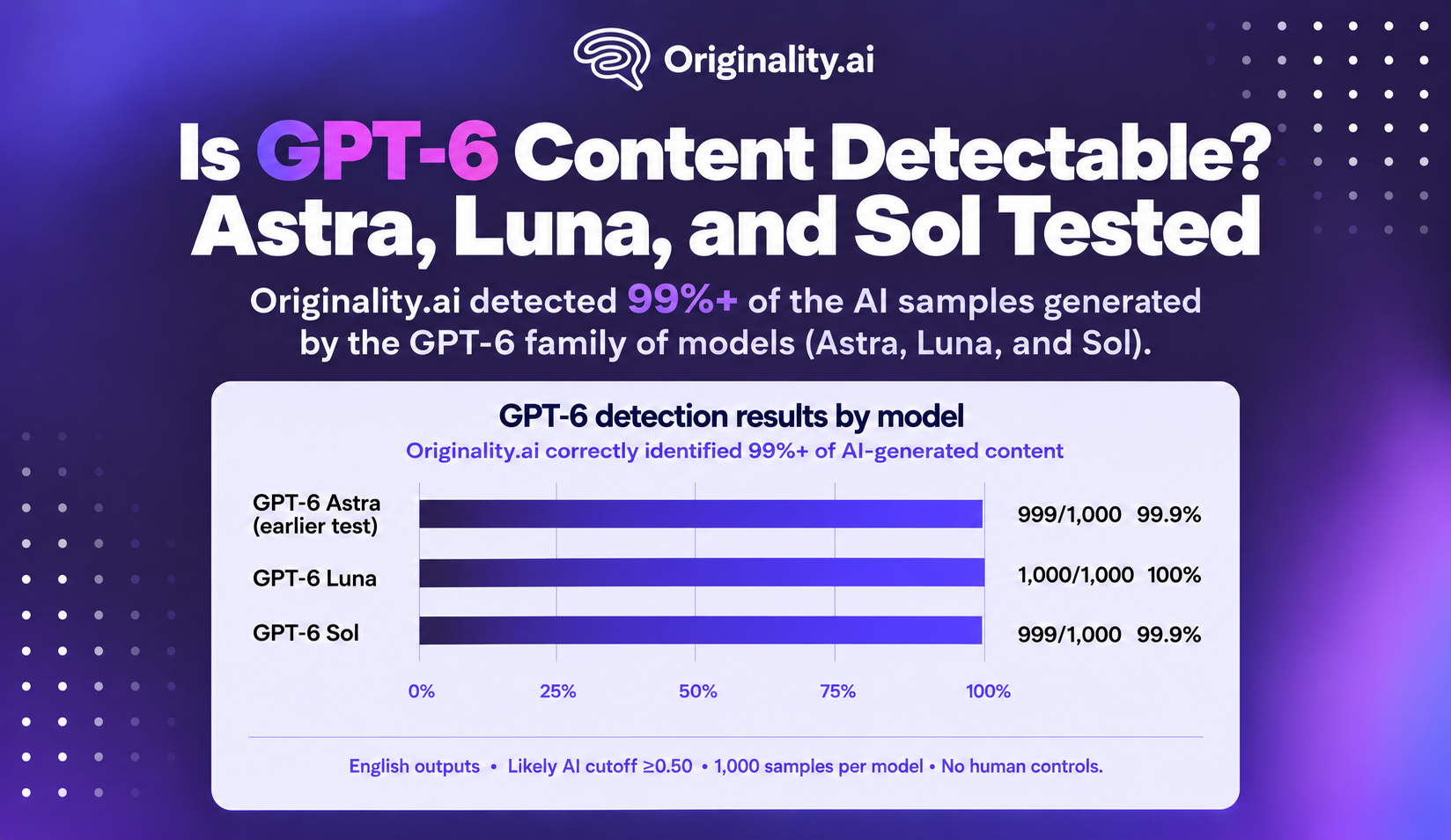
Samples were generated and scanned on September 23, 2026.
All 2,000 new scans succeeded.
On the 889 prompts unchanged across Astra, Luna and Sol, Originality.ai detected 889/889 Luna responses (100%) and 888/889 Sol responses (99.9%).
Updated methodology notes: This excludes replacement prompts and all length adjustments. Astra was tested earlier, so the results weren’t processed at the same time. They measure detection of known-AI text, not overall accuracy or false positives.
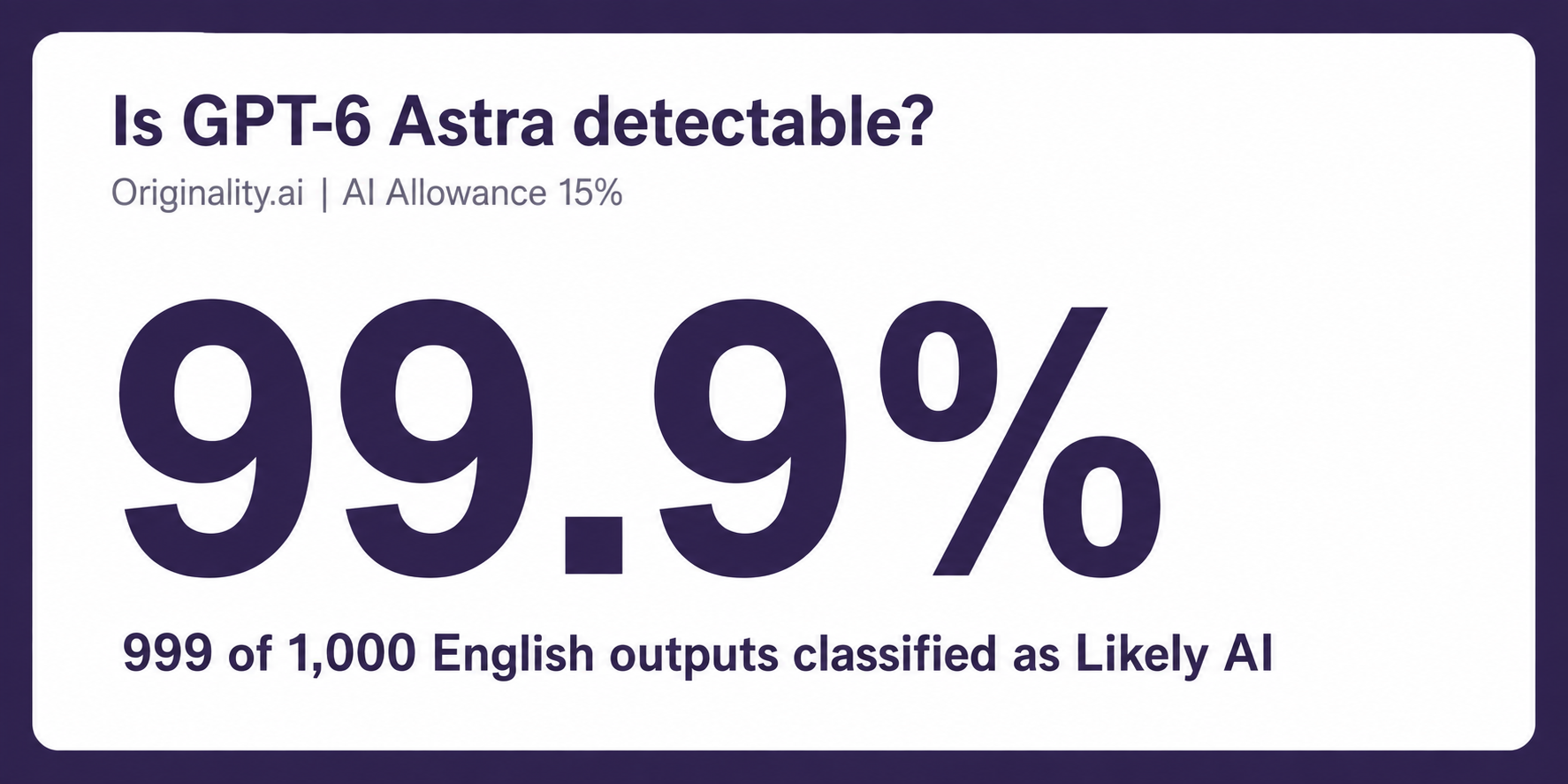
The original Astra study found:
This study follows the writing-task format used in previous tests.
The archived responses came from 17 model labels. Each prompt has one archived response, not a response from every model:
The sample contained 200 prompts in each of five content types: blogs, conversational writing, expository writing, news and reviews. Some briefs asked for human-like style or wording intended to be difficult for detectors to distinguish; these were retained, not rewritten for this test.
GPT-6 Astra generation and detection took place on Sep 4, 2026. We used the OpenAI Responses API with the model ID gpt-6-astra.
Only AI Allowance 15% results are included here; a score of at least 0.50 counts as detected. The 15% setting is a detector mode, not the percentage of words we claim were written by AI.
The one below-threshold response was conversational.
So GPT-6 Astra is detectable but what else can we understand about the text it produces compared to previous models?
Across the same prompts, the median GPT-6 Astra response was 892 words, compared with 1,112.5 for Kimi K3 and 269.5 for the archived responses. GPT-6 Astra was shorter than Kimi in 681/924 pairs (73.7%); the median within-prompt difference was 225.5 fewer words. Against the historical response, GPT-6 Astra was longer in 824/924 pairs (89.2%), with a median paired difference of 422 more words.
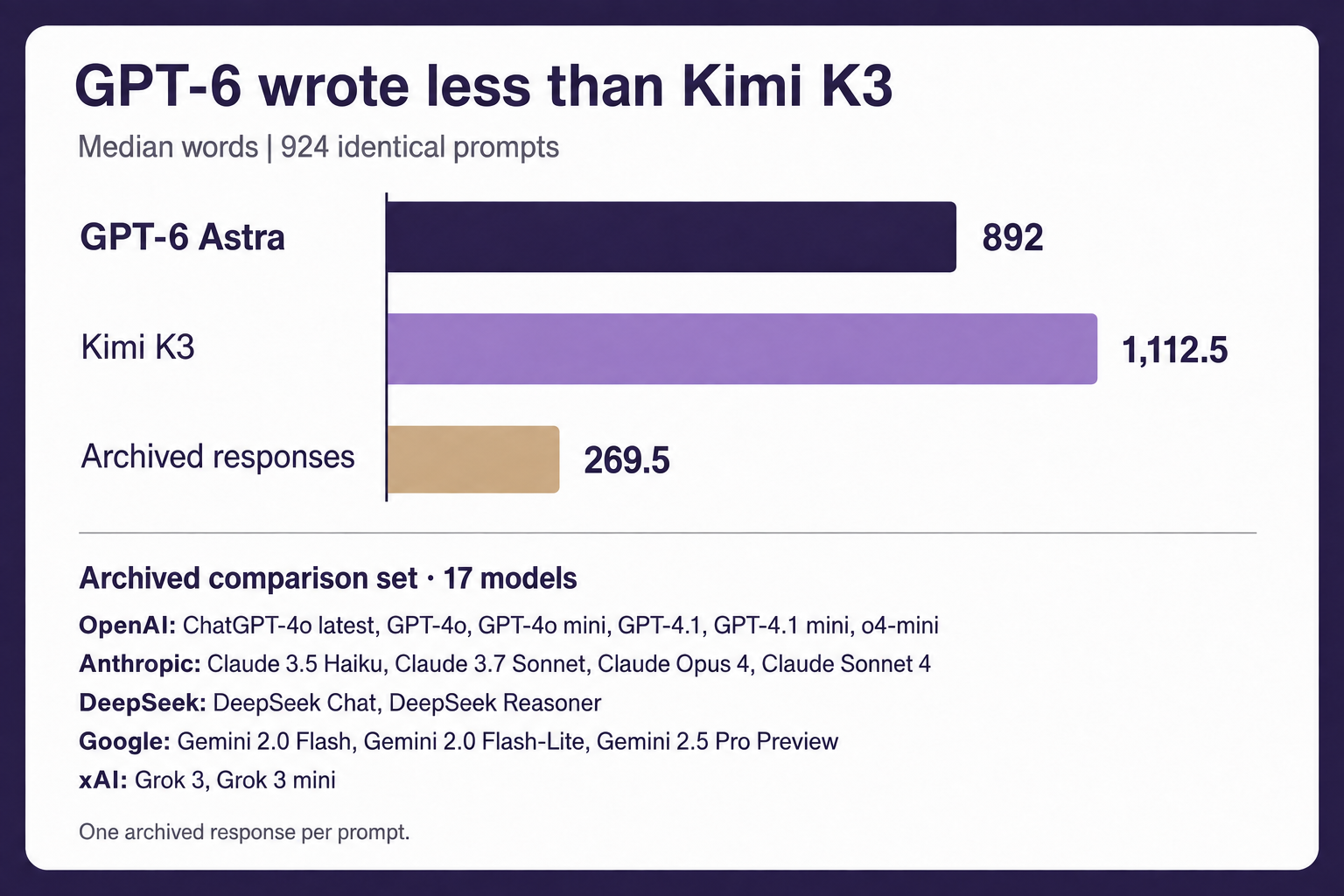
Length depended on the assignment. Expository writing produced the longest GPT-6 Astra responses; news produced the shortest. Blog medians were similar, even though GPT-6 Astra was shorter overall.
In the Luna/Sol follow-up, 889 prompts remained unchanged across all three GPT-6 models.
Median lengths were 599 words for Luna, 450 for Sol, and 917 for Astra.
On these same prompts, Astra’s median response was approximately 53% longer than Luna’s and 104% longer than Sol’s.
Note: This narrower subset excludes every replacement and length-adjusted prompt; it is separate from the 924-prompt comparison above.
Only two of the 1,000 prompts contained explicit numeric word-count targets. Both were approximate targets, and both remained unchanged. Most prompts specified the subject, style or format instead, so the dataset cannot establish a general word-count compliance rate.
GPT-6 Astra and Kimi came close to the requested lengths in these two examples. Two examples are not enough to rank instruction-following ability.
We used the Originality.ai Readability Checker on the complete responses to all 924 unchanged prompts. Its Flesch-Kincaid grade level estimates reading difficulty: lower scores mean simpler text.
Median grades were 11.0 for GPT-6 Astra, 8.9 for Kimi K3 and 10.2 for the archived responses. Comparing each prompt individually, GPT-6 Astra’s median gap was +1.1 grades versus Kimi and 0.0 versus the archive.
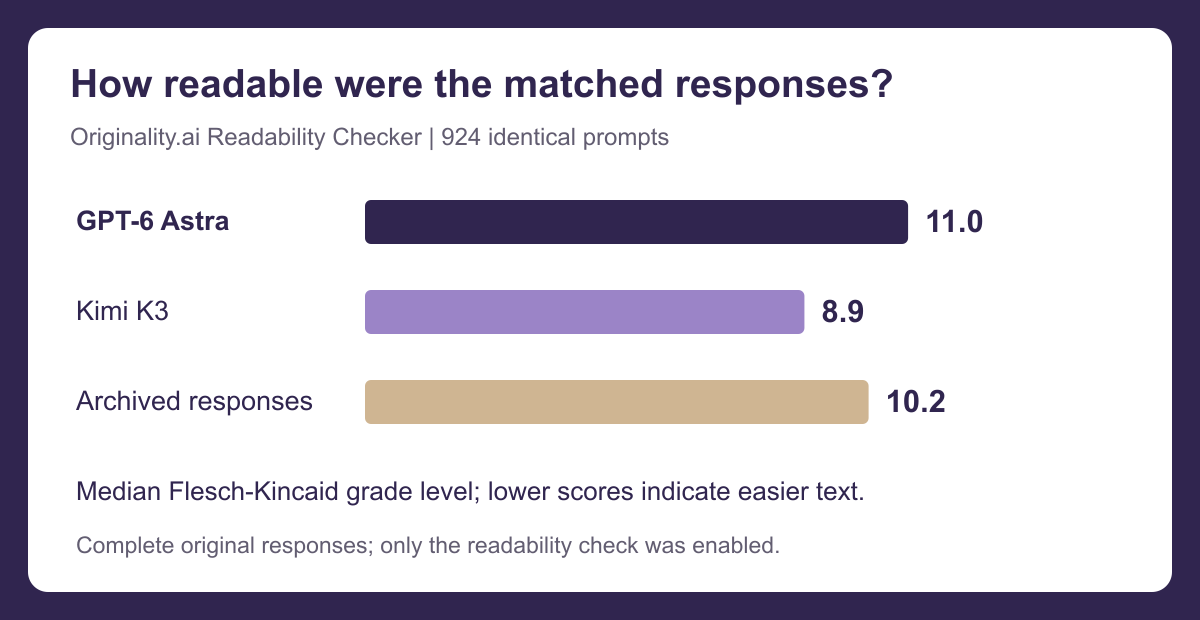
These scores estimate text complexity, not factual accuracy, writing quality or reader comprehension.
Originality.ai AI Allowance 15% detected 1,000/1,000 Luna outputs (100%) and 999/1,000 Sol outputs (99.9%), and in the latest update to the study 1,000/1,000 Sol 6.1 outputs (100%).
The earlier Astra test detected 999/1,000 (99.9%).
All of the GPT-6 models (Astra, Luna, and Sol), as well as the latest addition, GPT-6.1 Sol, were highly detectable in these benchmarks
So, if you’re a student, teacher, editor, or writer looking to check if content is Likely AI or Original, Originality.ai is highly effective at identifying GPT-6 Astra, Sol, and Luna, as well as GPT-6.1 Sol-generated text.
Further Reading:

AI & Plagiarism Detector for Serious Content Publishers
Originality.ai
64 Hurontario St
Collingwood, Ontario
L9Y 2L6