AI Checker
Plagiarism Checker
Grammar Checker
Content Quality
Guideline Checker
Readability Checker
Fact & AI Hallucination Checker

Extensions
MCP

The launch of Originality.ai 5.0 and 5.0 Max sets a new standard for AI detection capabilities.
This summer we launched AI Allowance, which accurately detected even the latest LLMs: think the GPT-6 family and GPT-6.1 Sol, Claude Opus 5.5, and Grok 4.7.
After listening to user feedback, we’re bringing you all the AI detection features you love in a simple, clean scan experience, all while pushing our accuracy even higher.
Originality.ai 5.0 and 5.0 Max are our most accurate AI detection models yet.
5.0 shows an increase in accuracy on pure AI and pure human-written (original) content. While identifying pure AI vs. pure human content is mostly a solved problem, it’s still essential to push accuracy as new AI models are released.
Further, 5.0 shows increased performance and accuracy on mixed writing, as content creation rapidly shifts towards hybrid AI-human workflows.
Get a breakdown of external and internal benchmarks and Originality.ai 5.0 Features in this post.
Please note that AI Allowance and Multi Language models have retired with the release of Originality.ai 5.0 and 5.0 Max.
This section shows how our AI detection models perform across publicly available datasets and compared to other leading AI detection tools.
Human-writing specificity (%): higher is better. Competitor results are limited to GPTZero 4o and Pangram 4.
Samples (Originality / Pangram): PERSUADE 25,996 / 25,996; Epoch 495 / 495; ELLIPSE 5,000 / 3,899; PELIC 5,000 / 15,005; Liang TOEFL 91 / 89; UChicago Booth 400 / 7,968. Originality counts apply to both models. GPTZero tested 10,402 PERSUADE essays; its Epoch count was not stated.
Competitor figures come from the GPTZero 4o release (September 2026), Pangram’s PERSUADE post (August 2026), and Pangram 4 technical report.
AI detection (recall, %): higher is better. Results below come from separate evaluations with different samples and scoring rules; they are not a matched head-to-head test.
Samples: Originality tested 1,600 UChicago AI texts, 594 Epoch AI texts, 3,200 MELD AI texts (1,600 clean + 1,600 attacked), and 2,400 DetectRL-X AI texts; counts apply to both models. Pangram tested 594 Epoch AI texts and 31,448 clean MELD AI texts. Its UChicago total of 15,936 includes human and AI observations. GPTZero’s Epoch count was not stated.
Pangram 4’s UChicago and MELD rates use a fixed 1% false-positive rate; its Epoch result counts AI-Assisted as a miss. The GPTZero 4o release does not specify how Mixed verdicts are treated. These evaluations use different samples and scoring rules. MELD clean is a subset of the combined row; blank cells mean no verified result for that version and dataset.
The ability for AI detection tools to identify pure AI and pure Human text is a mostly solved problem.
Leading AI detectors are highly accurate but not perfect on human and AI content.
Where things are tricky is on..
The next 2 studies explore these more challenging and realistic scenarios that educators and editors face when evaluating the true origin of text.
Humanized AI detection rate (%): higher is better. Originality results are internal retests; competitor results are from HumanizerBench’s October 2026 publication.
Sample: 420 humanized AI outputs per detector (14 humanizers × 30 outputs, spanning three source models and six writing categories). With no human controls, these figures measure AI detection, not overall accuracy or false-positive rates.
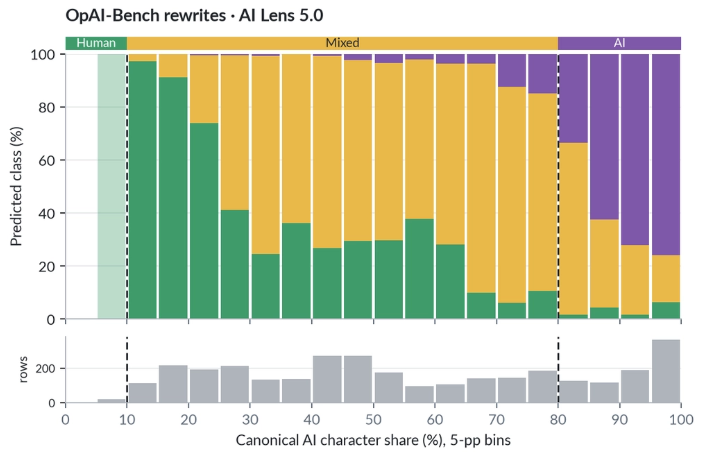
We used the test split of OpAI-Bench with 1000 mixed samples (0.10 < AI Character Ratio < 0.80), a benchmark for AI-text detection under progressive human–AI co-editing. It starts with human-written documents and introduces AI revisions into selected portions of each document.
Document-Level Classification

Now automatically detects languages and has a significantly improved false positive rate.
Our internal adversarial multilingual evaluation tested Originality.ai 5.0 and 5.0 Max on 30,000 texts across 30 languages: 15,000 human-written and 15,000 AI-generated texts, with 500 of each per language. This balanced design gives every language equal representation.
Across all texts, AI-class F1 was 92.01% for 5.0 and 93.07% for 5.0 Max. Max improved F1 in 29 of 30 languages and matched 5.0 on Hindi.
F1 balances precision (how often an AI flag is correct) and recall (how much AI text is detected). Higher is better; the figures below are F1 scores, not accuracy.
Our newest model generalizes well across multiple domains, including AI- and human-generated code.
We tested 300 samples from DroidCollection: 150 human-written and 150 AI-generated samples across Python, Java, C++, C, C#, Go, and JavaScript.
The evaluated model achieved 85.93% AI-class F1 and 87.67% overall accuracy. It correctly identified all 150 human-written samples and detected 113 of 150 AI-generated samples.
These results show promising performance on code but are still lacking compared to long-form text.
No false positives were observed among the 150 human-written samples.
See details for Originality.ai 5.0, 5.0 Max, and Deep Scan pricing below:
* Prices are listed in $USD.
Originality.ai 5.0 and 5.0 Max are now available across our full toolkit:
Deep Scan helps users ethically write more human.
With Originality.ai 5.0, using Deep Scan is now even more intuitive. Optionally run Deep Scan while scanning for AI text to see why it’s flagged as AI. Then, apply the tips to make your writing ethically sound more human.
With Originality.ai 5.0, we’ve also improved sentence highlighting to be even more accurate. So you can clearly see, sentence-by-sentence, the percentage of text that involves AI.
Not sure which model to choose? Here’s a quick overview of Originality.ai 5.0 vs. 5.0 Max mode:
Essentially, Originality 5.0 offers high detection accuracy with the speed and affordability to scan at scale. Then, Originality 5.0 Max provides our highest accuracy for important decisions where greater confidence is worth the additional time and cost.
Note: You can switch models in the editor.
Originality.ai 5.0 and 5.0 Max automatically detect which language you use for intelligent, intuitive AI detection scans with multilingual capabilities.
Note: With the launch of Originality.ai 5.0 and 5.0 Max, our Multi Language model has been retired.
When we first launched AI Allowance, customers told us they appreciated the ability to accurately understand the range of how much AI was in a document.
Now, our AI research team has built a detection model that provides an accurate percentage of AI in a document, so users can clearly view the percentage of AI involvement in text.
Mixed writing is increasingly important to identify, as writing workflows across marketing, academia, and other industries shift towards hybrid human-AI creation and away from pure AI vs. pure human writing.
Originality.ai 5.0 and 5.0 Max offer a simple, clean scan experience with clear and accurate AI scores.
Now AI scores show the percentage of your text that is:
Understanding mixed writing is now more important than ever. The new AI scores reflect that and transparently show you how much of your writing involves AI.
As AI detectors (even the most accurate) can make mistakes, an AI score should be interpreted as a signal for review, not proof of authorship or misconduct.
Note: If you are familiar with previous Originality.ai models’ confidence score. This has changed. AI scores now show the percentage of Likely AI, Original, and Mixed writing in text.
Originality.ai continues to be the industry leader in AI detection. With the launch of Originality.ai 5.0 and 5.0 Max, we’re setting a new standard for AI detection that combines an intuitive scan experience, Deep Scan insights for more human writing, and multilingual capabilities with the most accurate AI detector.
Further Reading:

AI & Plagiarism Detector for Serious Content Publishers
Originality.ai
64 Hurontario St
Collingwood, Ontario
L9Y 2L6