AI Checker
Plagiarism Checker
Grammar Checker
Content Quality
Guideline Checker
Readability Checker
Fact & AI Hallucination Checker

Extensions
MCP

Originality.ai classified 14.1% of eligible descriptions across four cities as Likely AI in October 2026, up from 4.9% in December 2023.
Somewhere in a busy dining room, a Michelin inspector is trying to look like just another person enjoying dinner. Another bite of the duck, a little more wine. Nothing to see here, chef. The anonymity is part of the job, while the overall experience will eventually transform into a few carefully chosen words that help other diners decide where to book. But after D Magazine questioned whether AI had helped write several Dallas-area descriptions, the guessing game moved from the dining room to the page. We decided to take a closer look.
Our team analyzed Michelin restaurant descriptions across eight cities to see how often they were classified as “Likely AI” over time.
Across New York, Chicago, London, and Toronto, the probable AI rate rose from 13 of 265 eligible descriptions in December 2023 to 60 of 427 in October 2026. The increase even appeared when we followed the same restaurants across the annual snapshots.
Note: The findings don’t tell us for certain who (or what) wrote the descriptions. Likely AI is a classification of a description. Michelin says it does not use AI to write or edit them.
Brian Reinhart’s October 16th D Magazine investigation raised questions about six Dallas-area restaurant descriptions, prompting Michelin to tell the magazine that its inspection team develops the descriptions collaboratively from firsthand dining experiences, and denied using AI in writing or editing.
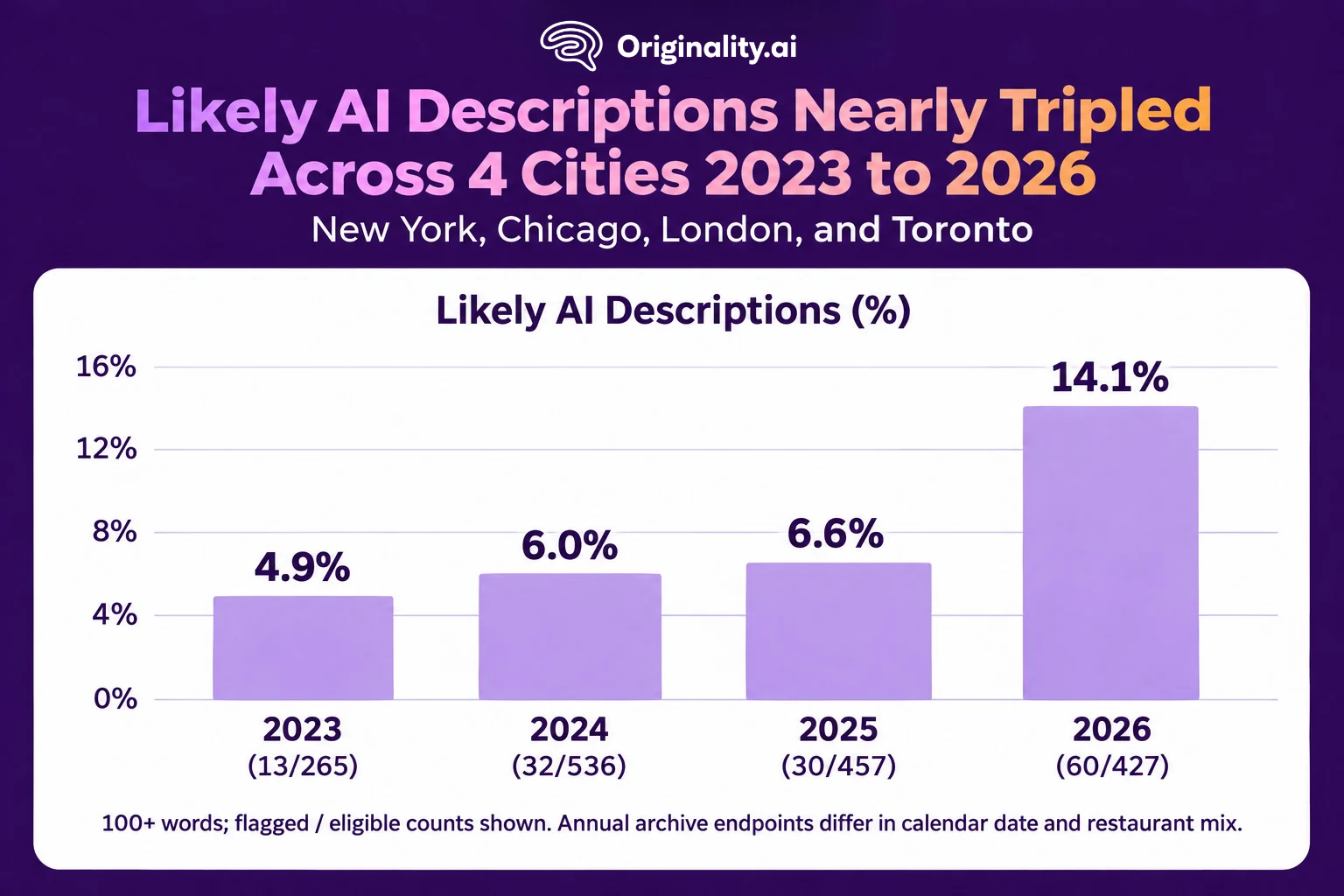
New York, Chicago, London, and Toronto provided the four-city comparison between December 2023 and October 3, 2026.
Descriptions needed at least 100 words to qualify for our research. The increase was 9.1 percentage points (2023 to 2026), calculated from the exact counts before rounding.
Considering that the number of eligible descriptions also changed, next we checked whether the pattern held among the same restaurants.
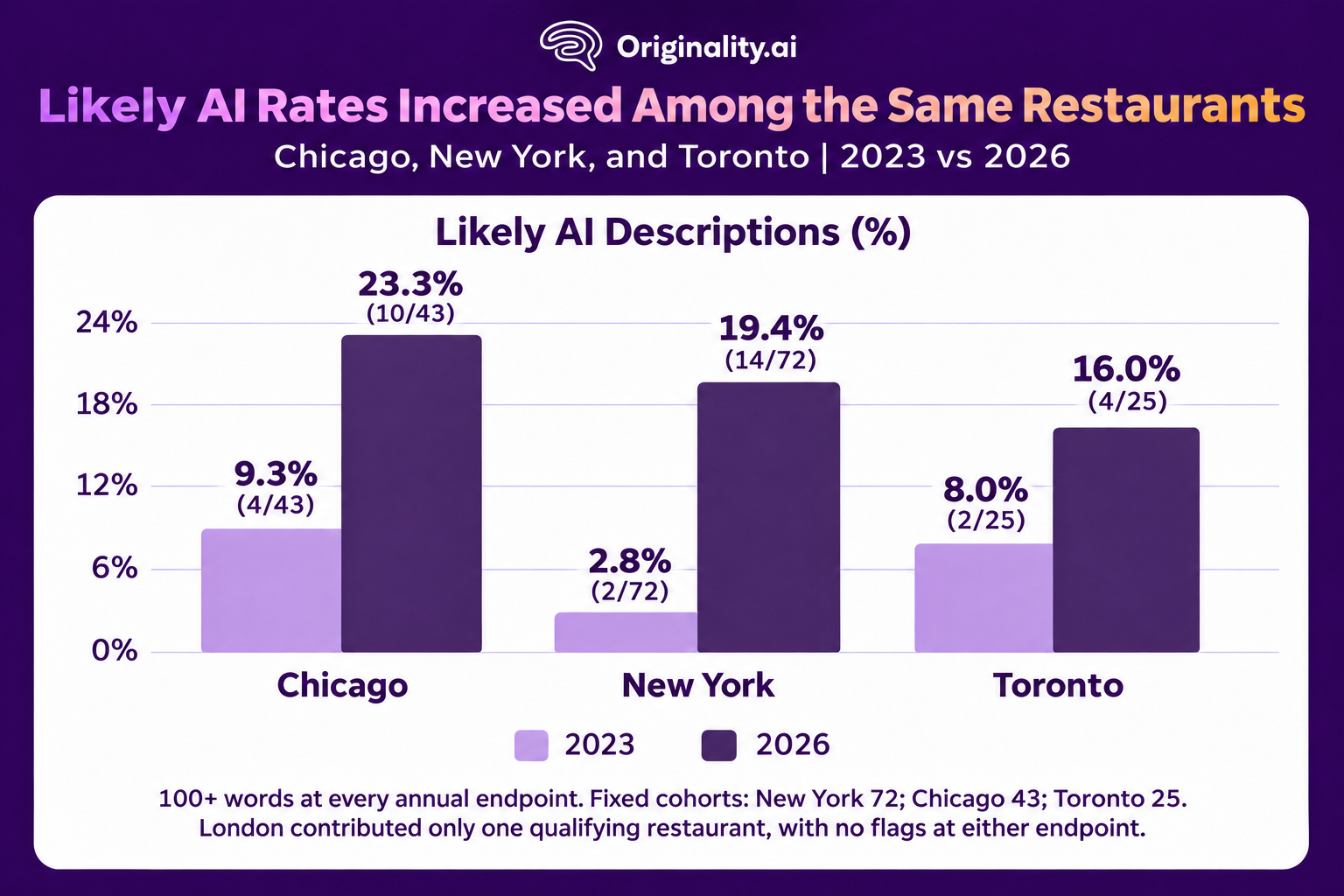
We followed 141 restaurants with descriptions of at least 100 words at every annual endpoint. Within this group, 8 descriptions were flagged as Likely AI in December 2023, compared with 28 in October 2026.
See a comparative table below:
London contributed only one qualifying restaurant, with no flags at either endpoint.
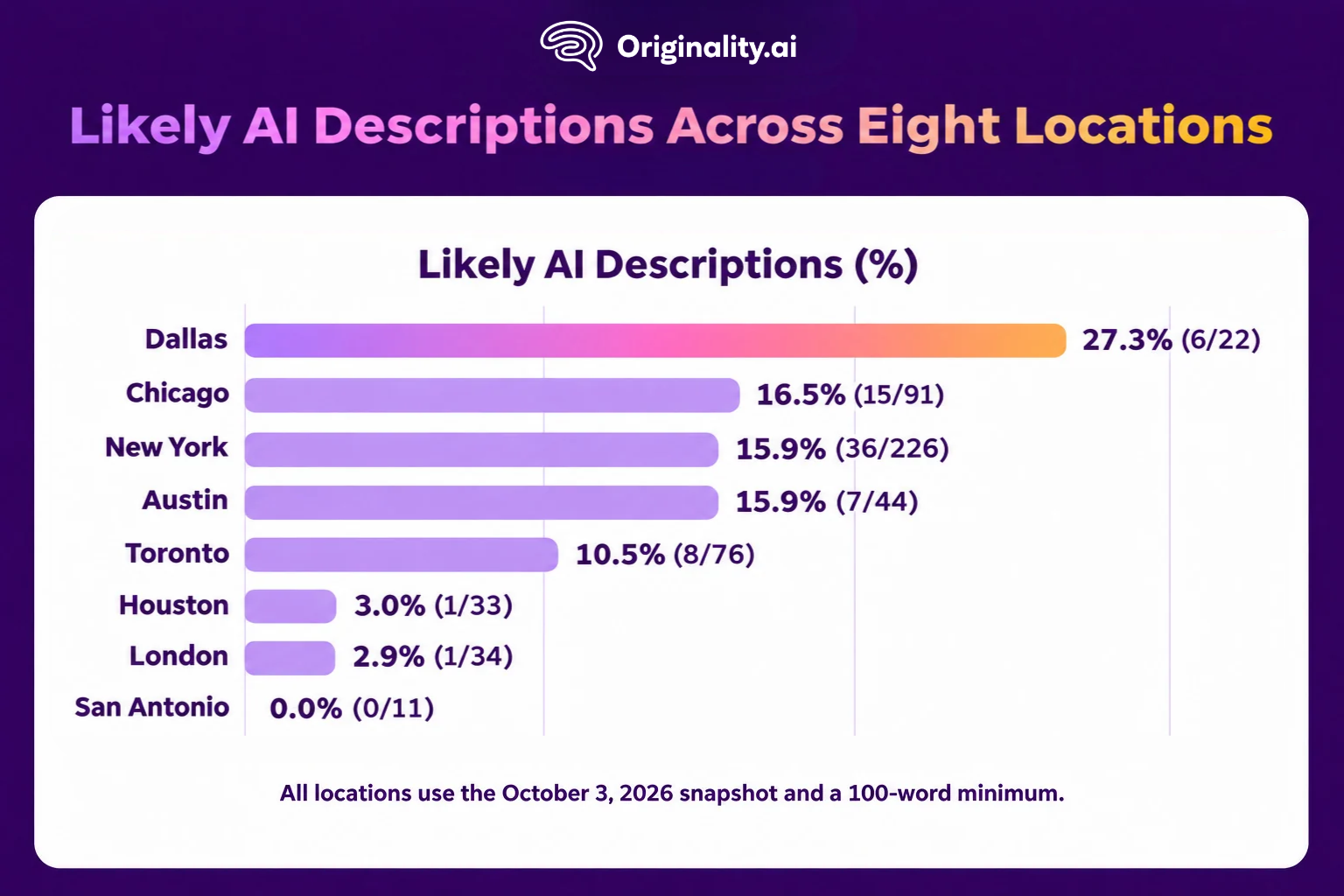
Dallas had the highest observed probable AI rate on October 3 at 27.3%, before the October 8 Texas announcement, which, as noted by D Magazine, was when Michelin updated its Texas guide.
Following Dallas, Chicago (16.5%), New York (15.9%), and Austin (15.9%) demonstrated the next highest Likely AI rates.
However, probable AI rates weren’t high everywhere. Houston’s rate was lower than in 2024, while San Antonio remained at zero.
When it comes to the London result, it should be noted that only 34 of 380 recovered descriptions met the 100-word threshold in October 2026. So, its 2.9% rate should not be read as a result for all London entries.
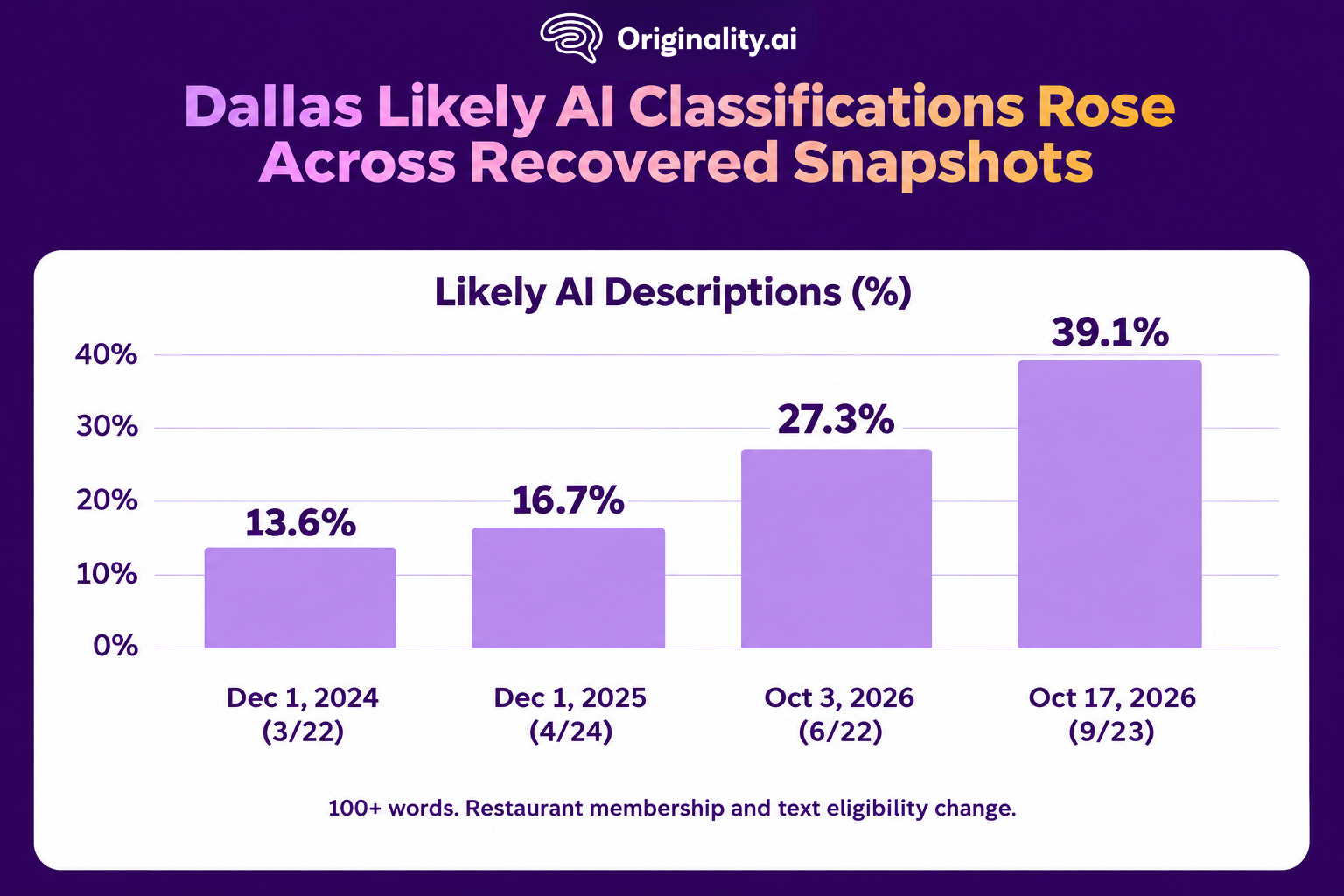
In the separate October 17 capture, 9 of 23 eligible Dallas-city descriptions were classified as Likely AI, or 39.1%. Compared to the Dec 1, 2024 archived snapshot (13.6%), that’s a considerable increase in the percentage of probable AI content.
Removing the four eligible Dallas-city descriptions covered in D Magazine’s investigation left 5 of 19 flagged, or 26.3%. Jashan, in Plano, was excluded from Dallas-city totals.
The October 3 and October 17 results are separate snapshots with different eligible counts.
These additional flags warrant further examination of how the descriptions were produced. They do not establish AI use at any restaurant.
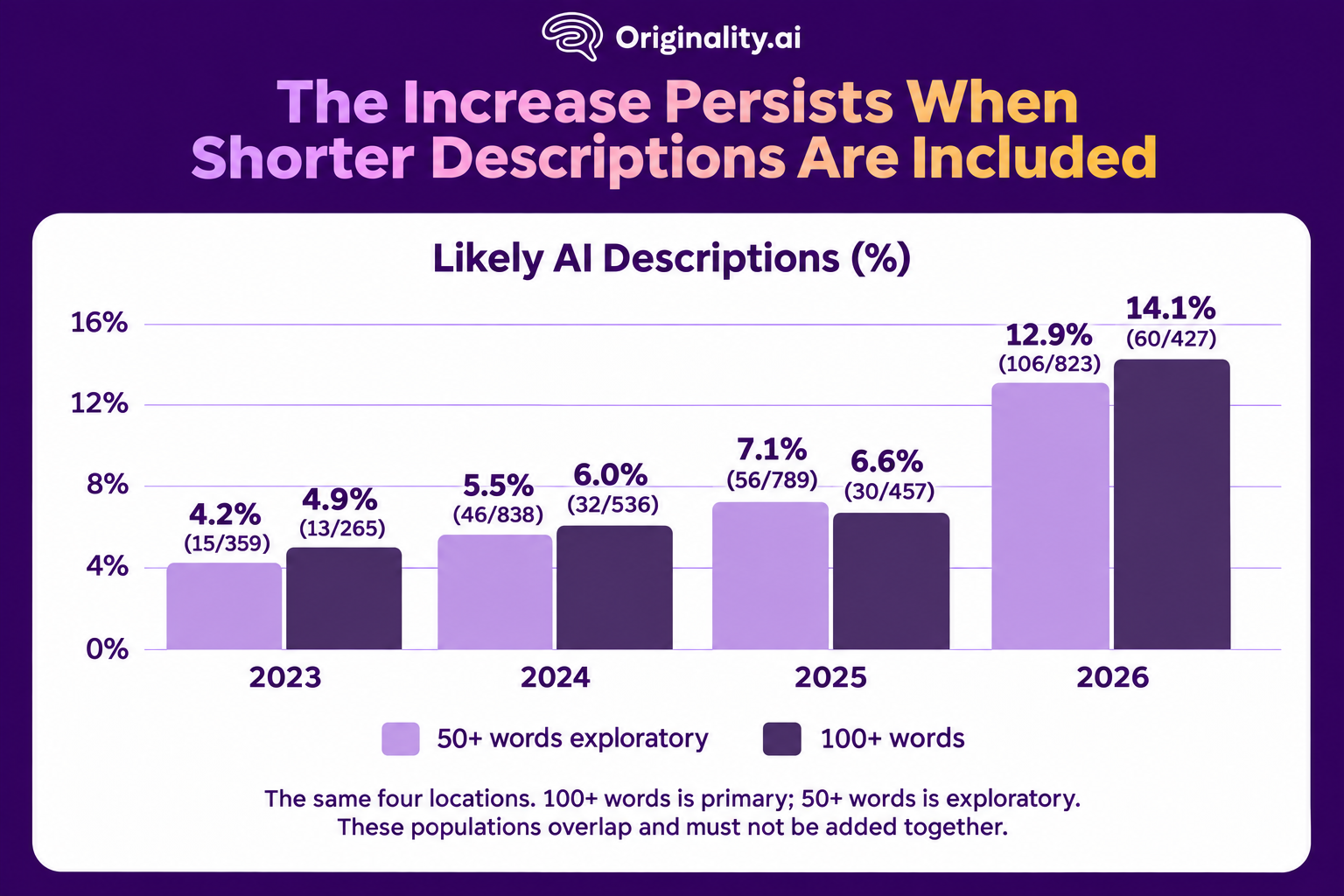
When we lowered the minimum to 50 words, the four-city rate rose from 15 of 359 descriptions (4.2%) in 2023 to 106 of 823 (12.9%) in 2026. This analysis is exploratory because shorter texts give detectors less evidence.
At Originality.ai, we recommend running AI detection scans with 100+ words for the best results.
The finding that Michelin restaurant descriptions across New York, Chicago, London, and Toronto saw the probable AI rate rise from 13/265 eligible descriptions in December 2023 to 60/427 in October 2026 (or 4.9% to 14.1%), about 2.9 times the earlier rate, raises a clear question for diners.
Are they basing their restaurant choice on a description written by a human or a probable LLM?
The experience of visiting and eating at a restaurant is distinctly human. After all, you can’t pass a Michelin star meal over to ChatGPT or Claude to have it taste the dish.
Readers, and the chefs of the prestigious Michelin star restaurants, deserve transparency around whether these descriptions are human-written or likely generated by AI.
Further Reading:
Likely AI is a classification of a description. False positives remain possible, and we do not have verified authorship records for these texts.
Archive dates show when wording was observed, not when it was written. The study does not establish whether inspectors visited, which tools a writer used, or whether an editorial policy was breached. It covers recovered English descriptions rather than the entire Michelin Guide.
Originality.ai conducted and funded the study using its own detector. AI tools assisted collection, coding, analysis, and drafting. The study’s evidence and calculations were checked programmatically. This article was also drafted with AI assistance.
Math Papers on arXiv are rapidly increasing. In our latest update, Originality.ai found: from October 2025 to October 2026, there was a 115.5% surge in new papers. Further, nearly 1 in 4 sampled abstracts showed signs of probable AI writing.

AI & Plagiarism Detector for Serious Content Publishers
Originality.ai
64 Hurontario St
Collingwood, Ontario
L9Y 2L6