AI Checker
Plagiarism Checker
Grammar Checker
Content Quality
Guideline Checker
Readability Checker
Fact & AI Hallucination Checker

Extensions

Which AI Detector is Most like Turnitin?
Based on our study, if your school uses Turnitin, then the best AI detector to use is the Originality.ai model with the 40% AI Allowance setting. A document marked human by this detector had a 96.3% chance of also being treated as human by Turnitin.
Find out which Originality.ai AI detector is most like Turnitin through a comparative analysis across five Originality.ai AI Allowance settings with a dataset of 300 student essays.
That way you can find the best AI detection model for your essay writing workflow, and get peace of mind that your hard work will be recognized as authentic.
Originality.ai’s 40% AI Allowance was the most similar to Turnitin in this test.
It made the same Human-versus-AI call on 209 of 300 documents (69.7%) when we treated a Turnitin score of 50% or more as AI-positive.
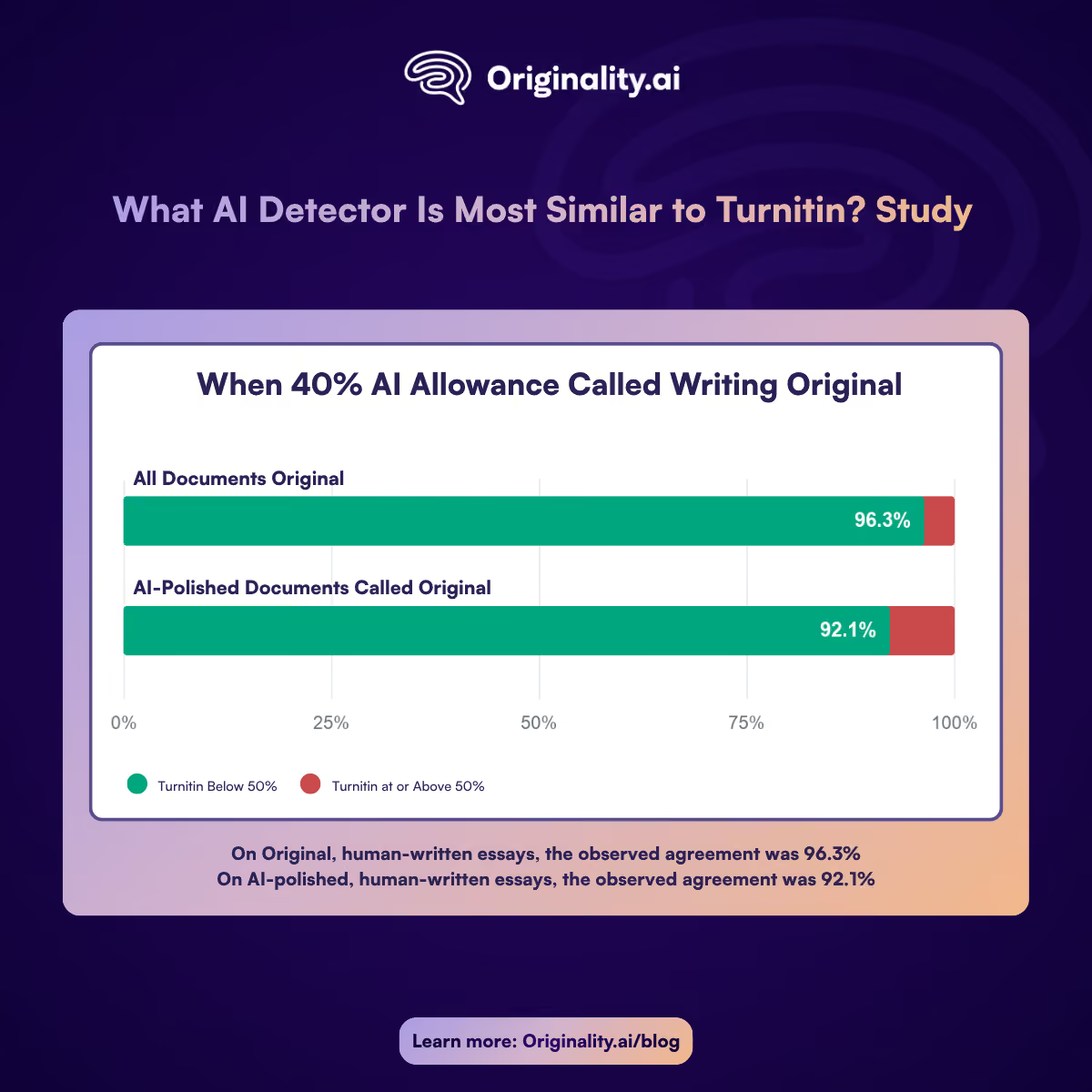
This means that, based on our study, a document marked Original by 40% AI Allowance had a 96.3% chance of also being treated as human by Turnitin using our study’s 50% boundary.
Note: These are measured likelihoods. The 50% boundary belongs to this study. It is not an official Turnitin Human/AI threshold, and a detector result is not a verdict on authorship.
In this study, we examined which Originality.ai AI Allowance setting most often made the same binary call as Turnitin across fully human, AI-polished human, and fully AI-generated essays.
The sample contained 300 English-language essays from GEDE, a public research dataset built for educational AI-text detection. We used 100 documents from each of three groups:
Each document was scanned by Turnitin, and then with AI Allowance at the 0%, 5%, 15%, 25%, and 40% settings.
We then reduced every result to a binary call:
Turnitin requires at least 300 words of prose for an AI Writing Report. The analysis therefore uses the 300 documents in the wider testing pool that could be scanned.
Turnitin describes its percentage as the share of qualifying prose that its model identifies as likely AI-generated or AI-paraphrased. It is not a confidence score for the whole paper. Turnitin also suppresses numerical scores below 20% in newer reports because it says false positives are more common in that range.
We chose 50% only to turn Turnitin’s continuous percentage into a balanced binary comparison. Turnitin does not say that 50% is an official Human/AI dividing line.
A score below 50% can still contain text Turnitin marked as likely AI; a score above 50% is not proof of misconduct.
The binary agreement (similarity) to Turnitin’s results was highest at 40% AI Allowance.
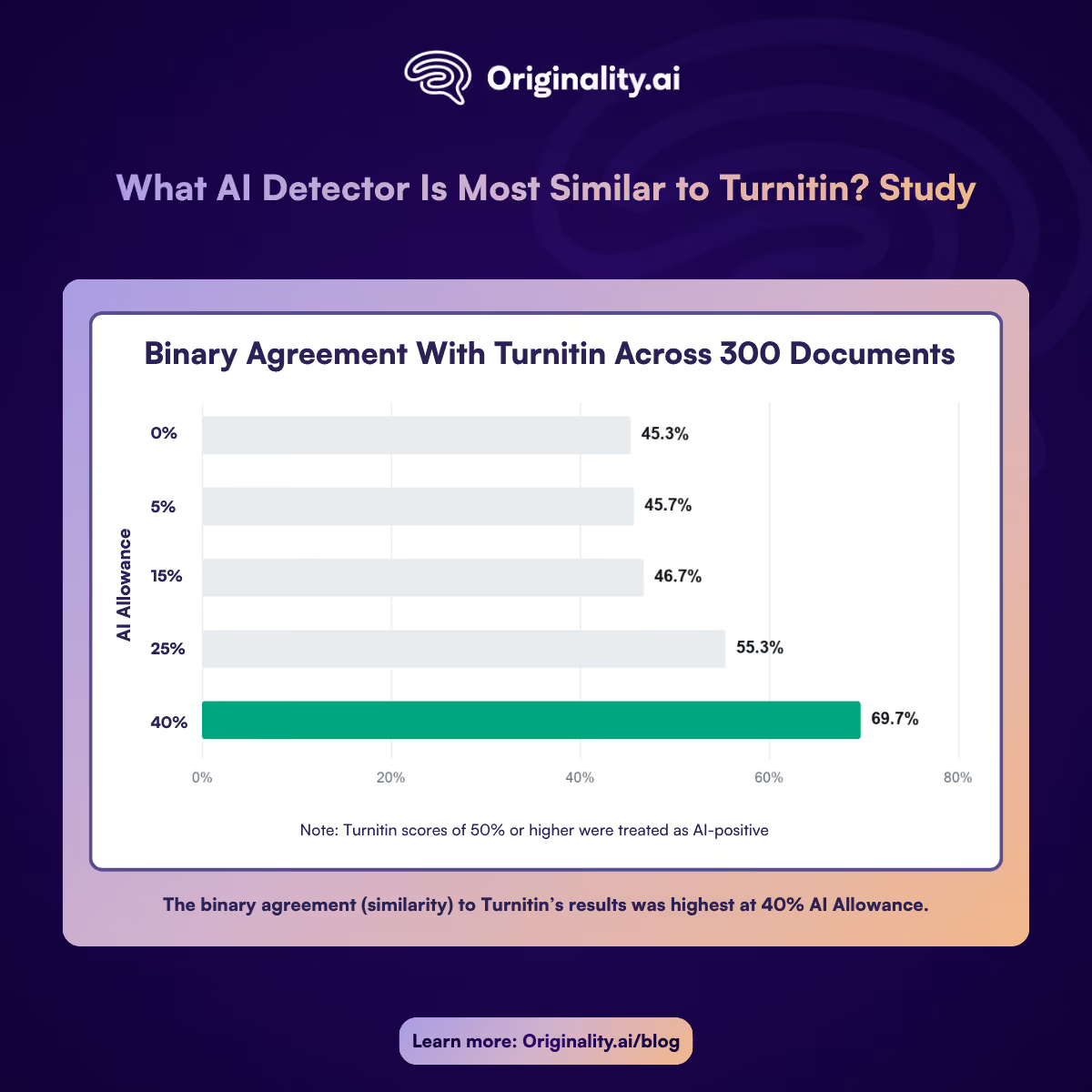
Keep in mind that 69.7% is not close enough to call the tools substitutes; however, for students looking for an alternative to Turnitin, Originality.ai’s AI Allowance at 40% is an excellent option.
A student checking a paper might ask: if Originality.ai calls this Original, will Turnitin as well?
Agreement Percentages on Original (human-written) essays
Across all 300 documents, the 40% AI Allowance model called 189 Original. Turnitin stayed below 50% on 182 and reached or exceeded 50% on seven.
The observed agreement was 96.3%, with a 3.7% exception rate.
Agreement Percentages on AI-polished human essays
Among the 100 AI-polished human essays, the 40% model called 89 Original. Turnitin stayed below 50% on 82 and crossed the boundary on seven.
The observed agreement was 92.1%, with a 7.9% exception rate.
If the 40% AI Allowance classifies your writing as Original, our results suggest Turnitin is likely to place it below the 50% study boundary.
This happened in 96% of documents overall and 92% of AI-polished human documents.
While this isn’t a guarantee, it indicates that the 40% AI Allowance model is most similar to Turnitin student use cases.
The polished group is the closest to a common student use case: a human writes the essay, then uses AI to improve the language.
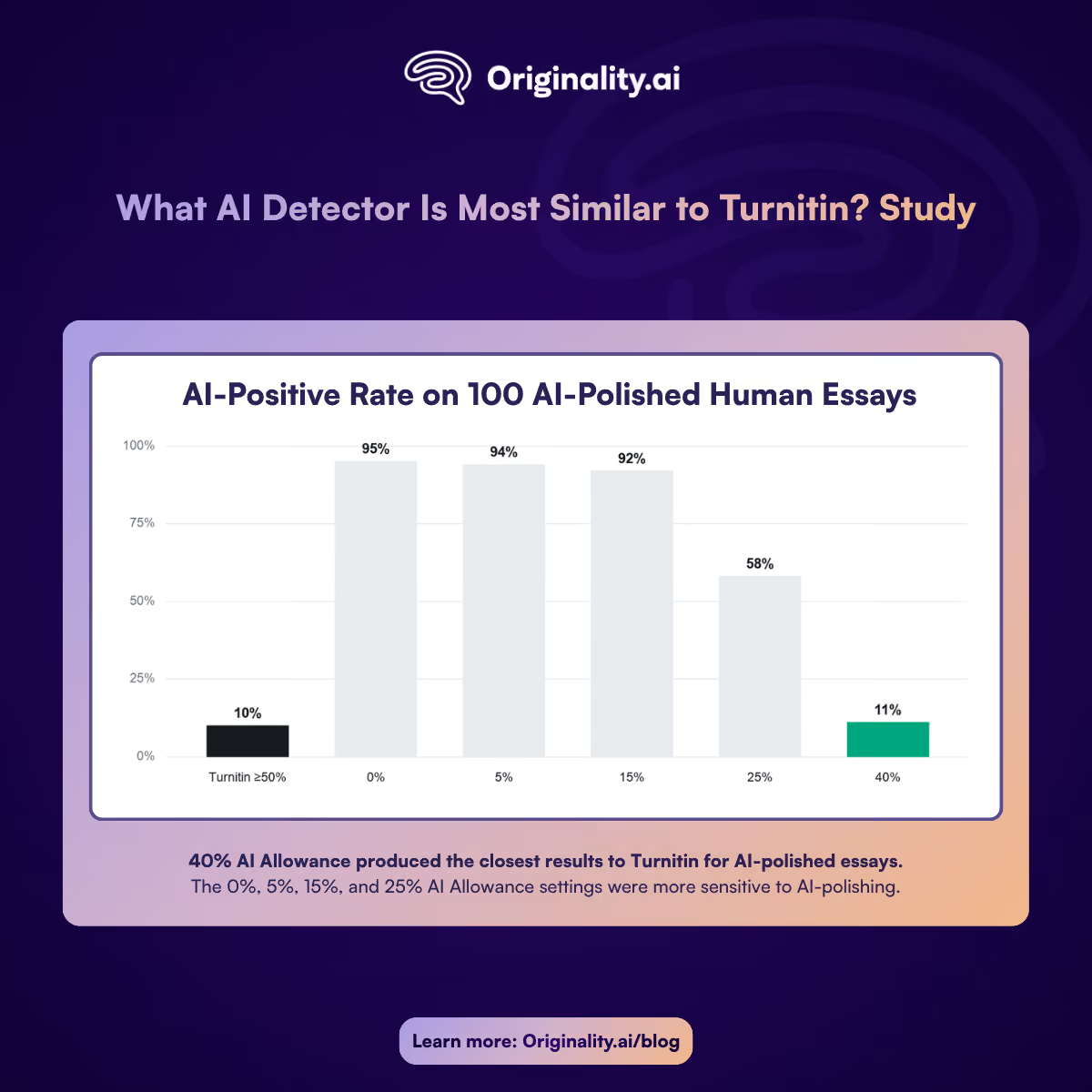
The 0%, 5%, and 15% settings were more sensitive to polishing, flagging between 92% and 95% of the group. The 25% setting flagged 58%.
Let’s take a look at the document-level comparison:
The detectors agreed on 85 of the 100 polished essays. Most of that agreement came from 82 papers that both treated as negative. They jointly flagged only three. That distinction keeps the 85% figure in proportion.
The two detectors behaved alike on known-human writing and were close on the share of polished essays they flagged. They differed on fully AI-generated work.
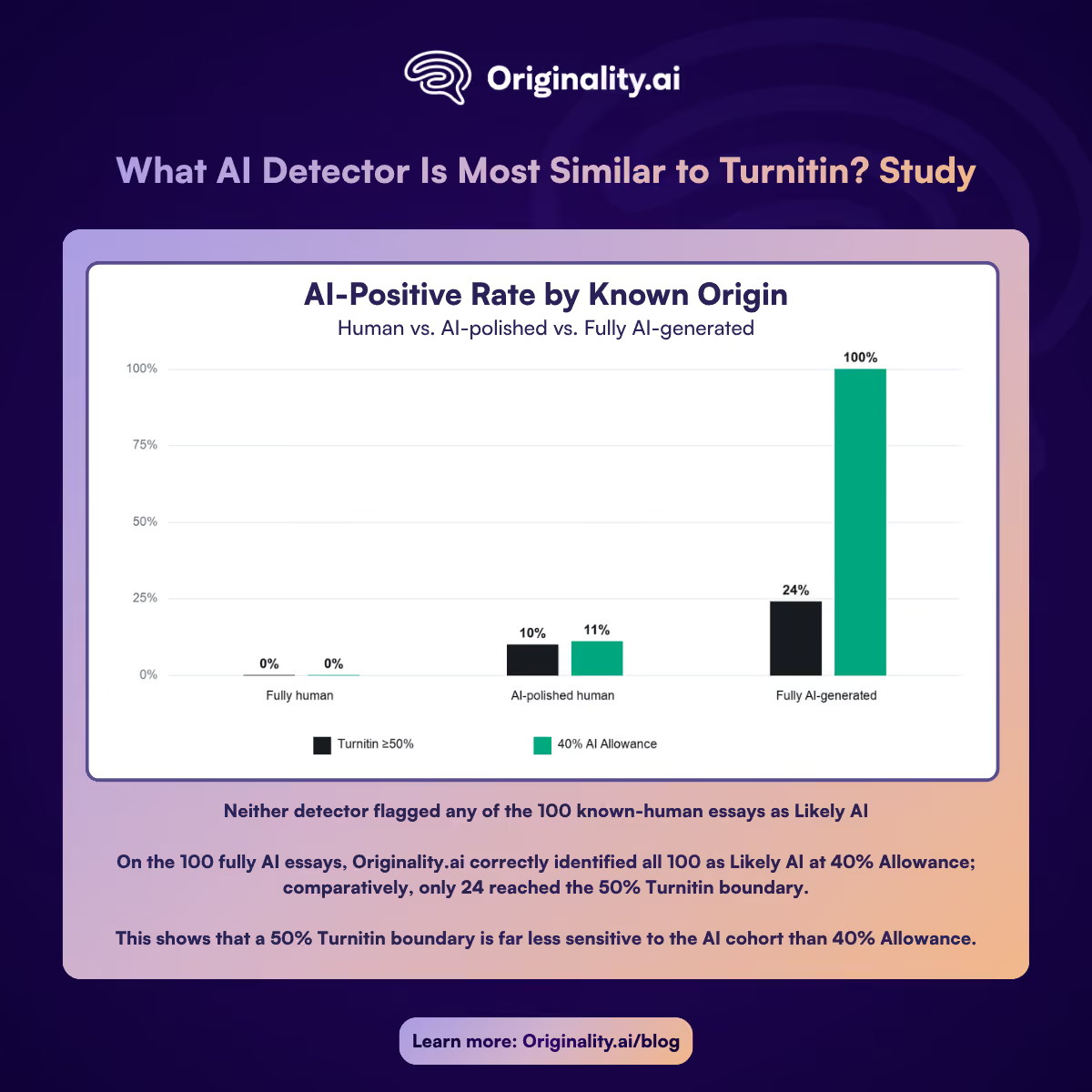
This shows that a 50% Turnitin boundary is far less sensitive to this AI-generated cohort than the 40% Allowance.
Now that we’ve reviewed the study results, let’s take a close look at why we ran this study for students.
Schools and universities often use Turnitin.
However, students may not always be able to see its AI writing report before they submit.
So, an AI detector that can produce similar results to Turnitin is essential. That way, students can have peace of mind that the authenticity of their work will be recognized.
While accessing a commercial AI detector can benefit students, the next step is to find one that produces comparable results to Turnitin.
Percentages across AI detection tools and brands may look relatable at first glance; however, they do not always translate directly. How AI detection works can vary by brand and even across AI detection models.
One detector may flag a paper that another passes, so a student may still be left wondering whether a routine grammar edit will result in a false positive.
40% AI Allowance is the best comparison point to Turnitin from the AI Allowance settings we tested.
A student whose paper is labelled Original can take some reassurance from the result, especially if the work began as their own writing and AI was used only for polishing.
However, there was some variation in the test cases, and schools may interpret reports differently.
Turnitin itself says its AI result should not be the sole basis for action against a student.
For students looking for an AI detection alternative to Turnitin for a comparison point before submission, Originality.ai AI Allowance at 40% is the AI detector that is most similar.
Check your work with Originality.ai for peace of mind and an idea of how your writing will be identified.
However, keep in mind that Turnitin is still a different AI detector than Originality.ai, so results can vary.
For best practice, write your essay in Google Docs, then use the Originality.ai Chrome Extension to demonstrate your writing process and authorship.
Then, check out the guides below to learn more about AI Allowance, how AI detectors work, and AI detection accuracy.
Further Reading
Which Originality.ai setting was closest to Turnitin?
40% AI Allowance at Originality.ai is the most similar to Turnitin. It matched the study’s binary Turnitin result on 69.7% of the 300 documents and on 85% of the AI-polished human essays.
Does an Original result guarantee the same Turnitin result?
No. Turnitin crossed the 50% study boundary in seven of the 189 cases that the 40% Allowance called Original. Indicating that results can differ between the tools.
Why use a 50% Turnitin boundary?
We needed one binary line for a document-by-document comparison. We chose 50% as a balanced study boundary. It is not an official Turnitin threshold.
Why can Originality.ai and Turnitin show very different percentages?
The numbers come from different models (and don’t use the same scale). Turnitin reports the share of qualifying text it identifies as likely AI or AI-paraphrased, while Originality.ai applies its own model and classification. So, a percentage or score from one shouldn’t be read the same as the other.
What should I do if Originality.ai and Turnitin disagree?
Review the paper, keep drafts and version history, and ask the instructor how the Turnitin report is interpreted. Then, use the Originality.ai Chrome Extension to show your writing process.
Will scanning my paper with Originality.ai put it into Turnitin's database?
No. Originality.ai and Turnitin are separate services. Running an Originality.ai scan does not submit the paper to Turnitin.
Is Originality.ai connected to Turnitin, or can it produce a Turnitin report?
No. Originality.ai is not affiliated with Turnitin. So it only produces Originality.ai reports.
Dataset: GEDE (Generative Essay Detection in Education), using the Human, Improved-Human and Task categories. The study source data and the document-level reconciliation are included in the supporting Google Sheet.
GEDE paper: Assessing LLM Text Detection in Educational Contexts
Turnitin documentation: Using the AI Writing Report
Originality.ai background: AI Detector Accuracy Study and AI Allowance

AI & Plagiarism Detector for Serious Content Publishers
Originality.ai
64 Hurontario St
Collingwood, Ontario
L9Y 2L6