AI Checker
Plagiarism Checker
Grammar Checker
Content Quality
Guideline Checker
Readability Checker
Fact Checker

Extensions

Originality.ai and Pangram are two highly accurate detectors with different approaches to mixed writing.
While Originality.ai and Pangram are both highly accurate (99%+) on the Pure AI and Human benchmarks, the more useful question is how they handle writing that falls between those two extremes.
For this study, Originality.ai results were measured at 15% AI Allowance. Where Originality.ai is recognized for a particular metric, those results were conducted with the AI Allowance model at 15% settings.
Let’s take a closer look.
The approach of writers and students towards using AI has changed since ChatGPT was first launched in 2022, and that’s not all. AI detection has changed too.
When Originality.ai launched as the first commercial AI detector, binary classification was a top AI detection method used to classify text as either Likely AI or Original (human-written).
Since then, workflows have evolved. Today, most content isn’t purely human or purely AI; it’s hybrid.
While many AI detectors can recognize fully generated text, they may struggle when AI rewrites a few paragraphs. That’s why we launched AI Allowance in 2026, to support detection of AI-human hybrid content.
We tested public datasets featured in Pangram’s published benchmarks.
Recall means the share of known AI texts a detector flags: higher is better.
The table identifies the Pangram version and sample size for each comparison.
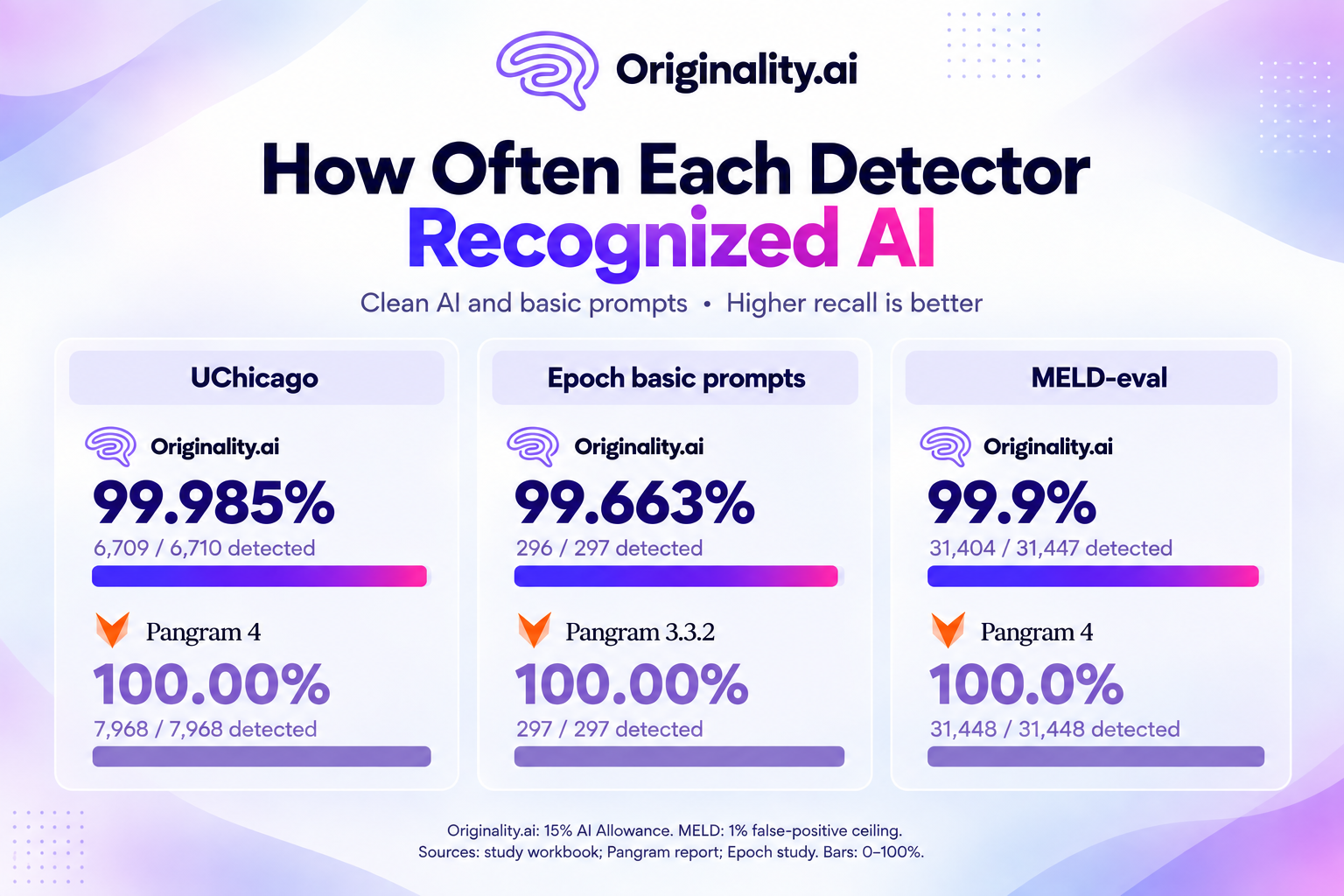
Both tools detected almost every UChicago AI text. Originality.ai missed one of 6,710 eligible texts; Pangram reported none in its 7,968-text benchmark.
On Epoch basic prompts, Originality.ai detected 296/297 texts and the independent study’s Pangram 3.3.2 detected 297/297. Pangram 4 does not publish a basic-only figure. Epoch study.
MELD-eval spans four AI generators and eight domains, including news, books, and reviews. Originality.ai achieved 99.9% AI detection on MELD-eval at a 1% false positive ceiling, with 43 misses. Pangram reported 100%. MELD dataset; Pangram MELD benchmark.
Specificity means correctly recognizing human writing. A false positive is a human text mistakenly flagged as AI.
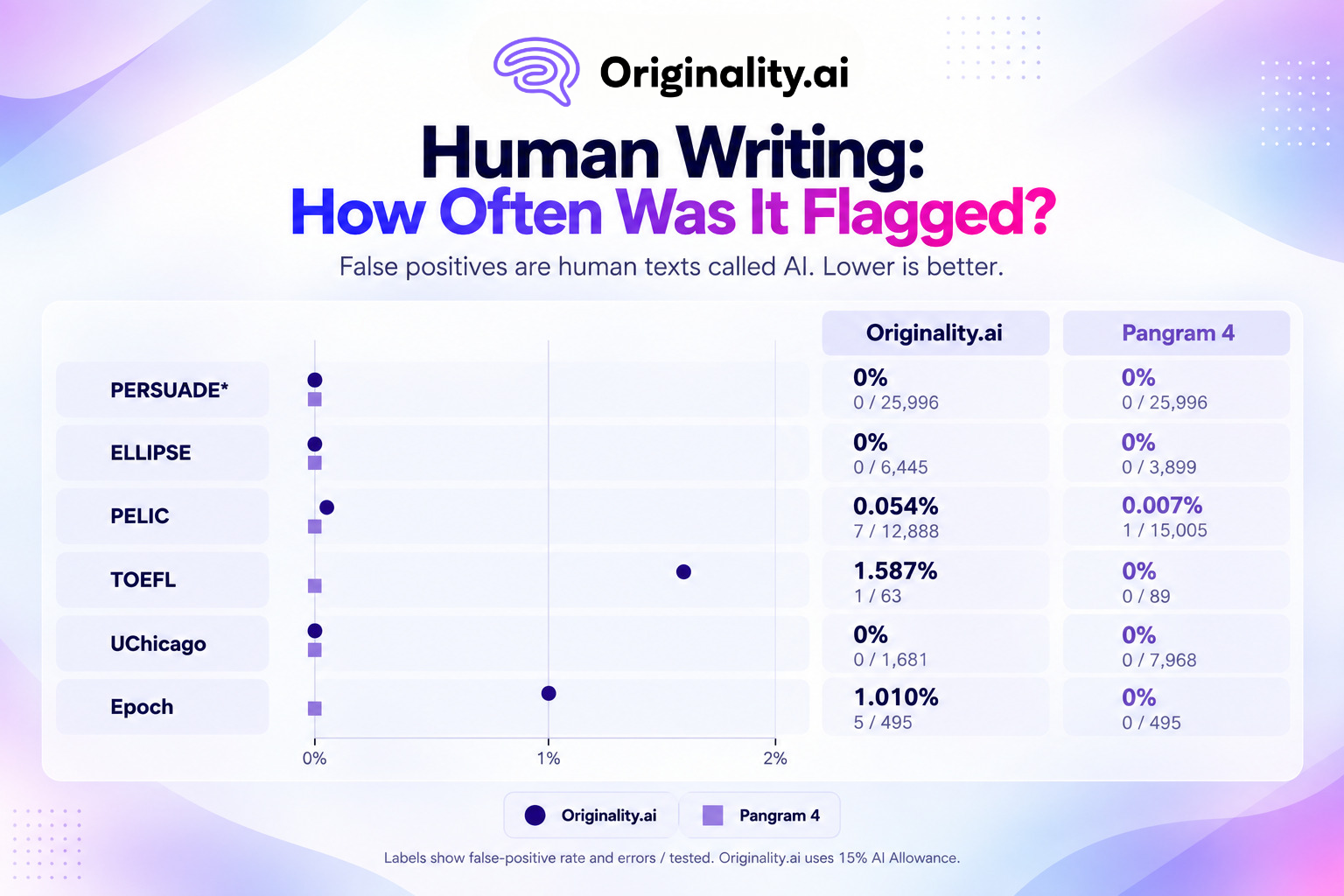
Across these six human groups, Originality.ai correctly recognized 47,555/47,568 records (99.97%), with 13 false positives.
Pangram human benchmarks; PERSUADE results.
Mixed writing, also called hybrid writing, combines human work with AI assistance. It can range from a lightly edited paragraph to a substantial rewrite.
Our two tests examine different versions of that scenario.
Originality.ai surfaced more AI-assisted writing in each. However, the results should be read separately and not combined into one accuracy score.
Consider a writer who drafts an article, then asks AI to rewrite several paragraphs. Most of the work may still be human, but a simple Human verdict can hide the assistance. Our test recreated that situation with 1,000 documents whose human and AI-rewritten components were known.
Example: a writer drafts ten paragraphs and asks AI to rewrite two. The finished article contains both human writing and AI assistance. That is different from asking AI to write the entire article.
Both tools look for signs of AI use, but they draw the line between Human, Mixed, and AI differently.
We used Pangram’s own labels and grouped Originality.ai’s results into the same three categories for Test 1.
What We Did:
This internal dataset contains 1,000 documents with known AI-rewritten passages.
Results:
The table shows each tool’s classification.
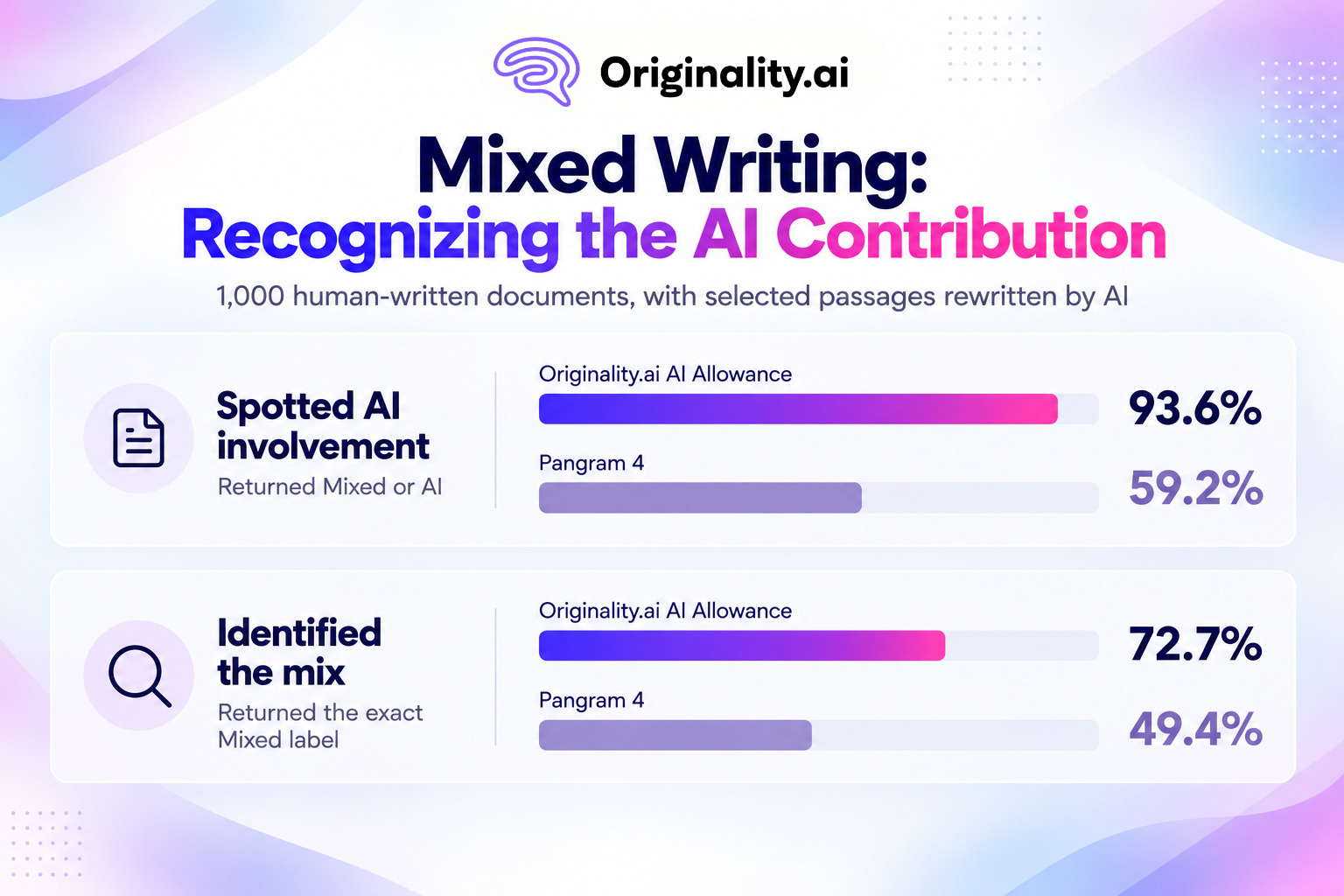
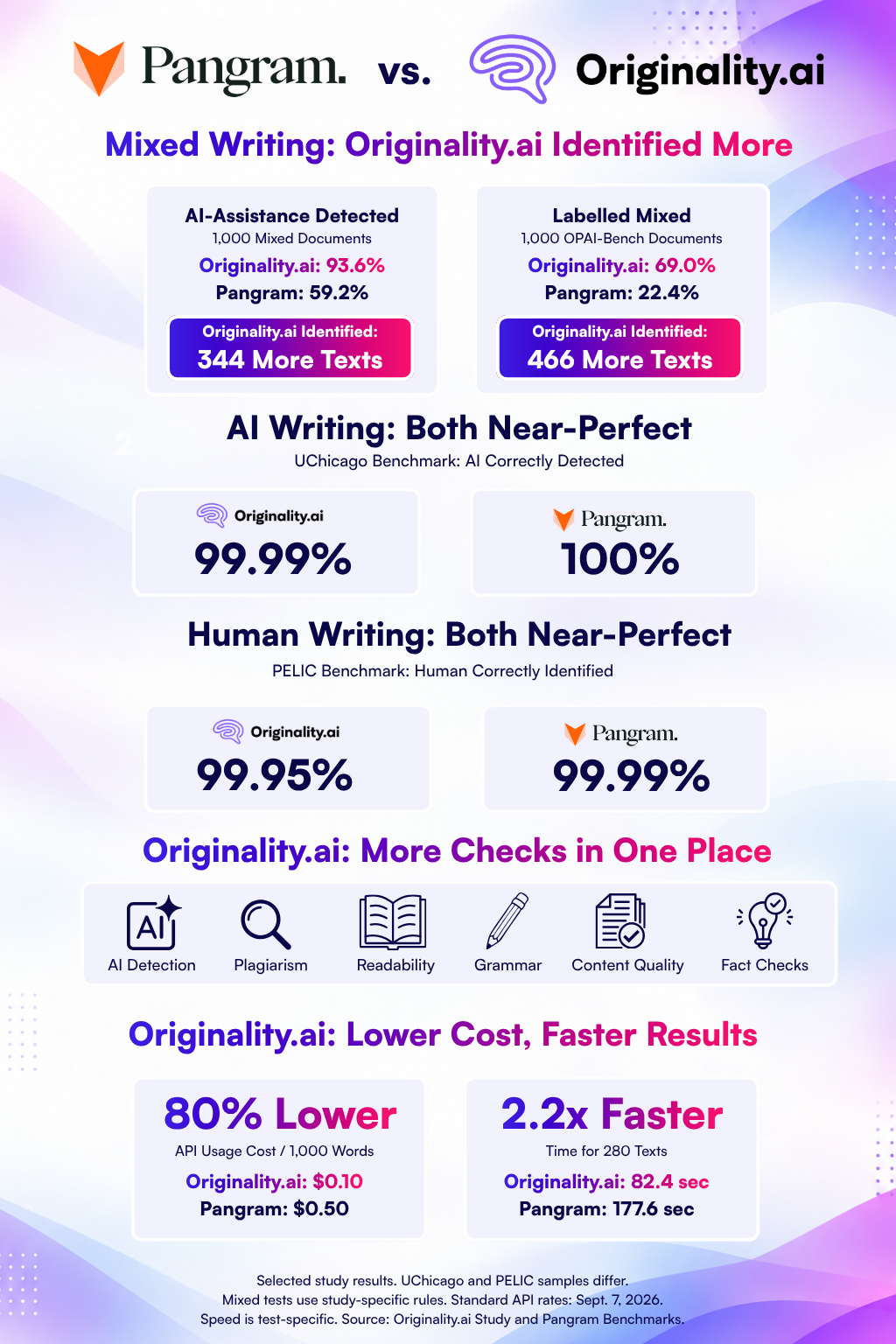
Detecting AI involvement: Originality.ai flagged 936/1,000 documents (93.6%), versus 592/1,000 (59.2%) for Pangram. It left 64 labelled Human, compared with Pangram’s 408.
Mixed classification: Originality.ai placed 727/1,000 documents in the study’s Mixed category (72.7%), compared with 494/1,000 (49.4%) for Pangram
What we did:
We used OpAI-Bench, a public collection of writing made by researchers outside Originality.ai. These texts started with a person’s writing, then AI changed some of it. We picked 1,000 random texts and checked the same texts with both tools.
Results:
Originality.ai spotted AI help in 690 of the 1,000 texts (69%). Pangram spotted it in only 224 (22.4%).
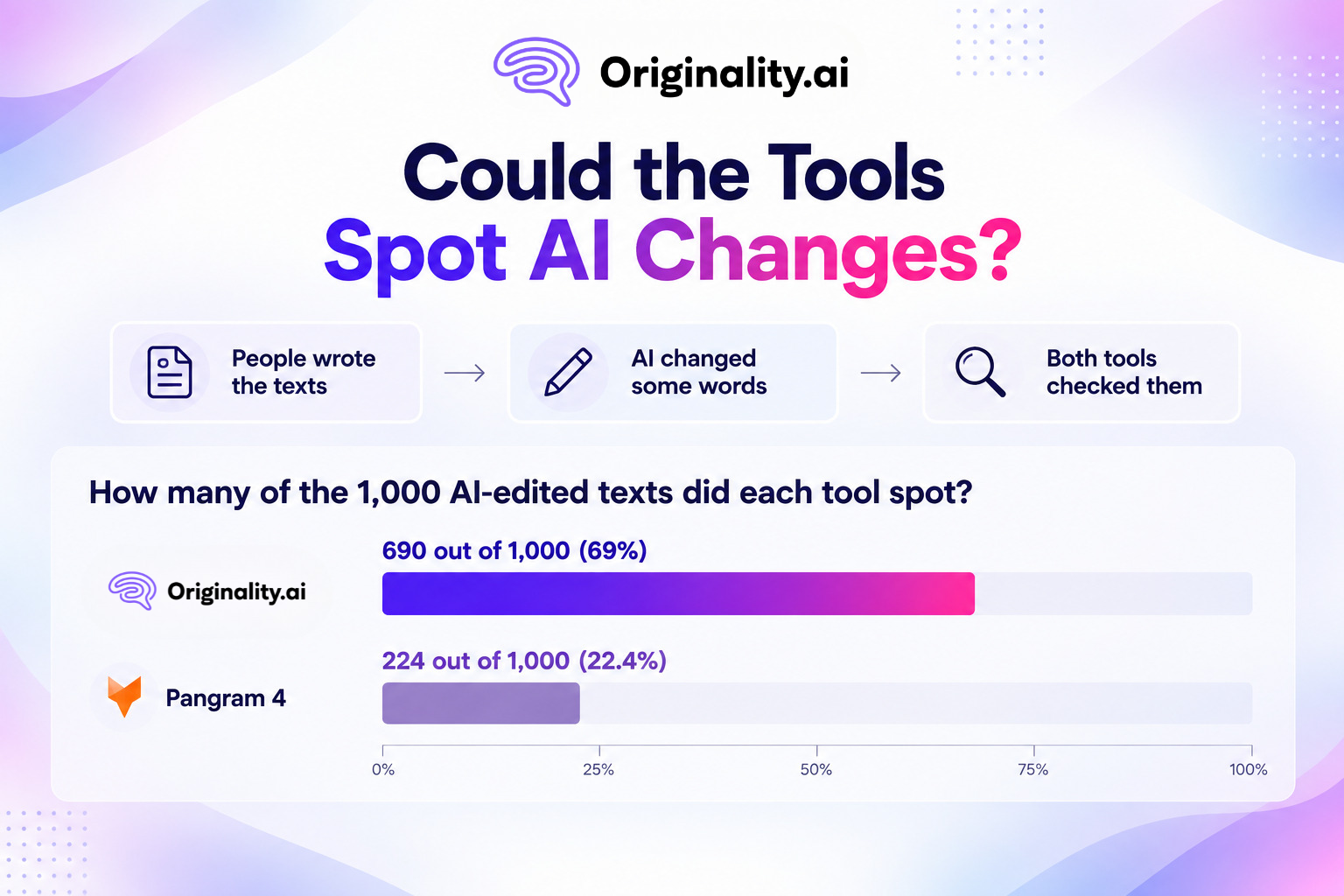
Originality.ai spotted AI help in 466 more texts. So, it was better at noticing AI changes in this test.
However, neither tool found them all.
The writing came from an outside research project, and Originality.ai ran this comparison. The exact selection rules are in the methodology.
Originality.ai surfaced more AI-assisted writing across these tests.
Identifying AI assistance can help editors and teachers review drafts or assignments and discuss permitted assistance, or how much AI is allowed for a given project.
What it does not mean is that every flagged draft violates a policy. Instead, it provides editors and teachers with the transparency tool needed to discuss AI usage with writers and students.
A publisher’s guidelines, a client’s brief, and a school assignment may allow different levels of AI help.
AI Allowance supports editors and teachers in asking: does this writing meet project requirements?
Originality.ai lets you choose how much AI you allow, then check if writing appears to meet it.
Writers can check their work before submitting it. Publishers, agencies, marketing teams, and educators can review content against their requirements.
The same document may meet a 15% allowance but exceed a stricter 5% allowance. These settings represent your AI guidelines depending on what you select (not an exact count of AI-written words).
Pangram: provides detailed results that developers can use to build their own rules. Pangram’s documentation.
Originality.ai: makes the allowance your choice when running a scan.
For publishers, schools, and content teams, the practical advantage is being able to review AI use, plagiarism, readability, grammar, and other writing issues (such as content quality) in one platform.
Originality.ai offers a broader set of content integrity tools. Here’s a comparative look at Originality.ai vs. Pangram features:
Based on pricing checked Sep 22, 2027:
All amounts are USD; taxes, minimum billing increments, and negotiated discounts are excluded.
At the published usage rates above, 100,000 words costs $10 with Originality.ai versus $50 with Pangram’s standard API: an 80% saving, or one-fifth of the usage cost.
Originality API pricing, Pangram API pricing
We timed both APIs on the same 280 texts.
Both timed runs completed all 280 texts. Originality.ai used one 15% AI Allowance call per text. Pangram’s client polled every two seconds, and clients and run times differed.
This is a difference in public reporting visibility, not proof of better uptime over a matched period. A status probe also does not guarantee every scan succeeded.
Both services reported all systems operational when we checked on September 22, 2026. The main difference was how much uptime history customers could review.
Pangram also maintains a separate past-incident list, which included a June 3, 2026 outage.
Originality.ai provides a longer uptime history to review. That offers more visibility, but does not prove better reliability because the reporting periods differ.
Originality.ai status, Pangram status.
Trustpilot snapshot checked Sep 22, 2026:
Originality.ai has the higher score and larger review base. Customer reviews reflect reported product experiences, not a controlled measure of detection accuracy.
Originality.ai — Trustpilot profile: 4.6/5 from 1,334 reviews
Pangram — Trustpilot profile: 2.0/5 from 49 reviews
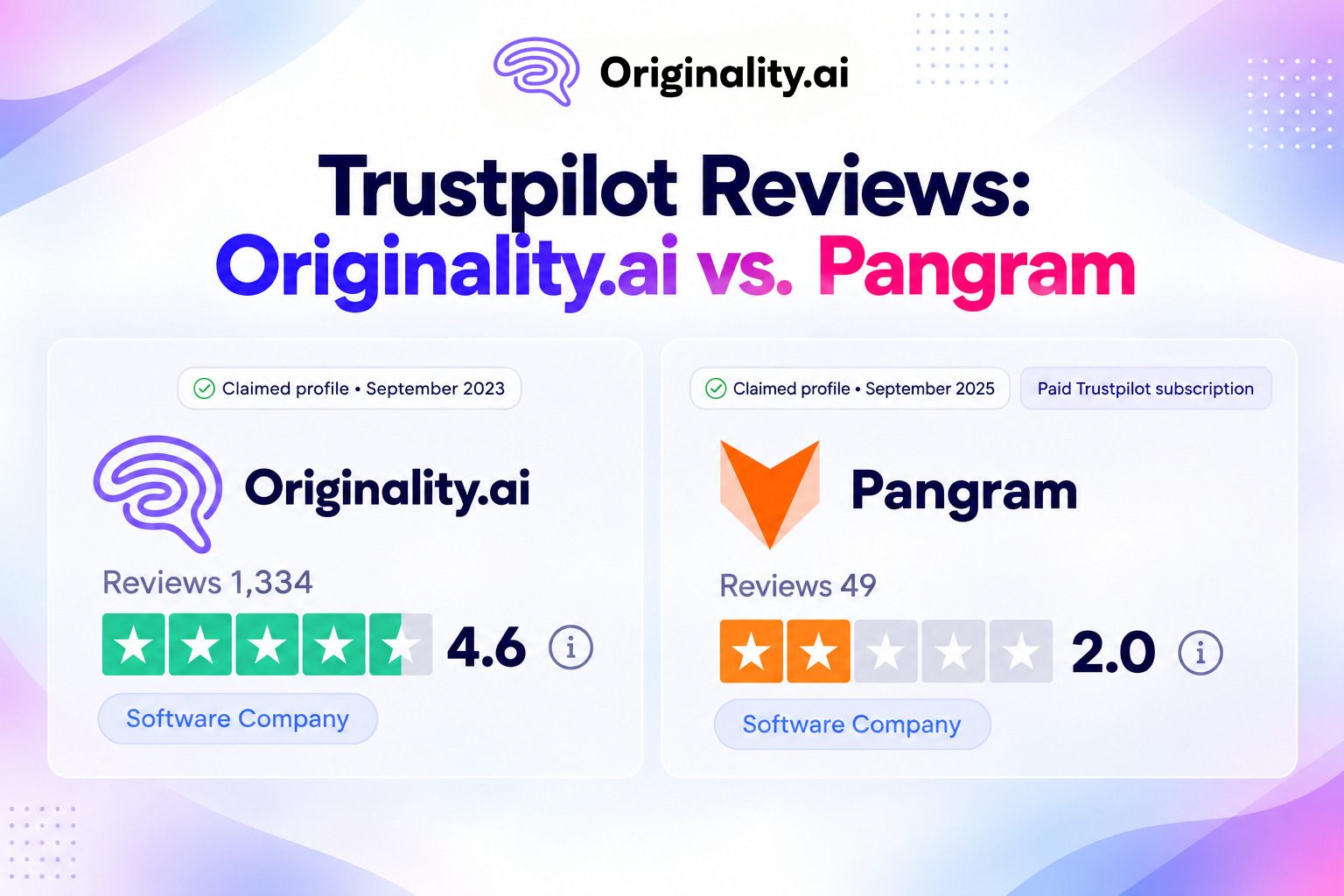
Originality.ai on Trustpilot and Pangram on Trustpilot.
Independent research has found strong results for both Originality.ai and Pangram, but neither tool is perfect. Below are selected findings from four studies run by third-party researchers.
The takeaway: Both tools have independent evidence behind them, but the results depend on the writing and how it is scored.
Sources: UChicago paper, Epoch study, dentistry study, VUB publication.
Originality.ai launched in November 2022; its 16-study roundup covers third-party, independent research from 2023–2026 in a meta-analysis that looks at Originality.ai’s detection accuracy.
Pangram, founded in 2023, also has a strong research track record. About Pangram.
Both tools performed strongly on human and fully AI-generated writing in the benchmarks reviewed here. Neither was perfect. Originality.ai’s clearest advantage in our tests was identifying AI assistance in mixed writing.
Originality.ai is a strong all-round choice for publishers, agencies, marketing teams, educators and writers. AI Allowance lets you match scans to your rules, while plagiarism and other writing checks help you review more than AI use. Its published API usage rate was 80% lower than Pangram’s standard rate, and it completed our API speed test about 2.2× faster.
Pangram is a strong option for AI-focused workflows. Its published results showed small advantages on several AI and human datasets. It also provides AI image detection.
Originality.ai had the higher Trustpilot score and more reviews in our snapshot.
The best fit is the tool that supports your rules and your work.
Further Reading on AI Detection:
AI Detection Tool Reviews and Comparisons:

AI & Plagiarism Detector for Serious Content Publishers
Originality.ai
64 Hurontario St
Collingwood, Ontario
L9Y 2L6