AI Checker
Plagiarism Checker
Grammar Checker
Content Quality
Guideline Checker
Readability Checker
Fact & AI Hallucination Checker

Extensions
MCP

The likelihood of AI-written content appearing in the House of Commons has tripled since 2024.
While members of the UK House of Commons wait to resume their business in mid-October, some lawmakers aren’t waiting for a parliamentary session to respond to threats posed by AI. In September 2026, reacting to British AI researcher Jacob Coxon’s viral warning that AI will kill all of humanity by the end of the decade, a cross-party group of MPs and lords published a report calling for a new bill to address the seriousness of dangers posed by artificial intelligence.
And yet, in parliamentarians’ own House of Commons, the prevalence of AI content has skyrocketed since the launch of ChatGPT in November 2022.
We at Originality.ai downloaded the entire federal British Hansard dating back to 2020, comprising hundreds of thousands of interventions—comments, questions, and prepared remarks. We then distilled the data and ran all viable samples through Originality.ai’s latest AI detector to detect the trends of AI usage over the last seven years.
We found an unmistakable rise in AI content read aloud in the House over the last four years, since the launch of ChatGPT.
We began by downloading the entirety of Hansard dating back to January 2020—more than 517,000 interventions. More than half were minor interjections or fell below Originality.ai’s 100-word minimum threshold, so we filtered those out, leaving 205,466 viable pieces of text. In addition to the verbatim text, each intervention also included a date, speaker name, party affiliation, debate subject, word count for their comment, and unique IDs for each member, debate, and specific contribution.
After filtering the Hansard data, we ran all 205,466 interventions through Originality.ai’s latest AI detection model at the time of data collection and analysis. Our model has tested at 99%+ accuracy and allows for some light AI content, which helps to reduce the number of false positives. Each intervention came back with an AI likelihood score, which determines the model’s certainty that the text was AI-generated. If an intervention scored over 50%, it was flagged as “Likely AI”.
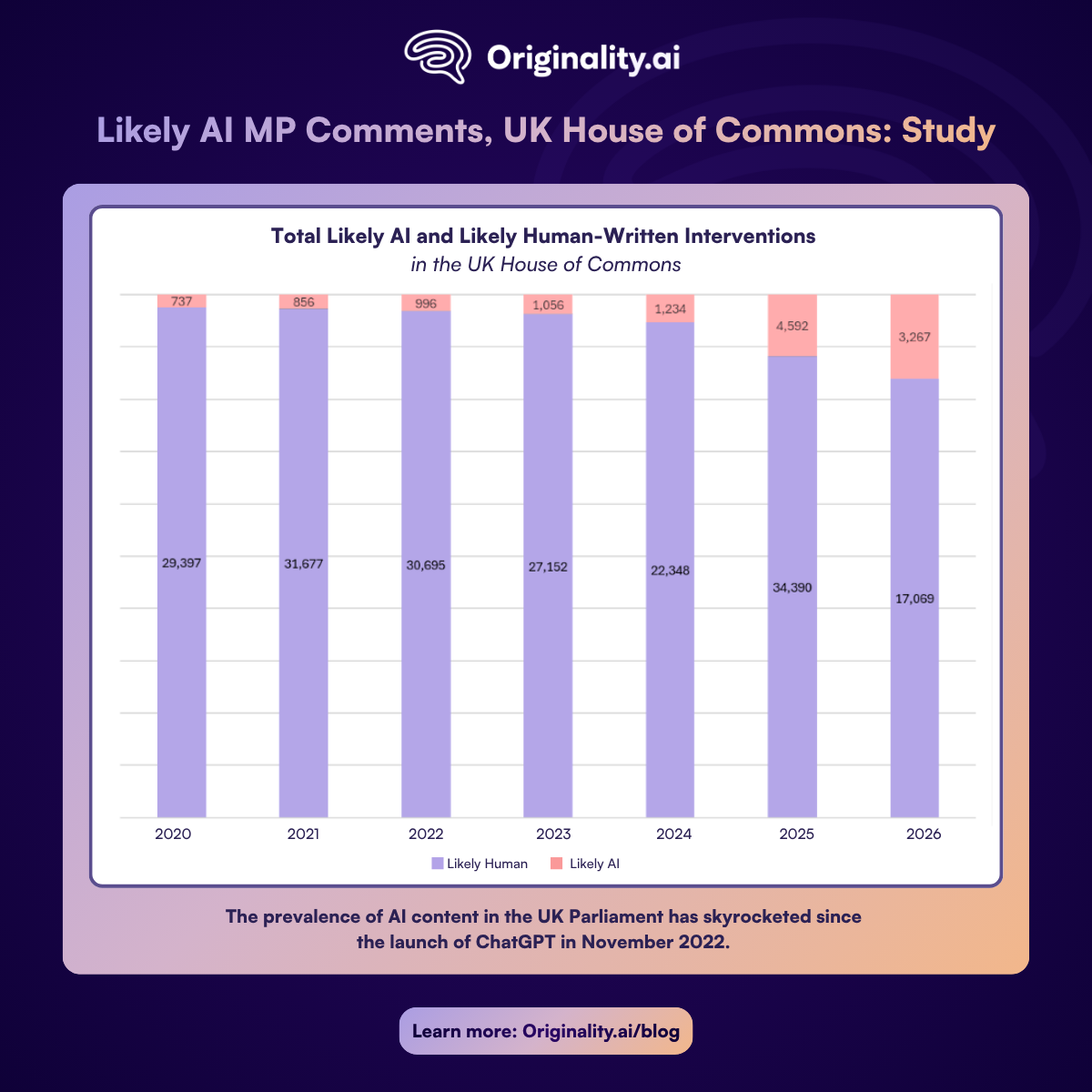
Zooming out from the data, we see a clear spike in AI likelihood beginning in 2024.
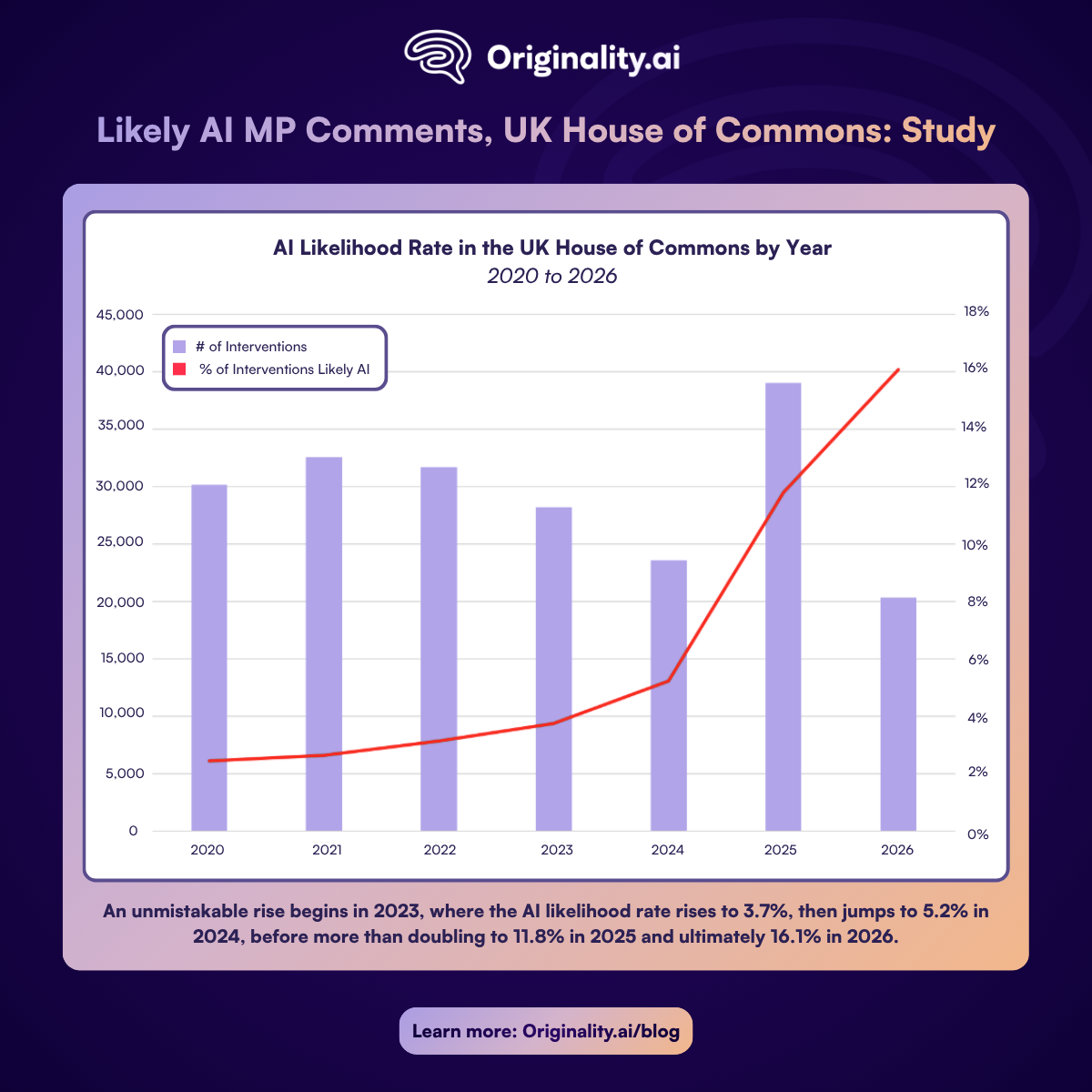
We looked at historical data reaching back to 2020 to give a strong four-year runway of what AI likelihood looked like before the rise of LLMs. From 2020-2021, under 3% of all interventions were flagged as AI-written—likely false positives, as ChatGPT launched in November 2022. In 2022, the rate of AI likelihood cracked 3% for the first time.
An unmistakable rise begins in 2023, where the AI likelihood rate rises to 3.7%, then jumps to 5.2% in 2024, before more than doubling to 11.8% in 2025 and ultimately 16.1% in 2026. The most recent intervention is from July 16, 2026, before the House rose for summer recess.
While the year-over-year numbers are stark, when we drill down per quarter, the growth is much steadier and more gradual. There is a clear rise from an average of 4% to 6% throughout 2024, then up to 8% in Q1 2025 before jumping to 13-14% throughout the rest of that year, and continuing its rise to about 15-16% in 2026.
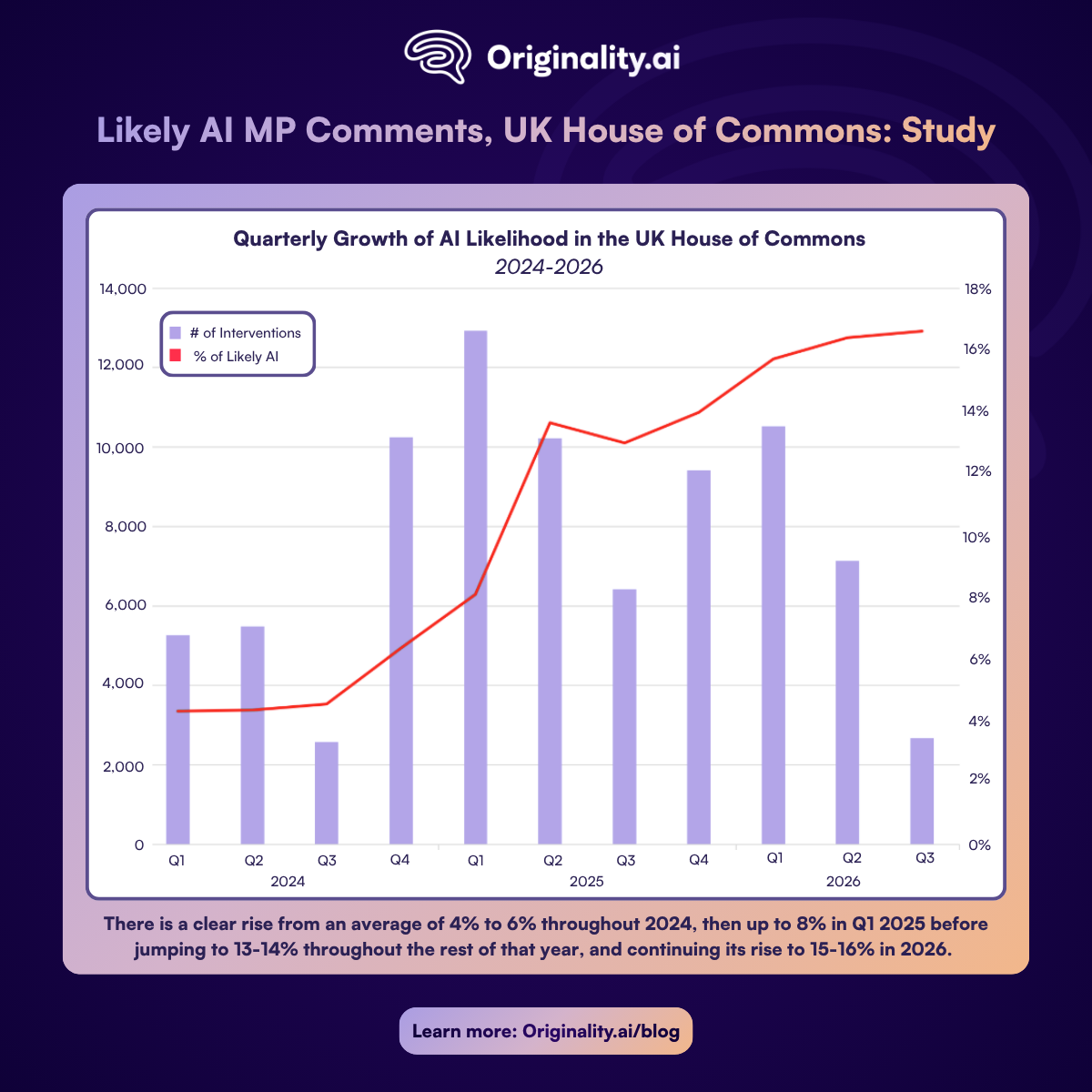
That the highest quarter for AI likelihood on record is the most recent—Q3 2026—suggests we may not have hit the ceiling of this trend. As the House resumes on Oct. 12, 2026, we may see Q4 numbers continue to rise.
In the timeframe of our study, the British political system has featured 19 formal and informal political parties (excluding solo independents, but including independent coalitions). To focus on only prominent parties, we set limits on the data: only parties with at least three sitting MPs and 100 interventions in a majority of years from 2020-26. Parties with fewer interventions sometimes saw major swings in AI likelihood due to small sample sizes.
That left the Conservative Party, the Democratic Unionist Party, the Green Party, Labour, Liberal Democrats, Plaid Cymru, the Scottish National Party, and Reform UK. Smaller parties such as the Alliance Party of Northern Ireland, the Social Democratic and Labour Party, Alba, Reclaim, Your Party and others were all included in our overall dataset, but filtered out for party-specific analysis.
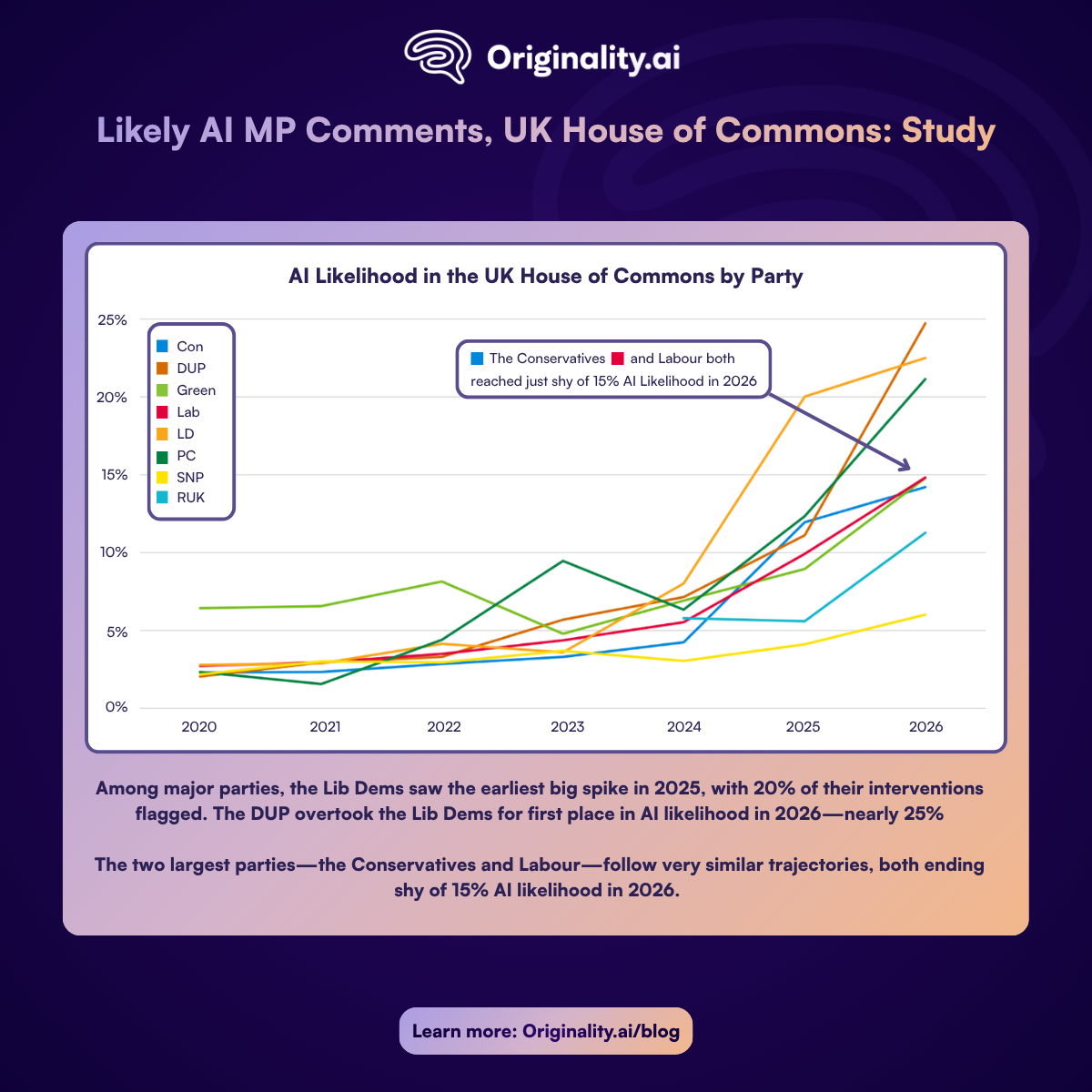
Among major parties, the Lib Dems saw the earliest spike in 2025, with 20% of their interventions flagged (964 out of 4,819 viable interventions that year) while every other party lingered in the low double or single digits. However, the other parties caught up, and the DUP overtook the Lib Dems for first place in AI likelihood in 2026—nearly 25% (126 out of 510 interventions) of their comments were flagged as likely AI.
The two largest parties—the Conservatives and Labour—follow very similar trajectories, both ending shy of 15% AI likelihood in 2026 on very high volume.
Reform, whose data only reaches back to 2024, has held their AI likelihood rate consistently lower than most other major parties, although their sample size is relatively small (only 86, 125 and 142 total qualifying interventions from 2024-26, respectively).
Plaid Cymru is a smaller party that shows how fewer interventions can cause larger swings: with only four sitting MPs this year, they shot up from 12.3% in 2025 to 21.1% the following year, largely based on their total intervention count going down. In 2025, 20 of 162 interventions were flagged; so far in 2026, it was 15 out of 71.
To determine whether the rise in likely AI usage is a widespread phenomenon or simply a few prominent actors, we looked at anonymized overall numbers and drilled down to look at growth within specific politicians.
Per year, 2025 saw a startling 90% of all MPs flagged as having read likely AI-written content at least once (568 out of the 632 MPs who spoke that year).
A relatively small fraction are one-time users. We detected 954 MPs who likely read AI-generated content aloud in the House; of that group, just 80—or 8.4%—only did so once. A further 132 did so 2-3 times (13.8%), while a clear plurality, 307 MPs, did so between 4-9 times (32.2%).
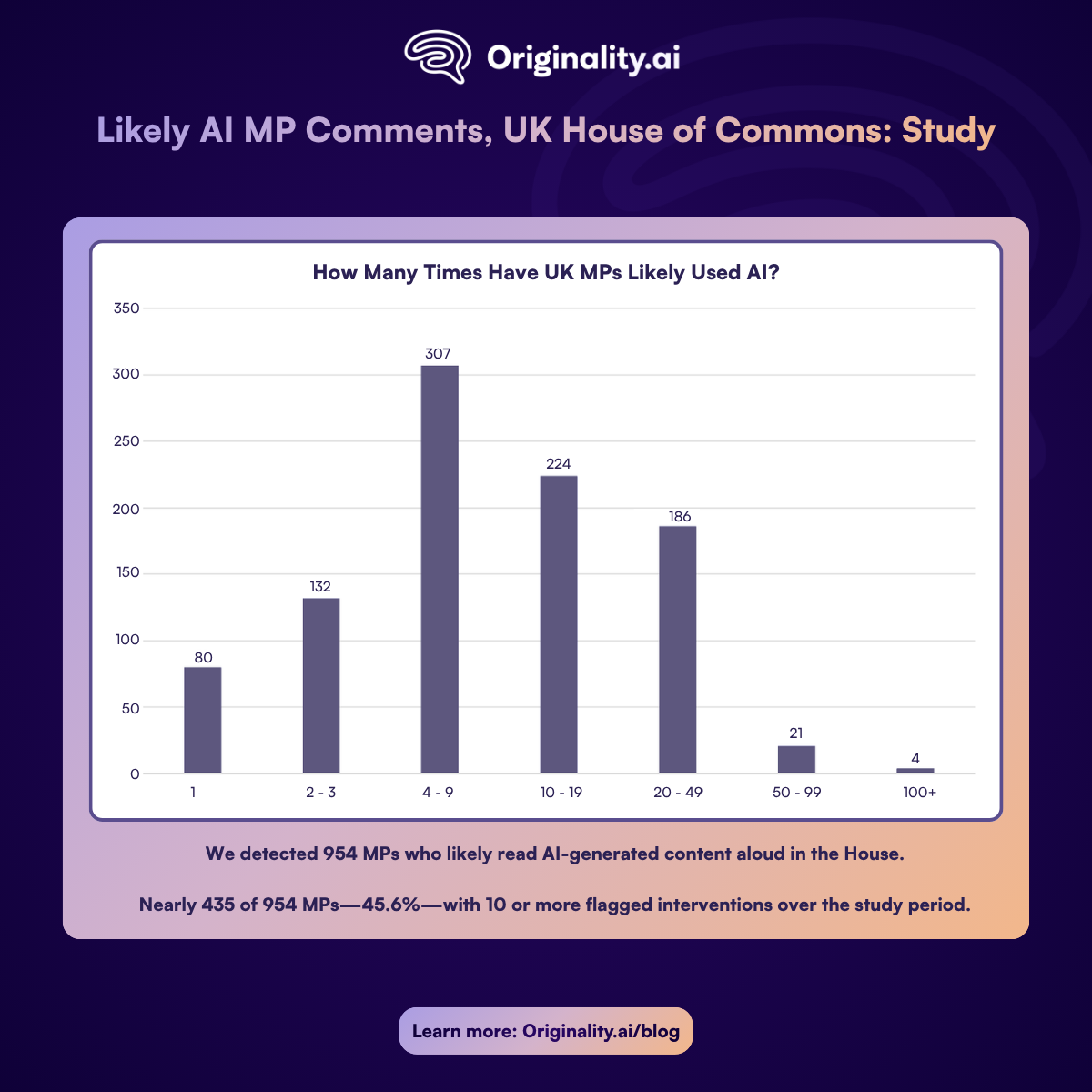
That leaves nearly 435 of 954 MPs—45.6%—with 10 or more flagged interventions over the study period. The number tapers off with increased usage, with the smallest fraction being the most extreme users; only four MPs have read AI content 100 times or more.
There are defensible use cases for AI in politics. AI tools can help lawmakers understand complex reports and data, speed up communications, and sift through archives to back up proposed legislation. The degree to which any of this should be moderated or overseen is a matter for Parliament and, perhaps, the public to decide. If Parliament has no overarching rules about AI usage in prepared House remarks, each party may decide to implement their own oversight independently. Regardless, transparency with regards to AI usage is rarely discouraged; when the technology gets good enough that people can’t tell the difference between human- and machine-written, transparency becomes more critical.
The fact that the numbers have risen exponentially since 2022 would indicate that we have yet to reach a plateau in AI adoption. Notably, because our data is delineated by calendar year and not parliamentary session, the numbers for 2026 may well rise further before year’s end—the House of Commons resumes Oct. 12.
None of this should be considered proof that the MPs themselves are using AI to write their remarks, which are often prepared by communications staffers. Government bureaucracy is expansive, and it’s easy for AI-written content to slip through. The British public has a right to know if that’s the case.
Note: This study was completed on a previous AI detection model (AI Allowance). To learn more about the recently released Originality.ai 5.0, check out this guide.
This study analyzed speeches and interventions delivered by MPs in the United Kingdom House of Commons to examine changes in the prevalence of text classified as likely AI-generated. Parliamentary transcript data was collected from the official UK Parliament Hansard service, text was scanned using Originality.ai, and results were analyzed in Microsoft Excel.
The dataset covered House of Commons proceedings from Jan. 7, 2020, through July 16, 2026. The 2026 data therefore represents a partial year, ending when the House of Commons rose for its summer recess. Hansard is Parliament’s official report and is described by Parliament as “substantially verbatim”: Members’ words are transcribed and edited to remove repetitions and obvious mistakes without changing their meaning. Commons Hansard includes proceedings in the Commons Chamber and Westminster Hall.
Parties, informal groupings and coalitions included the Alba Party, Alliance Party of Northern Ireland, Conservative Party, Democratic Unionist Party, Green Party of England and Wales, Independent Alliance, Independent Unionist, Labour Party, Liberal Democrats, Plaid Cymru, Restore Britain, The Reclaim Party, Reform UK, Social Democratic and Labour Party, Scottish National Party, Traditional Unionist Voice, Ulster Unionist Party, Workers Party of Britain, and Your Party.
A custom Python 3 pipeline was used to retrieve spoken contributions from the UK Parliament Hansard API. The pipeline separated proceedings into individual contributions, removed HTML formatting and normalized whitespace, and recorded available metadata including date, speaker, parliamentary member ID, debate title, debate ID, contribution ID, word count and transcript text. Entries without an identifiable parliamentary member ID and procedural interventions from Speakers and Chairs were excluded. Duplicate contributions were removed using the contribution ID where available, with date, speaker, debate title and text used as a fallback.
For AI analysis, contribution text was exported into a CSV containing a single text column and each eligible contribution was scanned independently using Originality.ai. The model used was AI Allowance, with an AI allowance setting of 15%. Eligible texts received an AI-likelihood score from 0 to 100 and were classified as “Likely AI” at a score of 50% or above and “Likely Human” below that threshold. Contributions shorter than Originality.ai’s minimum eligible length of 100 words were classified as N/A and excluded from AI-rate calculations. After filtering, the final raw dataset contained 205,466 individual spoken contributions.
Party labels were standardized for analysis. Entries labelled Reform and RUK were consolidated as RUK, and Labour & Co-operative MPs were grouped with Lab. Hansard’s broad Ind category was retained in the source data but supplemented with a separate analytical affiliation field where a larger identifiable grouping was relevant. This distinguished, where applicable, the Independent Alliance (IA), Independent Unionists (IU), The Independent Group (TIG) and Your Party (YP); remaining independent MPs continued to be classified as Ind. These analytical categories were date-sensitive so that an MP was not assigned to a grouping before joining it.
AI-likelihood rates were calculated as the number of eligible contributions classified as “Likely AI” divided by the total number of eligible classified contributions. N/A contributions were excluded from the denominator. Results were compared by year and political affiliation, alongside the empirical number of contributions receiving an AI flag. For party-level trend visualizations, parties were generally included where they had approximately 100 or more interventions in a year and/or at least three sitting MPs.
Counts of distinct MPs receiving at least one AI flag were treated separately from intervention-level AI rates. Because MPs can make dozens or hundreds of contributions in a year, even a relatively low per-intervention detector-flag rate can result in a large share of MPs receiving at least one flag through repeated exposure to the detector. An MP appearing at least once among flagged contributions was therefore not interpreted as evidence that the MP regularly used AI, or necessarily used AI at all.
Originality.ai scores should not be interpreted as definitive evidence that an MP, staff member or other individual used generative AI. Parliamentary remarks may be drafted, edited or prepared by multiple people, while linguistic AI detectors can be affected by factors including writing style, formality, text length and the characteristics of parliamentary language. Hansard itself is also an edited official transcript rather than an unaltered transcription of audio.

AI & Plagiarism Detector for Serious Content Publishers
Originality.ai
64 Hurontario St
Collingwood, Ontario
L9Y 2L6