AI Checker
Plagiarism Checker
Grammar Checker
Content Quality
Guideline Checker
Readability Checker
Fact & AI Hallucination Checker

Extensions
MCP

If your content process still looks like it did a few years ago, these B2B content marketing statistics may be the wakeup call you need for 2026.
Right now, smart B2B content marketers are investing more in content, figuring out where AI fits into their workflow, focusing on buyer trust and personalization, and prioritizing the channels most likely to drive results.
Here’s what you need to know to help you stay one step ahead.
Streamline your content quality checks with Originality.ai’s best-in-class toolkit, including AI detection, plagiarism checks, and fact checking.
Source: PathFactory
Clearly, B2B marketers still see content marketing as relevant and valuable heading into 2026. But budget increases come with higher expectations across the board: more content, more channels, and even more pressure to show a solid ROI.
If you’re still posting sporadically on your B2B blog, it’s time to rethink your strategy.
Source: CMI
At this point, AI investment is more than just a trend — it’s a full-on shift toward more of what’s working. With AI-powered tools like generative AI and predictive analytics topping the marketing budget priority list after teams have had time to experiment (it’s not like they’re brand-new anymore), teams obviously see their value.
Those who don’t adapt could risk getting left behind.
Source: SageFrog
If buyers don’t recognize you, they’re less likely to trust your content. That said, with increases expected in both content marketing budgets and AI tools, the content world may be more crowded than ever in 2026. You’ll need to make sure you’re showing up clearly and consistently to be remembered.
Source: Content Marketing Institute
Budget allocation (20%) and technology and tools (43%) also made the list, but it’s the content itself that many teams credit with moving the needle. It goes to show that you still need high-quality content to get results.
Source: Salesforce
For B2B marketers, this indicates that overall, marketers know that AI matters, yet implementing it is still a top challenge.
That means that if you start prioritizing it now in your B2B marketing strategy, there is still an opportunity to stand out by leveraging AI effectively. That being said, it’s important to integrate AI into content marketing mindfully and continue to prioritize high-quality people-first content.
Learn more about Google’s Search Quality Rater Guidelines around AI use and Google Penalties.
Source: Adobe
Lots are still in the testing stage (26% are piloting and 29% are testing informally). If you can be the brand that implements instead of just sketching it out on whiteboards, you may come out ahead with measurable, impactful data.
Source: Adobe
Leveraging templates, automation, and repurposing your content is no longer just something you keep in your back pocket for when the schedule gets too crowded. Marketers are now expected to use all the tools, all the time.
Be careful not to prioritize volume over value too much, though. It’s essential to find a balance that ensures content engages readers.
Source: CMI
Although generative AI can undoubtedly speed up content creation, B2B marketers know that it doesn’t always do it well (just consider the AI book list and Deloitte AI scandal). That’s where other tools, such as AI detectors and fact checkers, can be helpful.
Source: Forrester
With so much AI content in Google search results, B2B companies should be aware that content alone isn’t enough to build trust anymore. To help combat AI hallucinations and other low-quality content, more teams will likely recruit influencers to support their content strategy.
Source: Forrester
A generational shift is underway, and B2B companies must adapt to younger buyers. One thing to note is that Millennials and Gen Z often cite issues reaching an internal consensus when selecting vendors. You’ll need to figure out how to influence not just the individual, but their entire network to reach new generations of B2B customers.
Source: Deloitte Digital
Content that’s mass-produced to reach a massive audience just won’t cut it anymore. Buyers today want to feel seen and heard.
The more you can personalize and attach meaningful interactions to real behavior, the more likely your brand will be recognized and rewarded for it.
Source: Salesforce
The personalization bar has moved much higher. If you’ve already realized the value of treating people as individuals instead of numbers, you’re already way ahead of the game.
If not, there’s no time like the present to see the difference it can make.
Source: Content Marketing Institute
Thought leadership works best where people already expect to see expertise. Brands that treat LinkedIn as little more than an afterthought may be missing one of the best places to build authority and stay visible.
Source: LinkedIn for Marketing Blog via Dreamdata
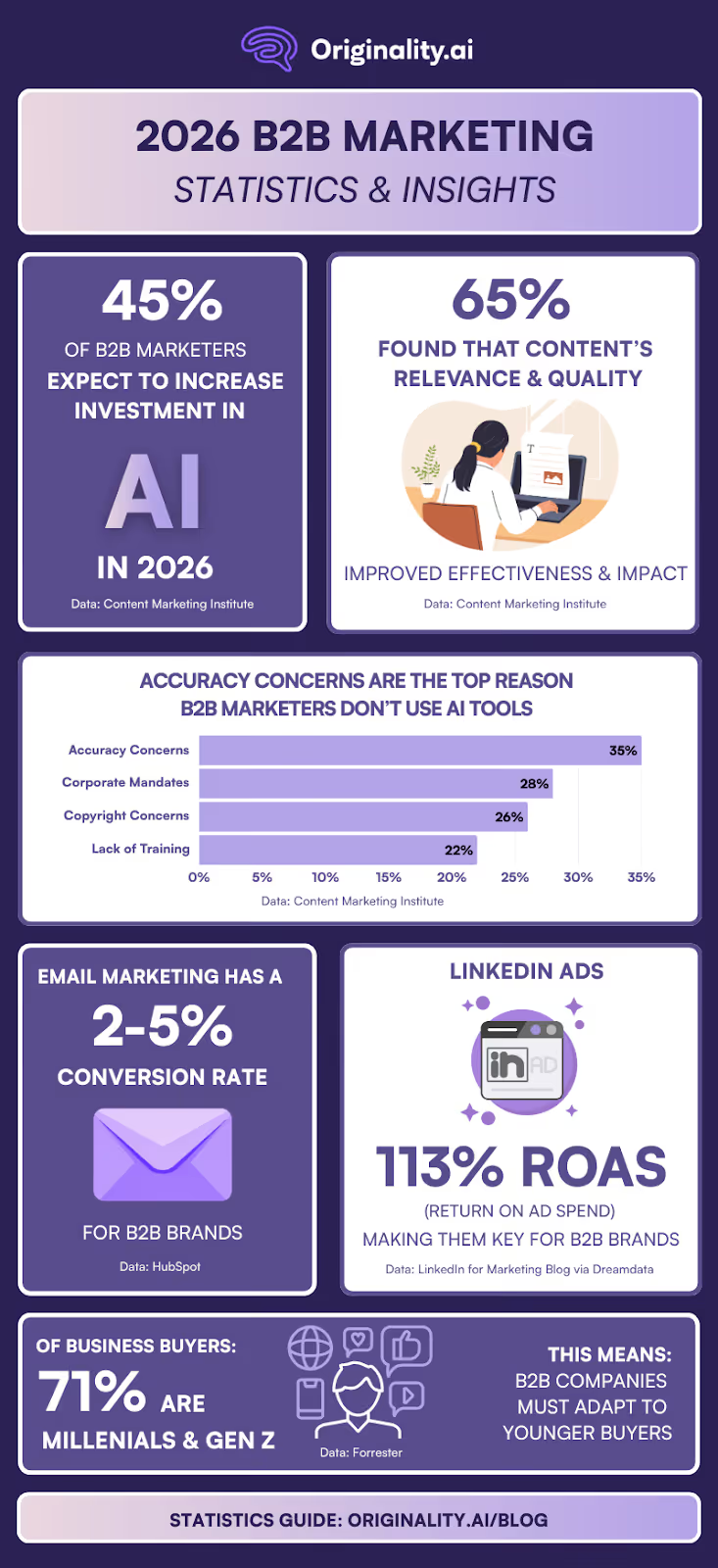
LinkedIn Ads get results, making them an important channel for B2B companies. They even outperform Meta Ads and Google Search Ads in terms of ROAS (return on ad spend), according to Dreamdata’s report.
Source: LinkedIn
LinkedIn is a lot busier than it was just three years ago. If you want your B2B content to stand out, posting alone may not cut it anymore. It may take stronger creatives, clearer positioning, or a better mix of formats to get your content seen over everyone else’s.
Source: HubSpot
Email marketing continues to be one of the best channels for marketers. According to HubSpot, B2B brands can expect a 2-5% conversion rate for their email campaigns. Further, it can provide one of the most cost effective channels for top-of-the-funnel cost per lead (CPL).
The takeaway? Email marketing still deserves a space in your budget. But make sure to write strong subject lines and email content; the inbox is prime real estate, but only if you can earn a spot in it.
Learn more about the content marketing funnel.
Source: PathFactory
There may be tons of content out there already, but customers are still looking for even more in-depth insights through gated content. As long as you make sure it’s valuable (think high-quality research and reports), the leads are likely to come.
Source: Datalily
It may take some extra work, but original research can help your B2B content stand out in a time when everyone else is constantly repeating the same content. Besides, Google likes it, and that can help you earn better rankings, clicks, and links.
Source: HubSpot
SEO campaign results require patience, but the ROI is there. Take the time to invest in evergreen content that ranks, and it can continue to ripple through to people for months and even years. Plus, you can combine it with paid social to amplify your content marketing goals.
Source: HubSpot
According to HubSpot, the social media channels that offer the best ROI for B2B marketers include Instagram, Facebook, and YouTube — B2C marketers also found those channels to be the top three most effective for ROI.
These B2B content marketing statistics show that content is still a major priority in 2026. It’s just that the expectations around it are getting much higher.
With both budgets and AI interest rising, it’s no wonder teams are feeling the pressure to produce more than ever. At the same time, though, it’s important to remember that you don’t always have to be the brand that does the most to get results. High-quality, relevant content never goes out of style and is the backbone of many effective B2B marketing teams.
So, in 2026, be sure to take the time to:
B2B content marketing has changed quite a bit over the past five or even two years. Generative AI, in particular, has made it easier than ever to create lots of content in a short time.
However, that doesn’t mean it’s all good content.
Since it’s still the quality stuff that moves the needle, it can help to have a tool by your side to tell the difference between Likely AI-written content and original work. Check out the Originality.ai AI Checker to help you publish B2B content with confidence.
Further Reading:

AI & Plagiarism Detector for Serious Content Publishers
Originality.ai
64 Hurontario St
Collingwood, Ontario
L9Y 2L6