AI Checker
Plagiarism Checker
Grammar Checker
Content Quality
Guideline Checker
Readability Checker
Fact Checker

Extensions

If you think email is too “old school,” we’re about to challenge that myth with 20+ email marketing statistics to know in 2026.
While many other social platforms’ algorithms are constantly shifting, email is quietly one of the most stable, audience-powered, and profitable marketing channels on the internet.
Let’s take a closer look.
Find out if an email you’re reading is real or Likely AI with the industry-leading Originality.ai AI Checker.
Source: Statista
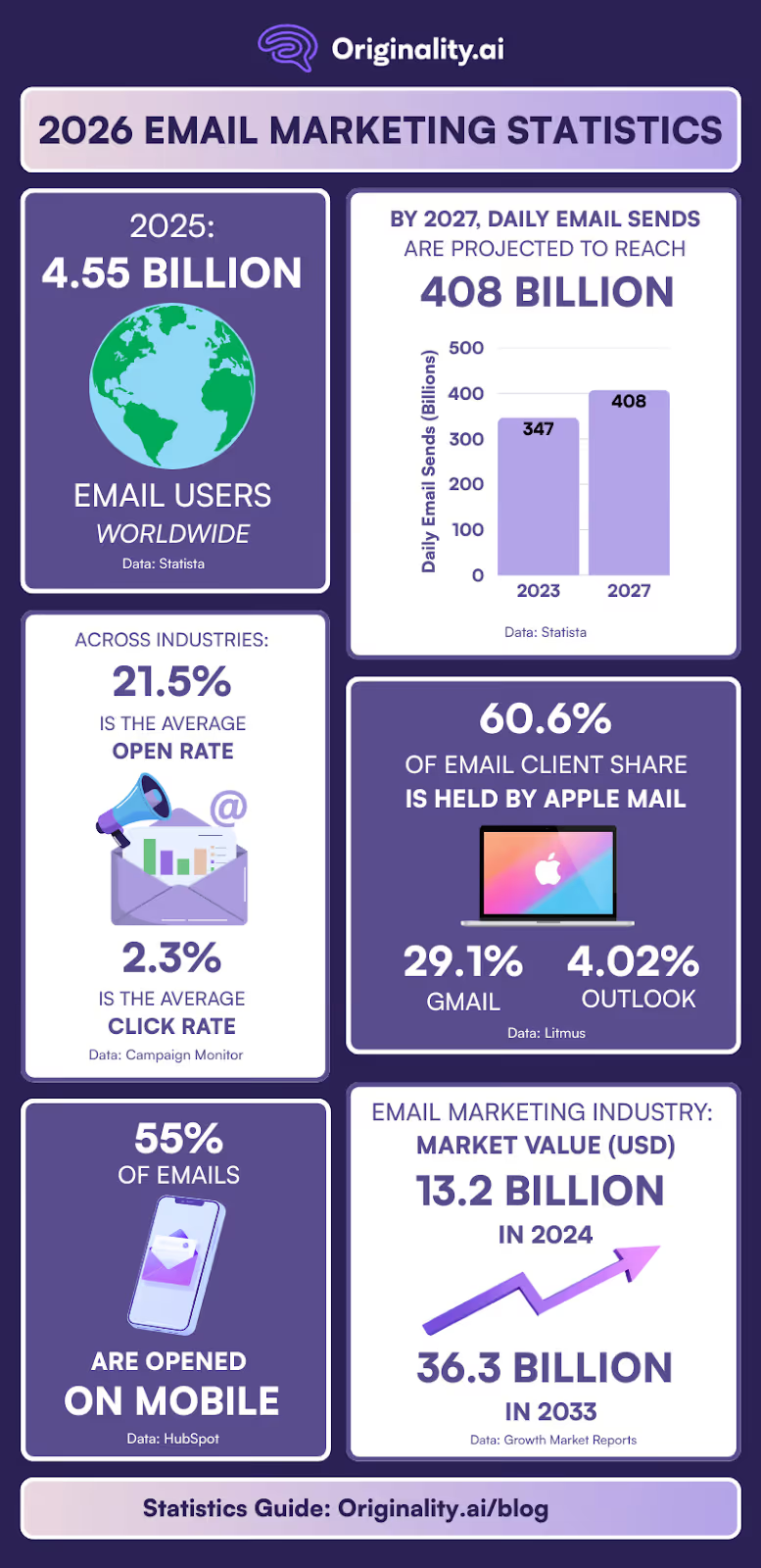
Email may be one of the oldest forms of online marketing communication, but it’s showing no signs of slowing down. If anything, it’s growing. Everything from banks to apps to subscriptions runs through email. The jump from 4.55 billion to 4.97 billion by 2028 would mean email is expected to grow by approximately 400 million+ users in just 3 years.
Source: Statista
Clever writing alone won’t cut it anymore. You need a strategy behind your segmentation, along with timing, mobile-first design, and a story readers can care about, especially considering that from 2023, that 347 billion daily email count is expected to reach 408 billion by 2027 (check out the statistic below).
Source: Statista
People are firing off tons of emails, and the number is only going to increase year after year. At the same time, inbox noise is getting louder. The answer is clearer emails that users feel compelled to open. Relevance beats frequency every time.
Source: Campaign Monitor
While the average open rate can fluctuate from industry to industry, if your open rates are in the range of the cross-industry average of 21.5%, it’s a good sign.
Source: Campaign Monitor
If your CTR is low, your message didn’t impact your audience the way you’d hoped. If your CTR is low, your call-to-action wasn’t compelling enough. These numbers will tell you exactly where the disconnect is. If your CTR is aligned with the average (or higher), it’s a good indicator that your email strategy is on the right track.
Source: HubSpot
People are browsing their emails while waiting in line, commuting, and shopping, especially considering that smartphones are so easily accessible. What does that mean for marketers? If your subject line is too long, your CTA is too small, or your design doesn’t load well on mobile, it could impact your email marketing campaigns.
Source: Litmus
This is the time when most people start to have caffeine in their system and are actively scanning for something worth their attention. Sending during this window alone could help to improve your open rate.
However, this can vary depending on the platform running the analysis. The CMO Club noted that 3 to 7 pm was the ideal send time for high engagement.
Source: TheCMO
Half of your subscribers will read your very first email. This is your handshake – your foot in the door. At this point, you set expectations, build trust, and bring them along on your journey.
Source: Adobe Business
Personalization is about much more than just putting someone’s name in the subject line. The right personalization tells your reader, “this will matter to you and here’s why. Show them that your message is worth it.
Source: Omnisend
Automations, done right, feel timely, relevant, and personal because they’re triggered by user behavior. We feel like a brand actually “sees” us when an email feels like a direct response.
Source: PowerDMARC
List cleaning and technical setup matter more than you think. You can write the best email in the world, but if your email lands in spam, it won’t get to see the spotlight. Monitoring delivery is a must.
Source: Litmus
Apple Mail stands out as one of the leading email platforms in 2025, with 60.6% of email client share. Gmail then follows up second with 29.1%, and Outlook comes in third with 4.02%.
Source: TheCMO
Consistency creates familiarity, but know your audience. Overdoing it is the fastest way to get them to hit “unsubscribe”. See what subscribers respond best to, because familiarity leads to trust, and trust leads to revenue.
Source: DemandSage
Nearly every email user accesses their inbox every day. That’s a loyalty that goes deeper than any algorithm or social feed. With email, your message isn’t fighting an algorithm or getting throttled based on engagement (or lack of it). Email is, in short, prime real estate.
Source: HubSpot
That means for B2C marketers, email is a highly effective way to communicate sales, promotions, and convert leads into customers.
Source: Litmus
The key takeaway here? Email marketing offers an excellent ROI. Email may not be as flashy as social, but it’s the quiet workhorse of marketing campaigns. When everything else fluctuates, email can give you predictable revenue.
Source: Hubspot
Segmentation makes your audience feel like your content was written just for them, and that’s part of what makes it convert so well.
Source: Omnisend
Why does automation work so well? Because automations are triggered by behavior, they meet people where they are, and not where marketers hope they are.
Your automated emails, from welcome messages to post-purchase, abandoned carts to onboarding, are your silent sales team. Optimize your automations, and revenue goes up without you needing to send a single extra email blast.
Source: Designmodo
Paid ads are expensive. Social media algorithms change. Email gives you the ownership and the inside track that every marketer dreams of, and with 42% describing it as their most effective channel, even ahead of social and paid search (with only 16% finding these the most effective), which means that putting an email marketing plan in place is a must.
Source: HubSpot
People want to hear from brands they actually care about, and with email, they’ve opted in to hear from you.
Source: Growth Market Reports
Email marketing keeps growing, simply because email continues to perform highly. When a channel grows at this speed, it means businesses are pouring money into it because it works. That means businesses that treat it as an integral part of their messaging will be the ones able to adapt the fastest.
Together, these email marketing statistics show a clear trajectory. Email may be old, but it’s still the backbone of marketing.
With 4.55 billion users and a 99% daily check-in rate, email is the channel everyone uses.
At the same time, 347+ billion emails sent and received every day means that mediocre, generic emails won’t survive. The inbox is getting louder, but so is the opportunity for brands who are ready to cut through the nonsense with strategies like:
What’s even more interesting is how quickly automation has become the new revenue engine. Automated flows now outperform campaigns by 332% in clicks, while driving 37% of all email revenue.
Yes, even as competition grows, email continues to reward the brands that really, truly connect with their people.
Wondering if an email you’re reading is real or Likely AI? Use the Originality.ai AI Checker to find out.
Further Reading:

AI & Plagiarism Detector for Serious Content Publishers
Originality.ai
64 Hurontario St
Collingwood, Ontario
L9Y 2L6