AI Checker
Plagiarism Checker
Grammar Checker
Content Quality
Guideline Checker
Readability Checker
Fact & AI Hallucination Checker

Extensions
MCP

In our latest study, Originality.ai classified at least one post as Likely AI or Mixed at 53 of 66 charities (80.3%). While YouGov found 47% of UK adults opposed AI-written charity web and social media content.
Following the surge of shopping for Black Friday and Cyber Monday, GivingTuesday aims to give back to communities globally, and is described as a “global generosity movement.”
This year, GivingTuesday falls on Tuesday, December 1, 2026.
There are several ways to participate in GivingTuesday, from volunteering to helping your community or neighbours to donating to a charity.
Yet, with so many charities to choose from, how do you choose which one you want to donate to? For many, it starts with researching the charity through their blog posts or articles.
However, what if the charity’s content is generated or assisted by AI? At Originality.ai, in this latest AI study, we’re studying whether charities are publishing AI-generated or AI-assisted/mixed human writing.
Plus, get insight into YouGov’s findings on what people in the UK think about charities’ AI use.
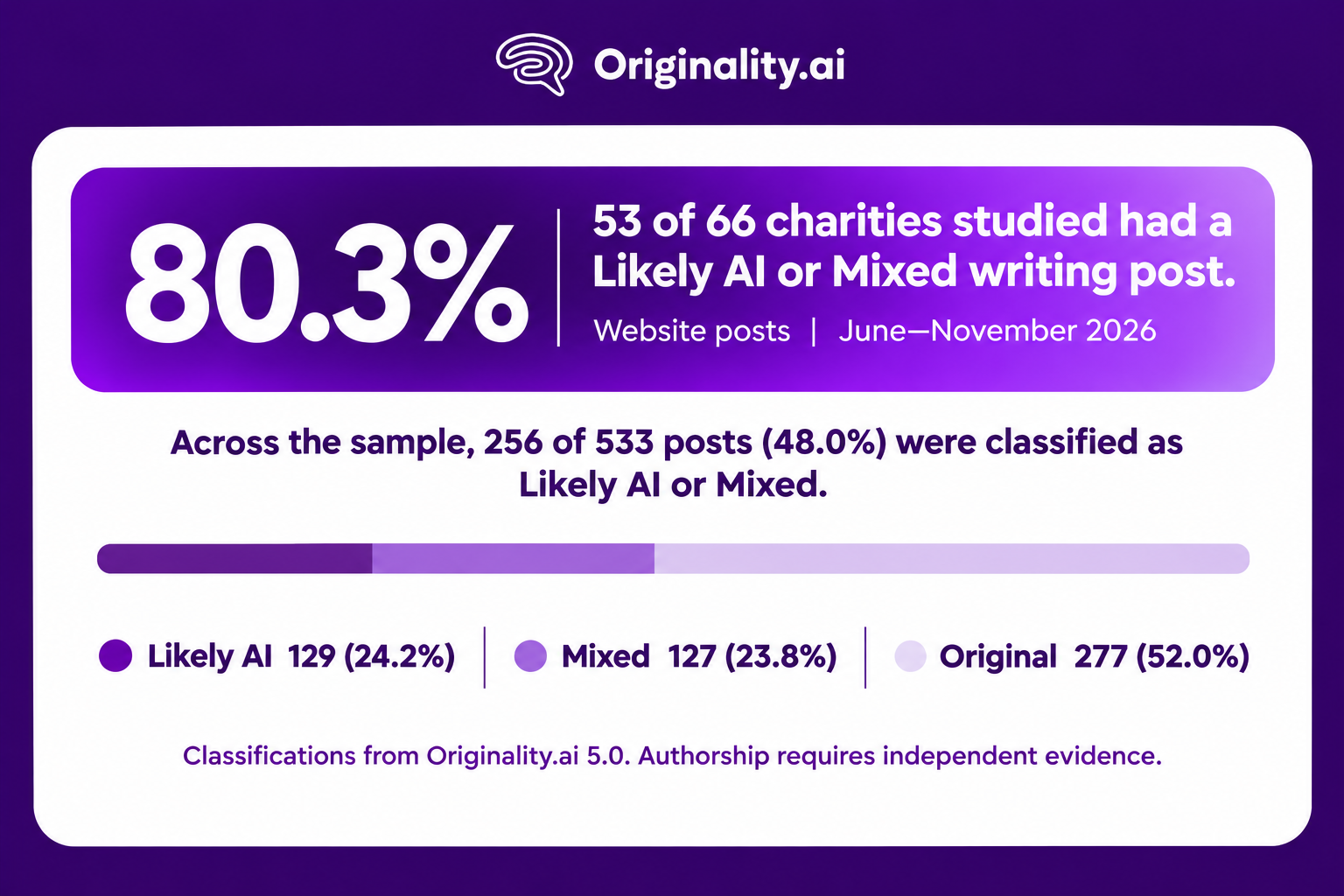
We found eligible posts at 66 of the 100 large registered charities we checked for this study, including universities and other institutions.
Across all 533 website posts, 256 (48.0%) were classified as Likely AI or Mixed.
Mixed writing indicates the model identified a mix of human and AI writing.
Originality.ai 5.0 identified:
The Likely AI classification alone appeared in at least one post at 37 of 66 charities (56.1%).
Still, authorship requires independent evidence; an AI score is a signal of probable AI use.
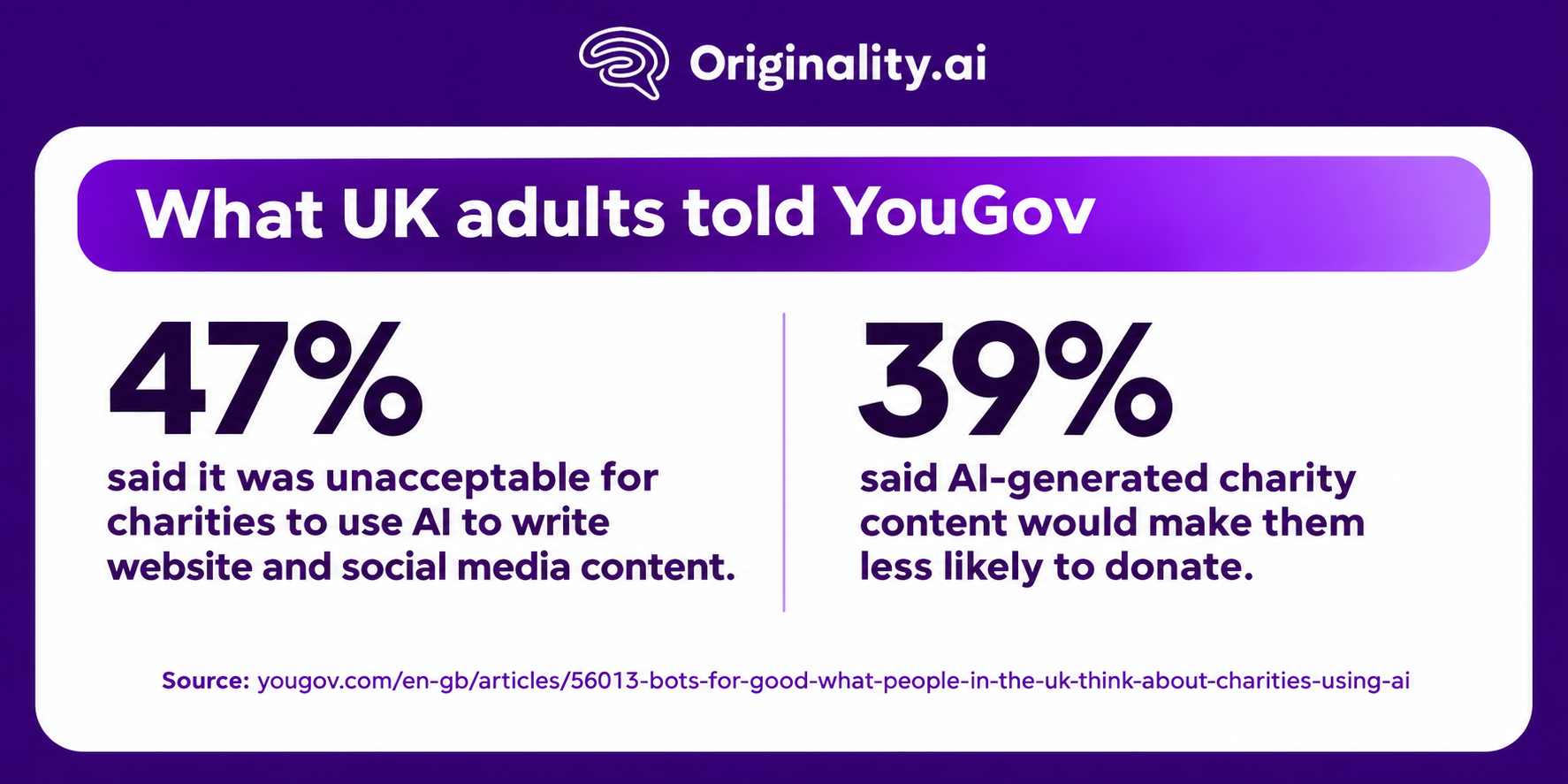
YouGov surveyed 2,097 UK adults in August 2026 and recently shared their findings.
They found that 39% of UK adults indicated that charity content generated by AI would make them less likely to donate.
Further, 47% said that it was “unacceptable” for charities to use AI when writing website content or posts for social media.
Based on our findings that 80.3% of the charities we studied probably used AI, this highlights a clear disconnect between how charities are likely using AI and sentiments around AI use.
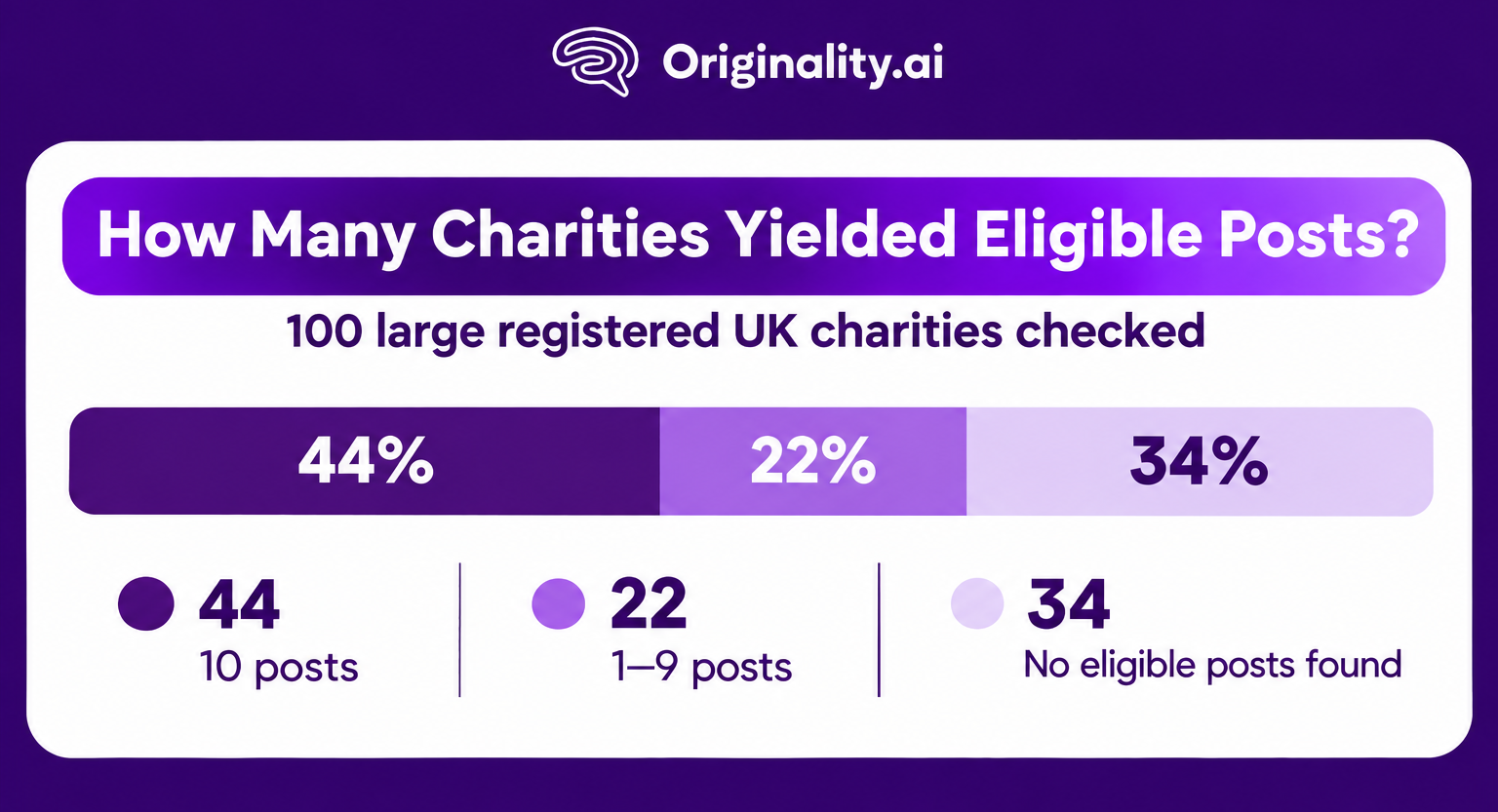
Our study researched 100 large registered UK charities. Of those, 66 had eligible posts for scanning.
Across that sample, for the 44 charities with 10 scored posts each:
Note: A charity with more scored posts had more opportunities to receive a Likely AI or Mixed classification.
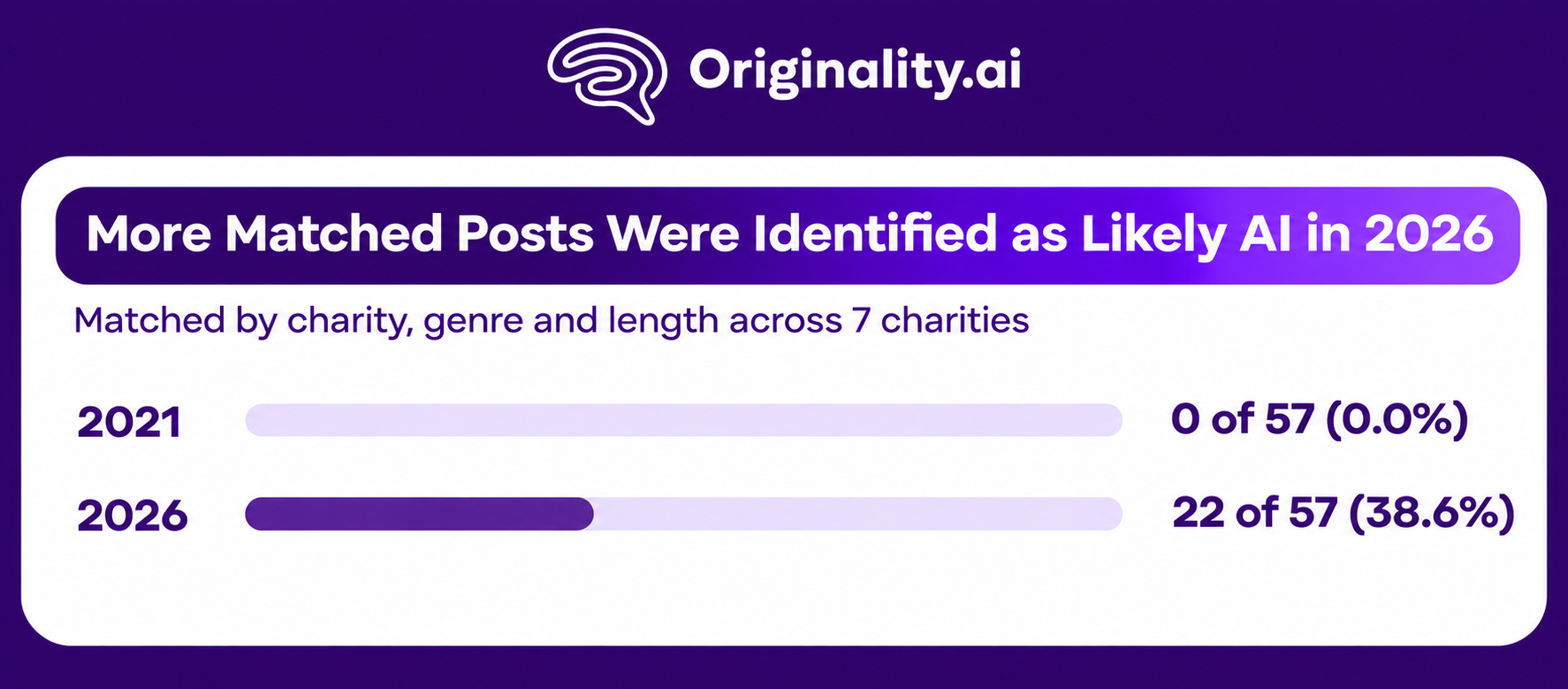
As part of this study, we also compared seven charities to see how the quantity of probable AI posts changed from 2021 to 2026.
The finding, even considering the relatively small sample size, was notable.
In 2021, 0% of the posts were Likely AI. Now compare that to 2026, with 38.6% of posts as Likely AI.
As GivingTuesday approaches and many are looking for ways to donate and give back to the community on a local and even global level, transparency around the content that is inspiring their donations is essential.
Those providing donations deserve to know whether the blogs, articles, and social posts they’re reading from charities are real or created by a probable LLM.
Learn more about the impact of AI in our studies:
We ranked active charities by latest reported annual income across the UK’s three charity registers and counted cross-registered charities once. We took up to ten of the newest English-language posts we could verify per charity, dated 1 June to 25 November 2026. Posts had at least 150 words after removing quotes and boilerplate. We removed duplicates and verified the saved API results.
Just 12 website posts asked for donations. A larger appeal sample would be needed to estimate AI use in fundraising copy.
Originality.ai ran the study, using the Originality.ai AI detector.

AI & Plagiarism Detector for Serious Content Publishers
Originality.ai
64 Hurontario St
Collingwood, Ontario
L9Y 2L6