AI Checker
Plagiarism Checker
Grammar Checker
Content Quality
Guideline Checker
Readability Checker
Fact & AI Hallucination Checker

Extensions
MCP

In our latest study, Originality.ai analyzed images from U.S. Facebook and Instagram ads across three Black Friday seasons.
Black Friday is one of the busiest shopping days every year. Adobe’s Holiday Shopping Trends report for 2026 projects that Black Friday shopping will reach $12.9 billion.
Even though Black Friday isn’t technically until Friday, November 27th in 2026, the sales have long since started.
With shoppers flooding websites looking for the best deals for their holiday shopping, and the increasing use of AI within marketing and ads, it raises the question: are the ads shoppers are basing their purchasing decisions on real or Likely AI?
We looked at ads launched in the same 15-day stretch before Black Friday each year (2024, 2025, and 2026) to see how common probable AI images had become.
Our finding? More than four in five images in our 2026 Black Friday ad sample showed signs of AI generation or editing.
Let’s take a closer look.
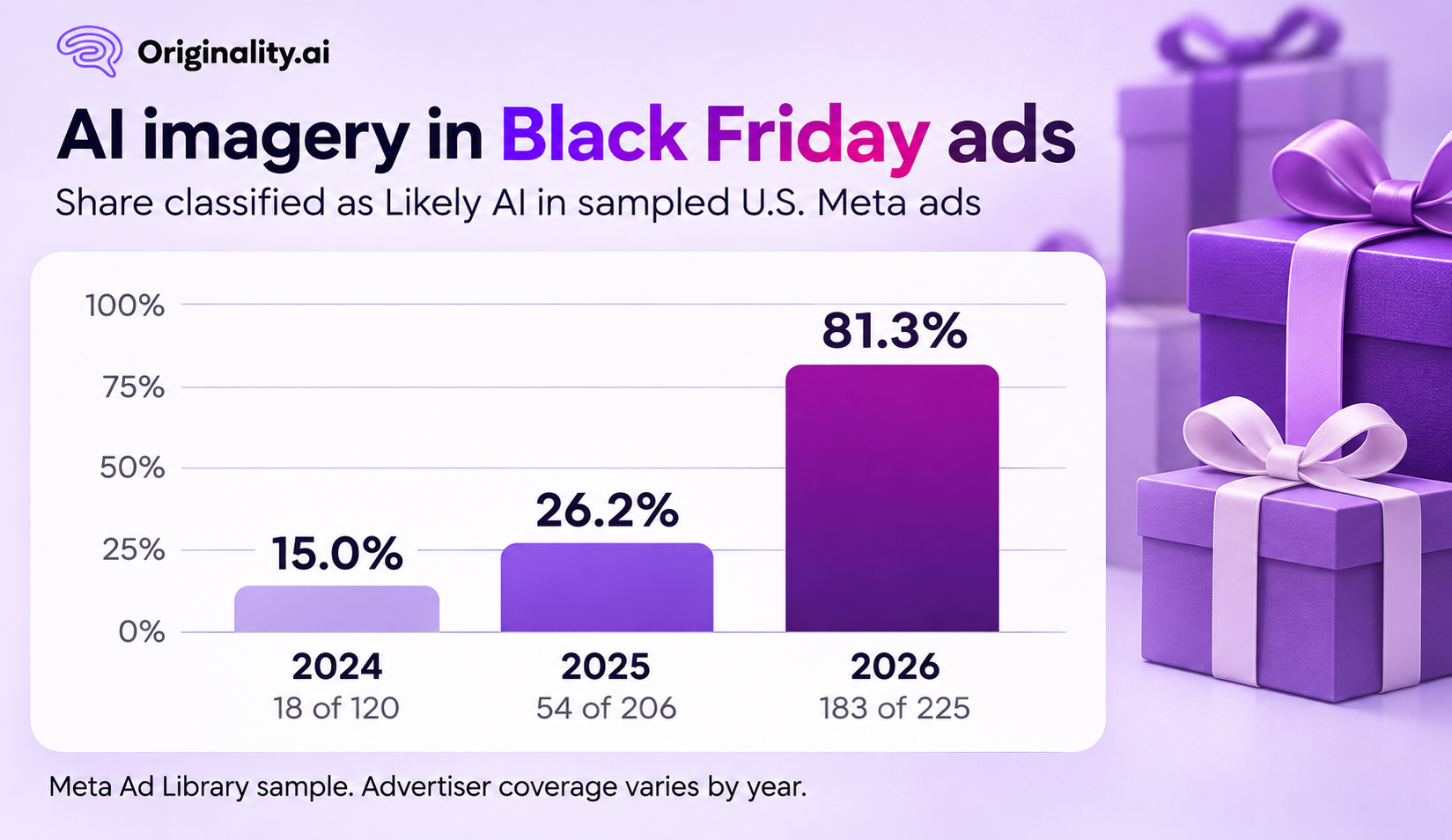
In 2024, Originality.ai classified 18 of 120 images (15.0%) as Likely AI.
That rate has only continued rising in the years since.
In 2025, the rate rose 11.2 percentage points, with 54 of 206 images (26.2%) classified as Likely AI.
This year, in 2026, the probable AI rate reached 81.3%, with 183 of 225 images flagged.
The two-year increase was 66.3 percentage points.
The 2026 sample contained 19 more images than in 2025, including 129 more classified as Likely AI.
Coca-Cola returned to live action for its new U.S. holiday commercial this November after two seasons of AI-generated holiday ads. Those earlier spots exceeded the company’s internal benchmarks and drew a mixed reaction from viewers, according to Marketing Dive.
AI is also becoming part of the everyday work of making ads. Nearly 10 million advertisers used at least one of Meta’s generative AI creative tools in the third quarter of 2026, the company said on its October earnings call.
The tools can generate variations on a product photo, changing the background or even the product shown, as TechCrunch reported when Meta introduced the feature.
That distinction matters in a Black Friday ad.
A generated image of a kitchen behind a coffee maker changes the setting.
However, consider a generated accessory beside it. For shoppers, this could imply that the accessory is part of their purchase. As a result, what the shopper expects to find in the box, and actually receives when they get their purchase, can notably differ.
When a sale ad doubles as a shopper’s first look at a product, details shape what they think they’re buying.
Meta has said that it was starting to roll out an “About this ad” panel with AI labels. It also said it would label ads when it detected signs they were created or edited with third-party AI tools. The labels are designed to give shoppers some context about how an ad was made, according to Meta’s ad transparency update.
The 2026 sample marks the clearest shift in the three seasons we studied.
Likely AI imagery was common whether we counted individual creatives, gave every advertiser page equal weight, or kept only ads from the keyword search.
For purchases this Black Friday and holiday season, shoppers can look for labels that indicate AI was used in the ad creation for transparency. However, keep in mind that not all websites require AI disclosure on ads.
Then, if you’re not quite sure if an ad you’re looking at is probably AI-generated, use the Originality.ai AI Image Detector, or if you’re reading ad copy or a product description, scan it with the Originality.ai AI Checker.
Read more about the impact of AI across industries:
Collection. We searched the Meta Ad Library for the exact phrase “Black Friday” with the country set to the United States. We included Facebook and Instagram ads with a single static image. We used the recorded launch date in UTC. The three windows ran from 18 days to four days before Black Friday, inclusive.
Deduplication. We excluded videos, carousels, and other multi-image creatives. If the same image appeared in multiple ads in a year, we counted it once. We kept repeated images in their respective years and reused the score for identical images that appeared in more than one season.
Detection. We analyzed the images using the detection model that powers Originality.ai’s Free AI Image Detector. We classified images with scores above 0.50 as Likely AI. All 551 sampled creatives scored successfully.

AI & Plagiarism Detector for Serious Content Publishers
Originality.ai
64 Hurontario St
Collingwood, Ontario
L9Y 2L6