AI Checker
Plagiarism Checker
Grammar Checker
Content Quality
Guideline Checker
Readability Checker
Fact & AI Hallucination Checker

Extensions
MCP

You post a carefully considered opinion, step away, and return to find that someone has appointed themselves the ChatGPT police. Suddenly, the conversation is about whether you wrote the thing at all.
Your argument, your experience, even your place in the discussion can come under suspicion.
But how much does a reply saying “you used ChatGPT” actually tell us?
Our team examined 1,000 publicly accused posts and comments on Reddit and Hacker News, matching each with a comparable text that had no observed accusation.
Originality.ai classified 62.6% of accused texts as Likely AI, compared with 10.5% of matched texts with no observed accusation. That’s roughly six times the rate.
The findings show a substantial connection between public suspicion and detector classifications. However, they don’t establish how often accusers correctly identified how someone wrote their post.
Note: The detector returned verdicts labeled Likely AI, Mixed, and Original. None of these classifications verifies authorship.
An accusation may be as simple as a few words.
Yet, understanding the writing process behind it takes more work.
The accusation alone may not distinguish between those situations.
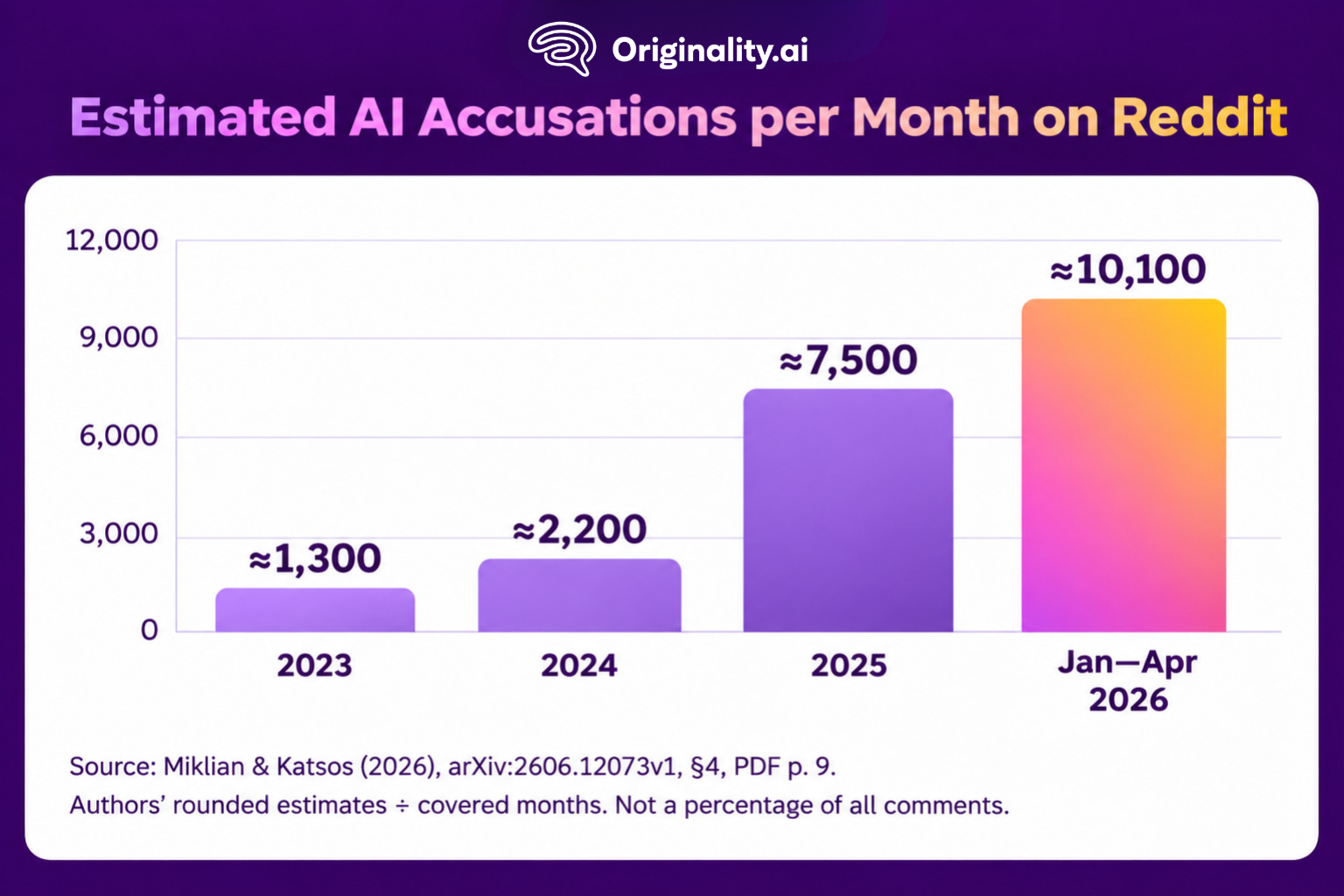
Meanwhile, earlier research suggests these exchanges have become increasingly common. A June 2026 preprint by Jason Miklian and John E. Katsos, “That’s AI Slop, You Bot!”, examined approximately 25 million comments.
Its estimates across 18 selected subreddits imply roughly 1,300 accusations per month in 2023, significantly rising to 10,100 per month during January–April 2026.
Our study asks a separate question:
How often does publicly accused writing receive a Likely AI classification compared with similar writing that attracted no observed accusation?
Let’s take a closer look.
Of the 1,000 accused texts, 626 received Likely AI classifications (62.6%). Among the 998 successfully scored comparisons, just 105 received the same classification (10.5%).
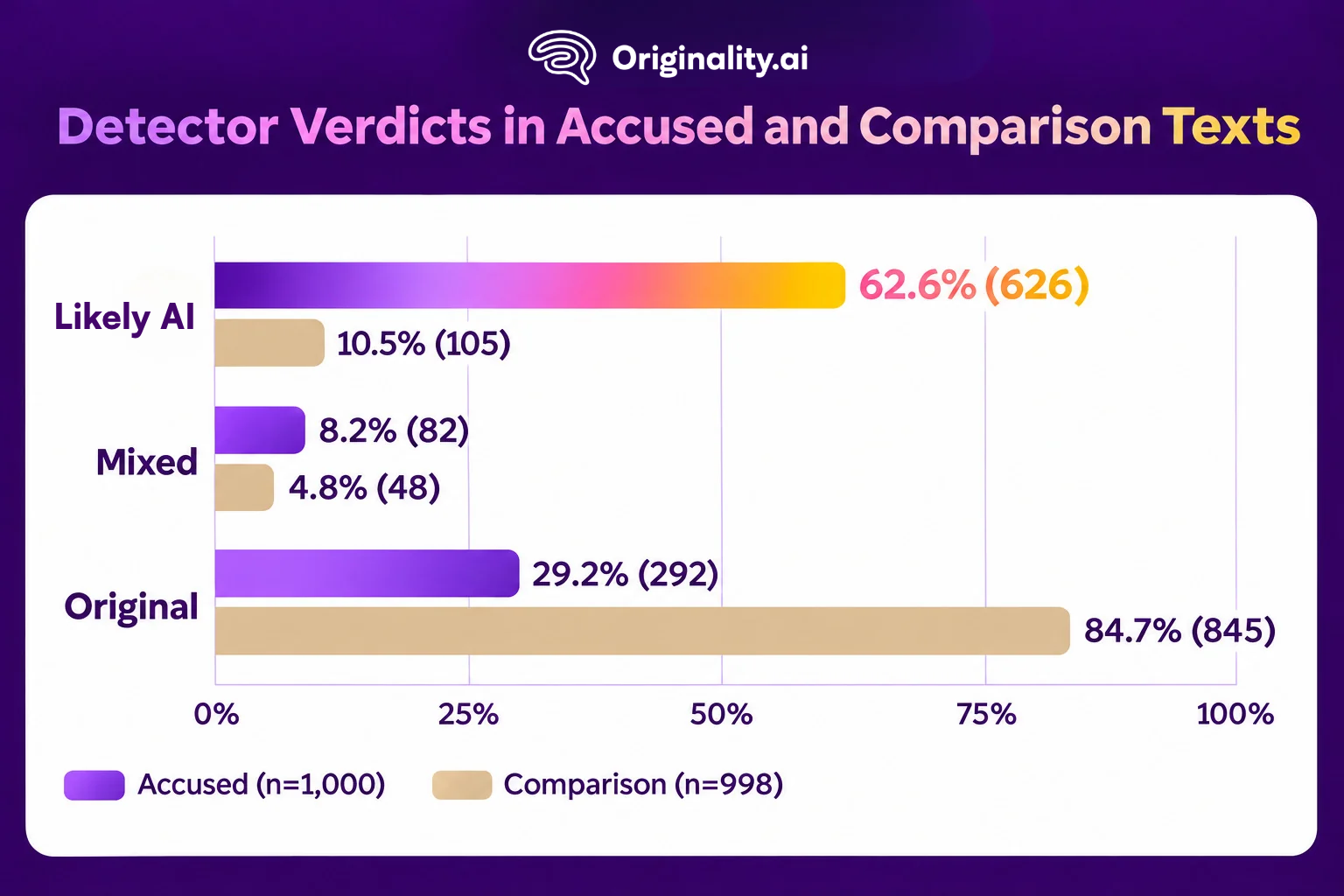
Within the 998 complete pairs, the difference was 52 percentage points.
Note: Two comparison texts could not be scored and were excluded from the comparison denominator. The comparison texts also should not be treated as verified human writing. We found no accusation in their retrieved replies, which does not establish how they were created.
So what do the 292 accused texts that were classified as Original indicate?
The 292 Original verdicts aren’t necessarily false accusations. A detector can miss AI involvement, just as it can flag human writing.
Further, the public exchanges also show why the details matter.
In one Hacker News discussion, an accused writer said they had used a tool only for translation, then shared Turkish text and another English rendering. The disputed 105-word comment received an Original verdict.
Another writer said they had written their comment themselves but used ChatGPT to adjust the opening paragraph’s grammar. That 241-word comment received a Likely AI classification.
Neither example provides an authenticated writing history.
What they do illustrate is how much can get bundled into the same accusation.
Learn more about false positives in AI detection.
Short replies leave a detector with less writing to examine.
So, we also checked whether the pattern remained when we focused on longer accused texts.
See a comparison of the Likely AI rates by minimum text lengths of 50, 100, and 150 words in the table below:
The finding? The association between accused texts and the Likely AI rate remained, even when we excluded shorter inputs.
We also removed pairs where the comparison text had no observed replies. Among the remaining 940 pairs, 578 accused texts received Likely AI classifications, compared with 96 comparison texts.
This check also helps address potential differences in the opportunity to attract an accusation based on the length of the post.
Note: These overlapping groups should not be read as evidence that length itself caused the higher rates.
Some accusers went a step beyond saying a post sounded like ChatGPT. They claimed a detector had flagged it.
Among 32 accusations citing an identifiable detector result, 26 disputed texts received Likely AI classifications from Originality.ai, or 81.3%. Among 965 accusations without a detector-result claim, the rate was 62.0%.
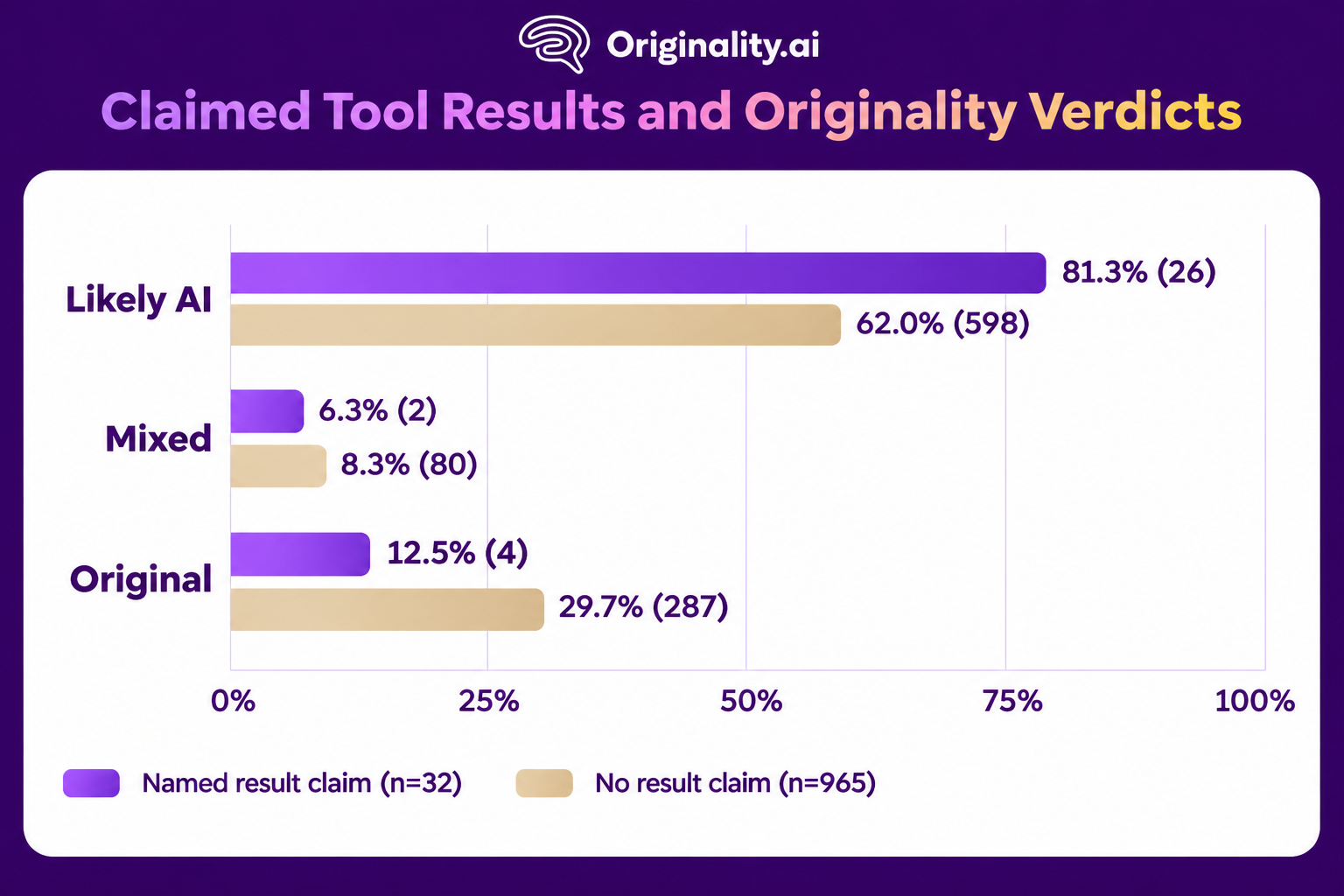
Three additional accusations claimed results from unnamed detectors and were analyzed separately.
Our detector classified 26 of those 32 passages as Likely AI (81.3%). With only 32 cases, a few different classifications would shift that percentage considerably.
We recorded the results accusers reported. We did not independently verify the scores they quoted, whether their screenshots were genuine, or whether they tested the same version of the passage we analyzed.
Agreement between detectors cannot establish who wrote a passage. Because our discovery process deliberately included detector names, these findings also cannot tell us how often forum accusers generally use detection tools.
Among accused comments, Reddit had a higher Likely AI rate (71.1%) than Hacker News (44.6%).
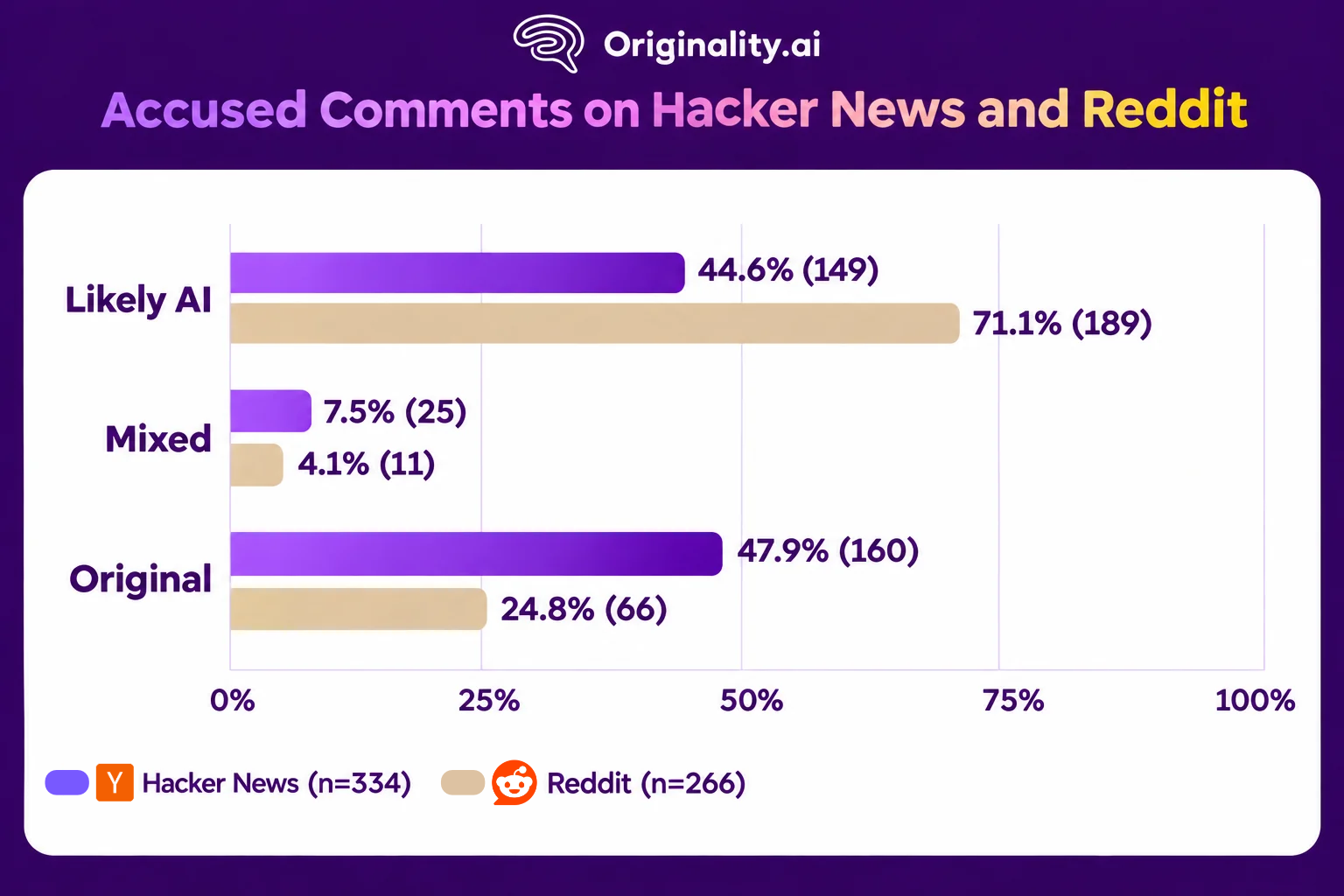
Reddit text posts are a separate content type and are shown separately from comments.
These differences do not establish that one community is better at identifying probable AI writing. Topics, text length, timing, community norms, and the ways we found examples may all influence the results.
A reply saying “you used ChatGPT” can change the entire conversation. The writer is suddenly defending the origin of their words as well as the argument behind them.
In our selected sample, accused texts were substantially more likely to receive Likely AI classifications than matched comparisons: 62.6% versus 10.5%.
That is a meaningful association, but it leaves an important question unanswered: What actually happened before the writer clicked “post”?
For readers and moderators, the findings support taking authorship concerns seriously while examining the context.
While a detector result can contribute evidence to that discussion, establishing someone’s writing process requires more.
Looking to maintain transparency about what you’re reading? Try the Originality.ai AI Detector.
Read more about the impact of AI:
Scope: English-language public texts dated January 1, 2023 through November 7, 2026 UTC, retrieved on November 8.
Sample: A search-discoverable convenience sample of 1,000 accused texts: 334 Hacker News comments, 266 Reddit comments, and 400 Reddit text posts. Texts contained at least 50 cleaned words, with priority given to texts of 100 words or more.
Eligibility: Accusations had to target an identifiable post or comment. We excluded generic discussion, unresolved targets, reproduced or predominantly quoted material, allegations about images, code or voice, and known automated detector notices.
Matching: Each accused text was paired with a comparison matched by platform, community, content type, and length stratum, within 30% of its cleaned word count. Of the 1,000 pairs, 973 matched calendar month and 485 came from the same discussion. The remaining 27 used adjacent months within 93 days. Text identities and pair assignments were frozen before detector outcomes were obtained.
Scoring: Originality.ai AI detection successfully scored all 1,000 accused texts and 998 comparisons. Two comparisons failed the minimum-word check and remained unscored. Reported percentages count texts receiving classifications, rather than the percentage of words generated.
Supporting data: Exact denominators, additional methodology, sensitivity checks, and prior-research chart inputs are available in the study workbook.
This study measures an association between public accusations and Originality.ai classifications in a selected sample. It does not measure how often accusations are correct, the prevalence of probable AI writing across either platform, or the frequency of accusations overall.
We did not have verified authorship records or authenticate anonymous account identities. Comparison screening may have missed accusations, and matching cannot eliminate all selection differences. False positives and missed AI involvement remain possible.
Originality.ai funded the study and supplied its own commercial detector. Codex performed collection, contextual coding, analysis, and writing. This article was drafted with AI assistance.

AI & Plagiarism Detector for Serious Content Publishers
Originality.ai
64 Hurontario St
Collingwood, Ontario
L9Y 2L6