AI Checker
Plagiarism Checker
Grammar Checker
Content Quality
Guideline Checker
Readability Checker
Fact & AI Hallucination Checker

Extensions
MCP

An Originality.ai study extension of 362 human, AI, and mixed documents
Hybrid AI-human workflows have become increasingly common.
A writer might draft a paragraph, ask ChatGPT to tighten it, rewrite half of what comes back, and delete the rest. Alternatively, a student may write a paper and then use AI only to refine grammar or spelling.
This raises a key question for editors, teachers, and others reviewing writing: how much of the essay, blog, or article was generated by AI?
Researchers at the Technical University of Darmstadt have helped bridge that gap. Their public dataset, AITDNA, records the writing process itself and provides a reference to compare against.
Originality.ai 5.0 AI scores show the percentage of AI in a document, helping users to identify whether text is Likely AI, Mixed Writing, or Original.
So, we ran all 362 of the AITDNA dataset through Originality.ai 5.0 to see how Originality.ai stacked up in this study extension. Let’s take a closer look at our findings.
AITDNA was introduced in the study “Your AI Text is not Mine” by Nils Dycke, Marina Sakharova, Nico Daheim and Iryna Gurevych of the UKP Lab at Technical University of Darmstadt, Germany.
The researchers recorded 99 writers’ edits and interactions with AI as they wrote essays and scientific texts, aiming for 350 to 450 words each.
Some people wrote without any help, while others wrote with an AI model, and the interface logged every insertion, deletion, prompt, and response. That history lets us identify the proportion of final text labeled as AI, or the recorded AI share.
We tested all 362 documents in the dataset:
Here’s how Originality.ai 5.0’s estimates lined up:
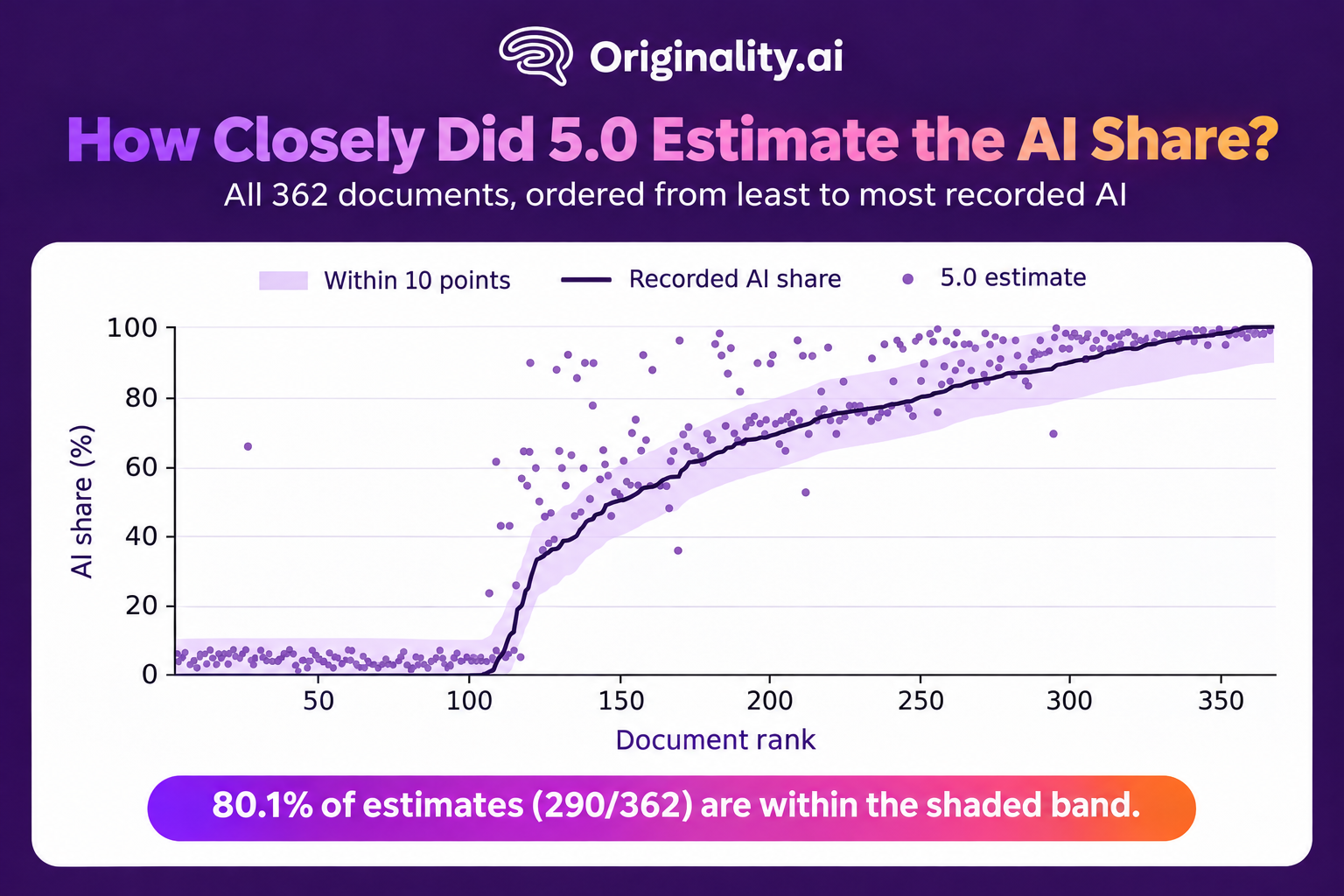
Each dot shows 5.0’s estimate for one document. The line shows recorded AI share, with documents ordered from least to most recorded AI. The shaded band marks a gap of no more than 10 percentage points.
The short answer? Close, on most documents.
Correlation describes how closely the estimates rise as recorded AI content increases.
A result close to 1 indicates a strong positive relationship; Originality.ai 5.0 scored 0.959.
Then, average absolute error answers a different question: how far apart were the two percentages? For example, an estimate of 50% against a recorded share of 40% is a 10-percentage-point error.
Across all documents, the average gap was 7.7 percentage points.
Four in five estimates (290 of 362, or 80.1%) were within 10 points of the recorded share.
Model note: The results reported here use Originality.ai 5.0. In a follow-up run on the same 362 documents, 5.0 Max improved most measures, such as a 6% lower average absolute error overall and 8% lower error on mixed content.
The percentage is only part of what you see in the scan, though. Originality.ai 5.0 also notes whether text is Likely AI, Mixed Writing, or Likely Original (human-written).
For a like-for-like count comparison, we grouped both the recorded shares and Originality.ai 5.0’s estimates using the same bands:
In the app, Originality.ai 5.0 shows these as Likely Original, Mixed Writing, and Likely AI.
As these are percentage bands, a Human classification can include a small amount of recorded AI text.
Scoring a fully human or fully AI document is one thing.
The 251 documents containing both human and AI text (or mixed writing) are the real test.
Within this group, correlation remained strong at 0.856 and average absolute error was 9.0 percentage points.
Nearly three-quarters of estimates—180 of 251, or 71.7%—were within 10 points of the recorded share.
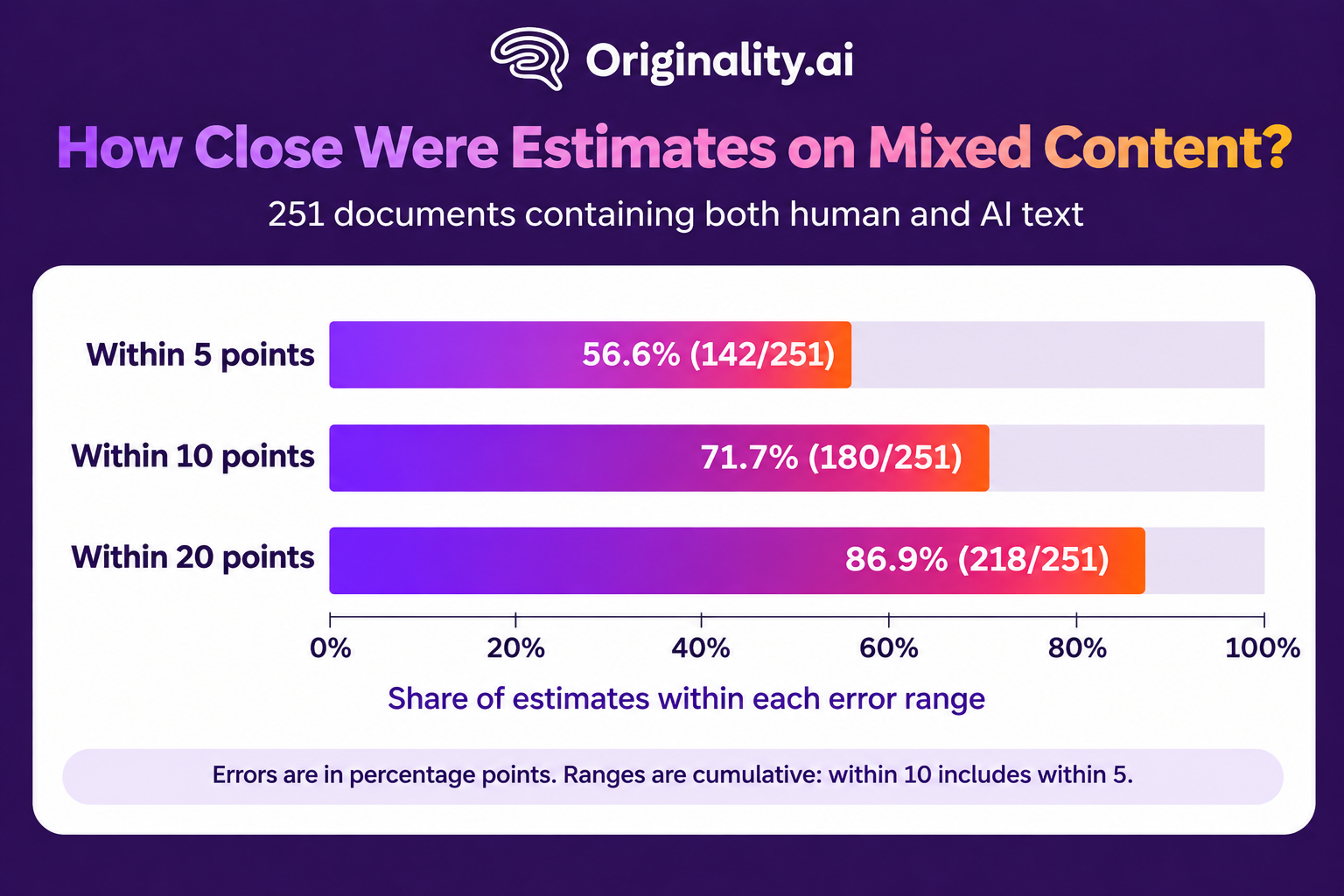
Estimates tended to run high, and the gap varied by AI share.
Average absolute error was 4.8 points for the 138 documents with 75% to under 100% recorded AI.
It reached 21.8 points for the 28 documents with 25% to under 50% recorded AI, where the average estimate was 61.8% against a recorded average of 40.2%.
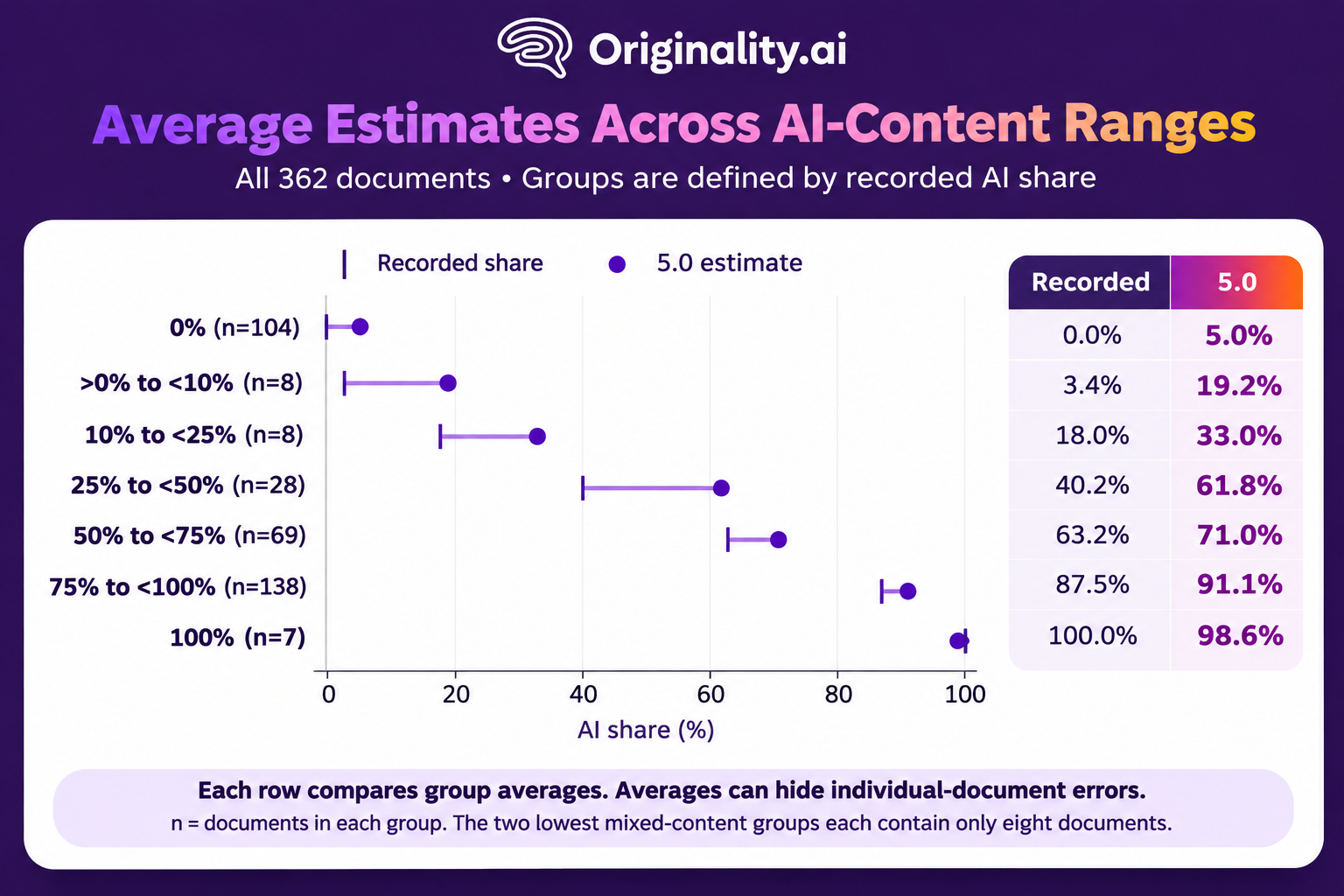
The markers compare group averages; their separation is not the same as mean absolute error.
Part of that upward gap may come down to definitions.
The upward gap raises a question: what counts as AI-written? The dataset uses a fair, reproducible definition based on recorded text origin. That can capture less than the broader idea of AI-assisted writing.
These are plausible reasons for part of the gap, not measured corrections.
All results above use the dataset’s original labels.
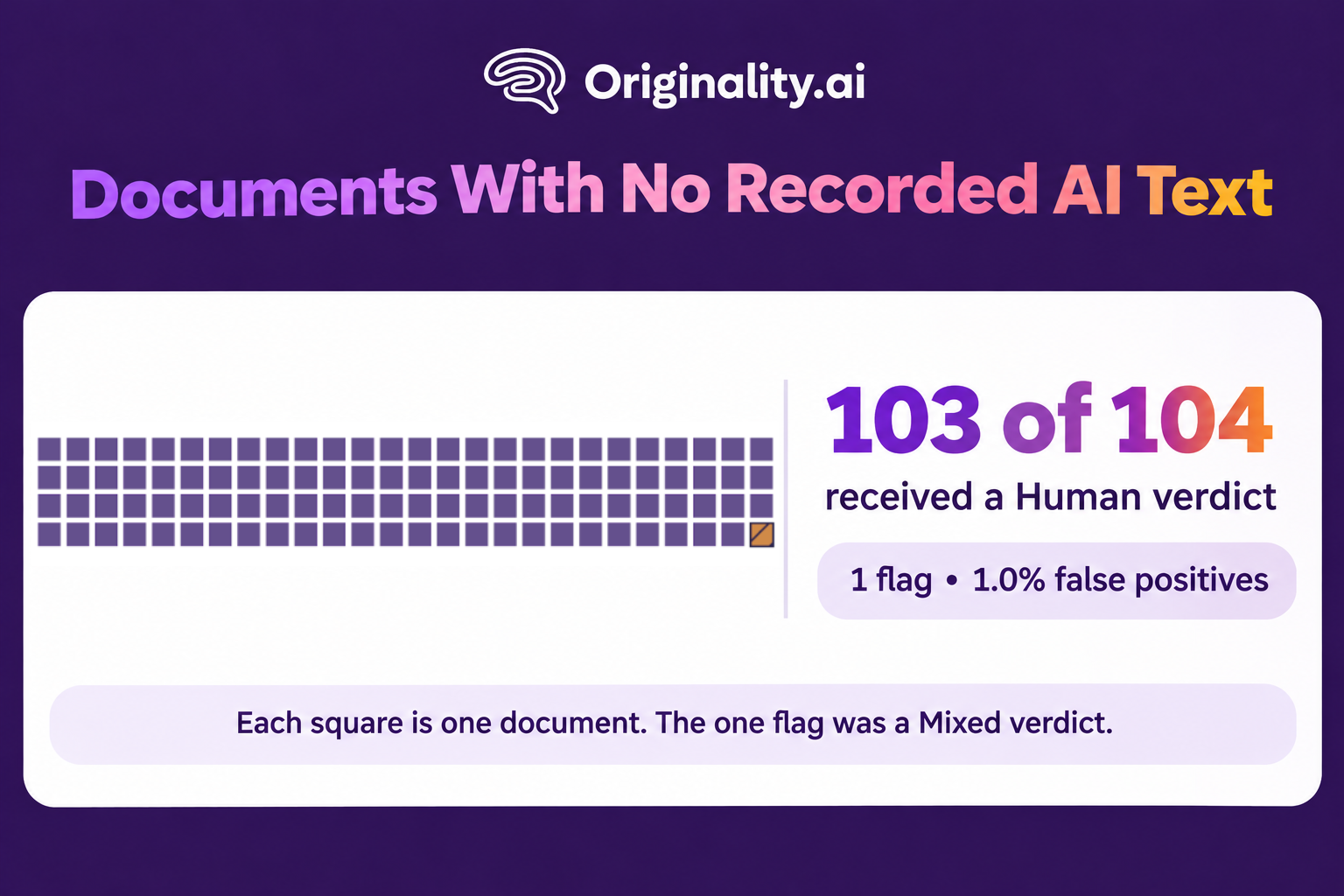
Of the 104 documents with no recorded AI text, 103 received a Human verdict, and one received a Mixed verdict.
This gives a 1.0% false-positive rate, rounded, on this zero-AI subset.
Note: The paper does not report Pangram or GPTZero’s rates for the same subset.
The AITDNA paper also evaluated eight open detectors and two commercial ones, Pangram and GPTZero.
We reconstructed its scoring rules to compare two detection tasks:
Both use F1, which balances how much AI text a detector finds with how reliable its flags are. Higher is better; 1.0 is perfect.
Originality.ai 5.0 recorded the highest sentence-detection F1 of these three results, a useful measure for locating AI within mixed writing.
Whole-document F1 placed 5.0 between Pangram and GPTZero.
These detection scores do not measure percentage-estimation error, so they cannot rank competitors against the 7.7-point result.
The central finding is that Originality.ai 5.0’s percentage estimate closely followed recorded AI content, including within mixed documents. Estimates were less precise in some lower-AI ranges.
For editors and teachers, the percentage provides a starting point for reviewing how much AI text a document may contain.
Like any AI score, it is a signal for review, not proof of authorship or misconduct, and sentence highlighting can show which passages to read first.
Try the Originality.ai AI Detector.
Read more about AI detection and AI detection accuracy:

AI & Plagiarism Detector for Serious Content Publishers
Originality.ai
64 Hurontario St
Collingwood, Ontario
L9Y 2L6