AI Checker
Plagiarism Checker
Grammar Checker
Content Quality
Guideline Checker
Readability Checker
Fact & AI Hallucination Checker

Extensions
MCP

Did Jaclyn Soroka really use AI to write dozens of pages of AI slop?
On Oct. 21, 2026, a three-judge panel in Florida made headlines for their scathing order against local lawyer Jaclyn Soroka. She had filed 82 confusing, unfocused pages of text—written, the judges believe, by AI—in an effort to defend herself against accusations that she’d previously used AI multiple times.
If that sounds confusing—by the sounds of it, her court filings were even worse.
“[Soroka] has filed an 82-page response that misses the point,” the judges wrote. “No competent attorney, much less one who holds herself out as board certified, should file a similar petition in an appellate court.”
The judges repeatedly called out Soroka for her “frivolous” filing, specifically citing erroneous interpretations of transcription typos and one seemingly hallucinated quotation as a citation from a previous court case. “Until AI, and until this case,” they wrote, “we never encountered lawyers ‘hallucinating’ non-existent quotations.”
Jaclyn Soroka, who has been a Florida Bar–certified specialist in marital and family law since 2020, denies that AI wrote her filing, though she doesn’t deny using AI in her practice.
So what’s the story? Did Soroka really use AI? And does it even matter if she did?
Although news outlets like Reuters are reporting on the potential AI slop associated with the case, AI slop is actually not what this court case was initially about.
The controversy stems from the Lisandrillo v. Palozzi case, a Florida family-law dispute between Lorie Jean Lisandrillo and Renee Palozzi involving their 10-year-old child. It has been a contentious and emotional situation for both parties.
In mid-2026, Soroka began representing Lisandrillo in the case. After being hired, Soroka spent the next several months submitting unusual filings (see docket entries for this case here).
The filings included a petition that contained “eight proceedings in one,” later described as a “red flag”:
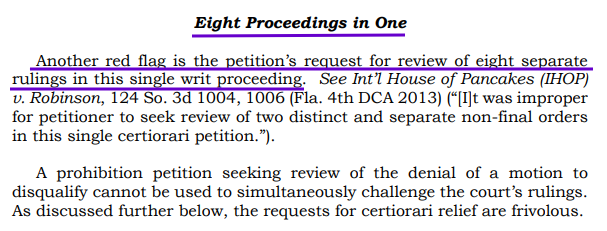
She also submitted multiple filings labelled “emergency” motions, which were also described as a “red flag,” in which “Counsel merely sought priority over other litigants, which is an abuse of procedure.”
Eventually, after several rejections, Soroka filed a motion to disqualify a judge from their case, to which the Sept 16th filing responded, “A judge cannot be disqualified based on AI-hallucinated events.”
After that request for disqualification was denied, Soroka filed a 61-page petition.
That was the last straw for the Florida appeals court, which, in the previously quoted Sept. 16th opinion/filing, denied her appeal request—and shifted into a whole new subject.
“We deny the extraordinary writ petition seeking review in this dissolution of marriage case,” the judges wrote, “and write solely to address counsel’s filing of what appears to be ‘AI slop.’”
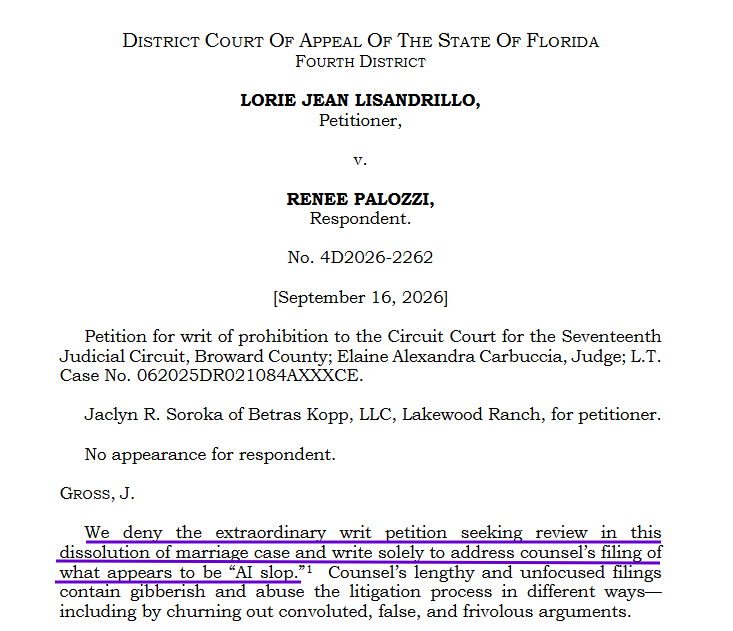
And so the entire conversation shifted away from Lisandrillo and Palozzi and towards Soroka herself. The judges slammed her filings as “voluminous” and “unfocused”, claiming they contained “gibberish” and “convoluted, false, and frivolous arguments.”
Soroka responded to the accusations, about a week later, with the defiant 82-page defence referenced at the top of this study.
At that point, the Florida judges essentially threw their arms up in the air and directed her to the Florida Bar association, asking them to deal with her.
At Originality.ai, we felt we could help shed light on whether Soroka probably used AI in her filings.
Using our latest AI detector, Originality.ai 5.0, we tested Soroka’s 82-page response to the court’s accusation, as well as a later 70-page response, and one publicly available excerpt from her filings, submitted before the judges publicly called her out for using AI.
All three were flagged as likely AI-generated—although none entirely so.
The samples scanned represent clean text, submitted by Soroka to the courts, which was publicly available, often recovered by quoting the appellate court or Soroka herself, who quoted the passages in later submissions. Since joining this court case, Soroka has submitted multiple documents that are not publicly available on the Florida courts’ website, limiting our dataset.
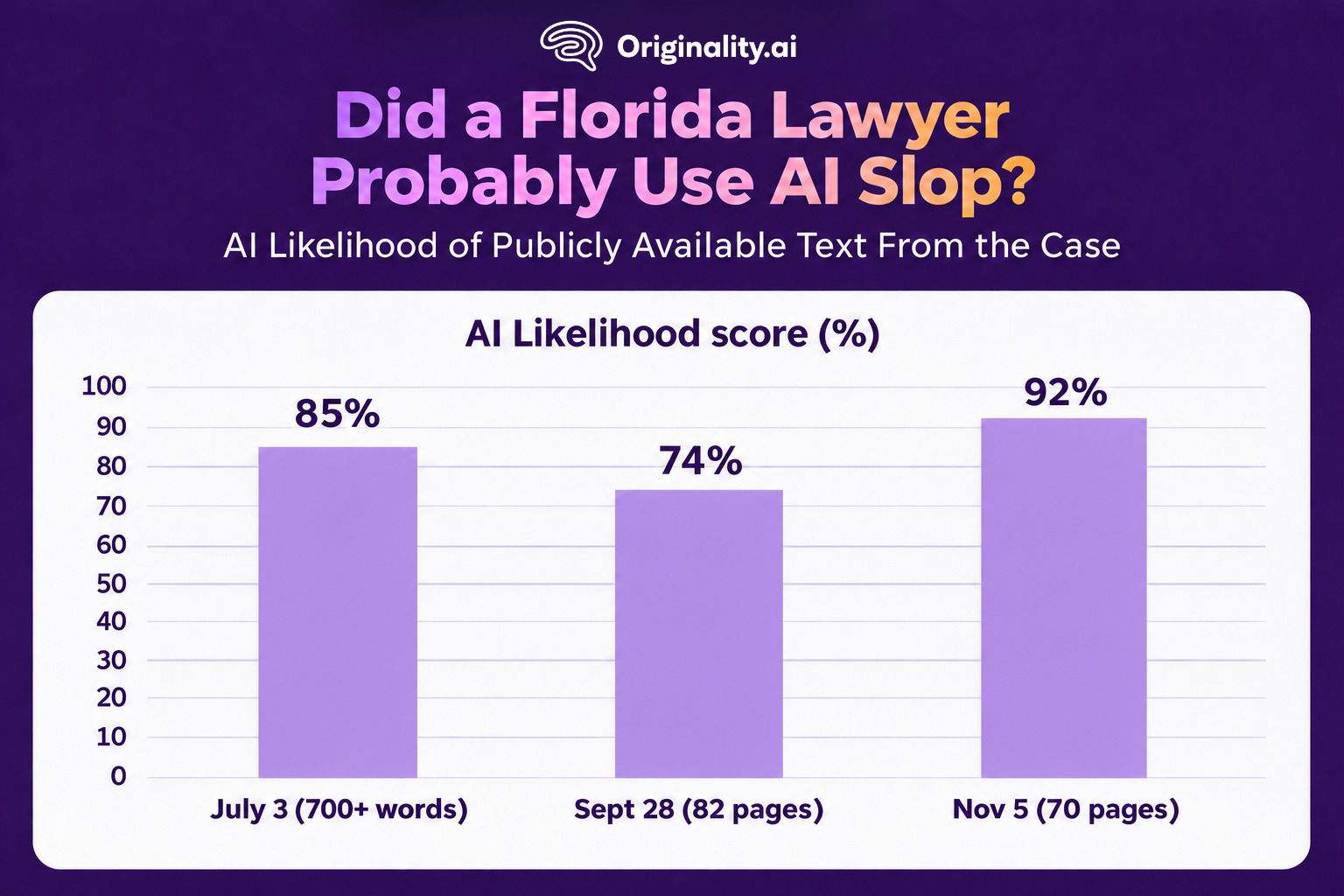
The full document from July 3, according to the appeals court, was 41 pages long, seeking to cancel an upcoming contempt hearing and requesting 13 forms of relief. The court reproduced the application’s complete “WHEREFORE” clause—the section specifying what Soroka wanted the judge to do—offering us 700+ words to scan for AI likelihood. While the sample was written in dense legalese, our model detected that it was 85% likely to be AI-generated. View the results of our scan here.
One of the most significant documents is her 82-page defence, submitted after the appeals court accused her of wantonly relying on AI slop. The document contained 19,000+ words.
The entire document was found to be 74% likely AI, on the high end of what Originality.ai considers a “mixed” result, blending human- and AI-generated text. You can read the verbatim document and see our results here.
In it, Soroka acknowledged she used AI, but defended her integrity:
I do not delegate the generation of a filing to artificial intelligence, to any tool, or to any other person; I have no associate, because my work product is mine, and its strategy, its judgment, and its words originate with me and pass through my experience, my practice, the circumstances, and the client. Technology assists me the way a computer or a telephone does, and to that extent it is welcome, but I would not trust a machine to do what I do not entrust to another human being, and I do not. Every word I file is a word I have read, judged, verified against its source, and adopted as my own, with the technological competence the same opinion requires. That is what it means to generate a filing: the judgment and the responsibility are the lawyer’s, and the filing is hers.
That entire section was flagged as 100% Likely AI-generated.
That 82-page document led to the appeals court referring her to the Florida Bar—but Soroka didn’t stop there. She filed another response, this time around 70 pages (14,000+ words), asking for the court to withdraw its opinion and rehear her case. That document wound up scoring highest with our AI detector: 92% Likely AI. (View the results here.)
Despite the AI likelihood scores, the passage above is broadly accurate: lawyers can use AI as a tool, the same way they use computers, phones, and other pieces of technology.
The Florida Bar explicitly permits using AI, with predictable conditions about authorship and accountability.
Human lawyers must remain responsible for their work, verify their filings, and not delegate tasks that require a professional lawyer’s personal judgment. The judges who chastised Soroka did not call her out for using AI—they specifically accused her of filing frivolous “AI slop”.
Even before AI, it was not uncommon for lawyers to “bury” their opponents in paperwork. On-screen legal dramas often feature scenes wherein stacks of boxes are dumped on the desks of small-town, independent lawyers who are unable to make sense of it. In the ChatGPT era, burying someone in AI slop paperwork could become a genuine concern—and a more frequent tactic.
Lisandrillo v. Palozzi remains unresolved. See the case docket for the latest entries.
We analyzed three samples attributable to Jaclyn R. Soroka in Lisandrillo v. Palozzi, Florida Fourth District Court of Appeal case No. 4D2026-2262.
The primary documents were Soroka’s complete response to the Sept. 16 order to show cause and her Nov. 5 filing asking to reconsider the matter, both of which contained searchable text that was extracted and scanned using Originality.ai 5.0.
We also tested one pre-accusation excerpt reproduced verbatim in public court materials: the complete “WHEREFORE” section of the Urgent Omnibus Application, filed on July 3, 2026, which is approximately 700+ words.
AI-detection scores are probabilistic indicators, not proof that a particular person used artificial intelligence.
Math Papers on arXiv are rapidly increasing. In our latest update, Originality.ai found: from October 2025 to October 2026, there was a 115.5% surge in new papers. Further, nearly 1 in 4 sampled abstracts showed signs of probable AI writing.

AI & Plagiarism Detector for Serious Content Publishers
Originality.ai
64 Hurontario St
Collingwood, Ontario
L9Y 2L6