AI Checker
Plagiarism Checker
Grammar Checker
Content Quality
Guideline Checker
Readability Checker
Fact & AI Hallucination Checker

Extensions
MCP

Track how much long-form written content published online in September 2026 was Likely AI in this study that explores AI’s impact on the Dead Internet theory.
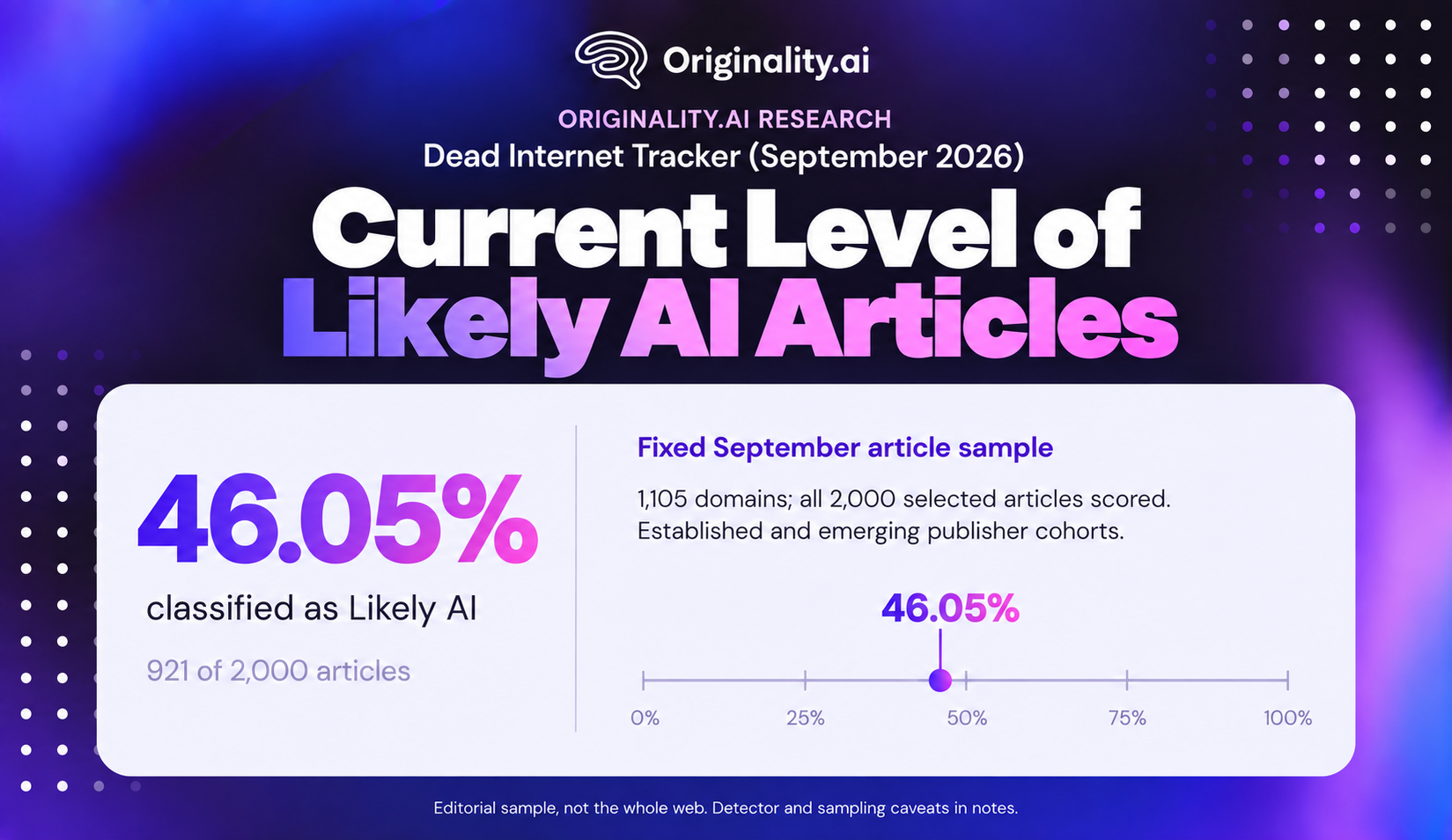
The proportion of long-form AI-generated editorial content published online has remained remarkably consistent throughout 2026, where it has hovered just below the 50% threshold.
Originality.ai examined 2,000 randomly selected long-form English-language articles published to the editorial web across 1,105 unique domains and captured by Common Crawl in the month of September. The analysis ultimately found that 921, or 46.05%, were Likely AI.
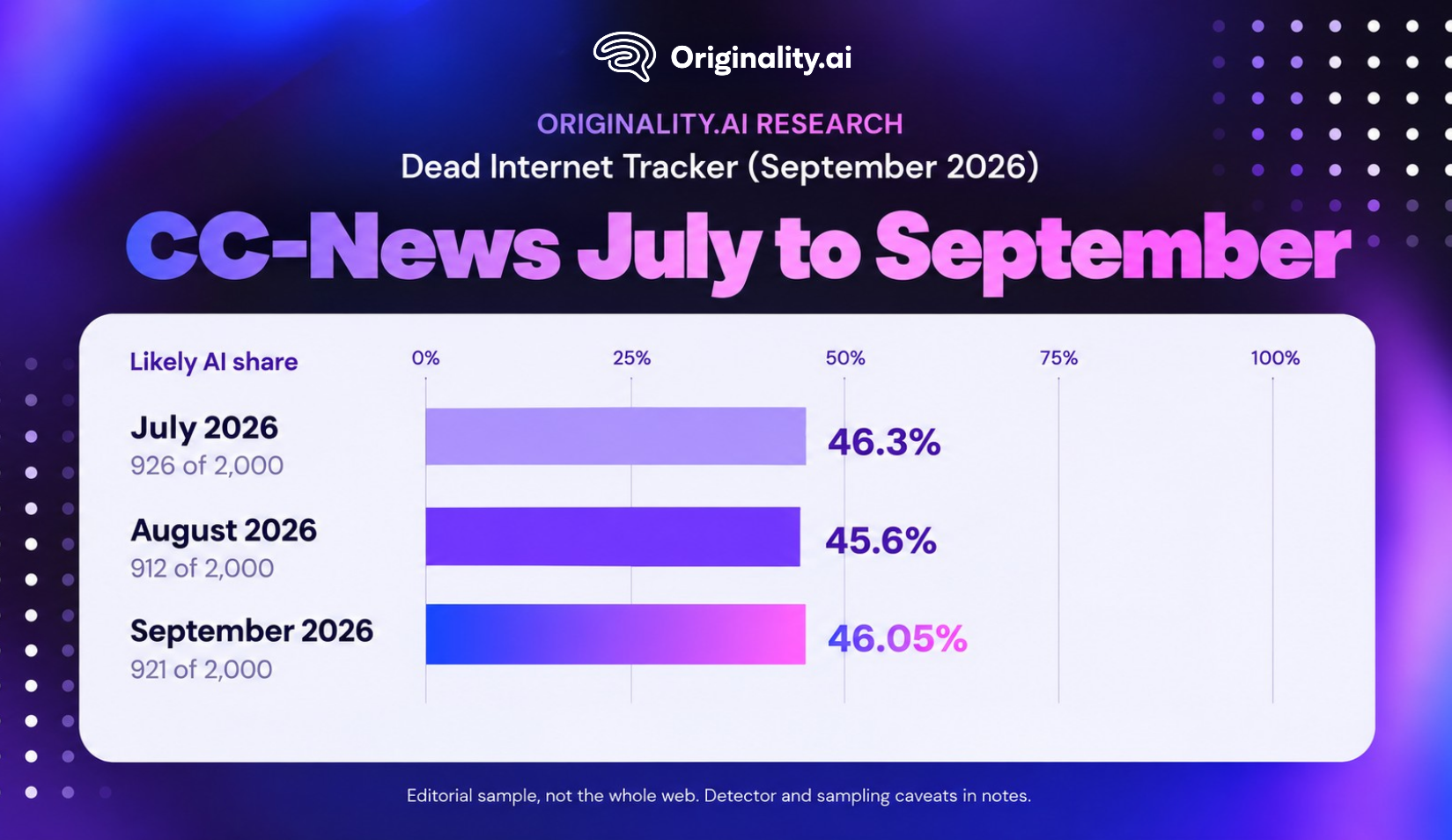
The latest reading is almost identical to August’s 45.6% and July’s 46.3%. In fact, our analysis of Common Crawl articles published in 2026 has returned remarkably consistent results, with all monthly readings landing between 40% and 47%.
By contrast, our historical analysis of 148,000 articles published online starting in July 2020 demonstrates a sharp rise in likely AI content following the launch of ChatGPT in late 2022, before this year’s plateau.
While we previously speculated that online content would soon tip over the 50% threshold, a slight majority of online articles remain mostly human-written, at least for now.
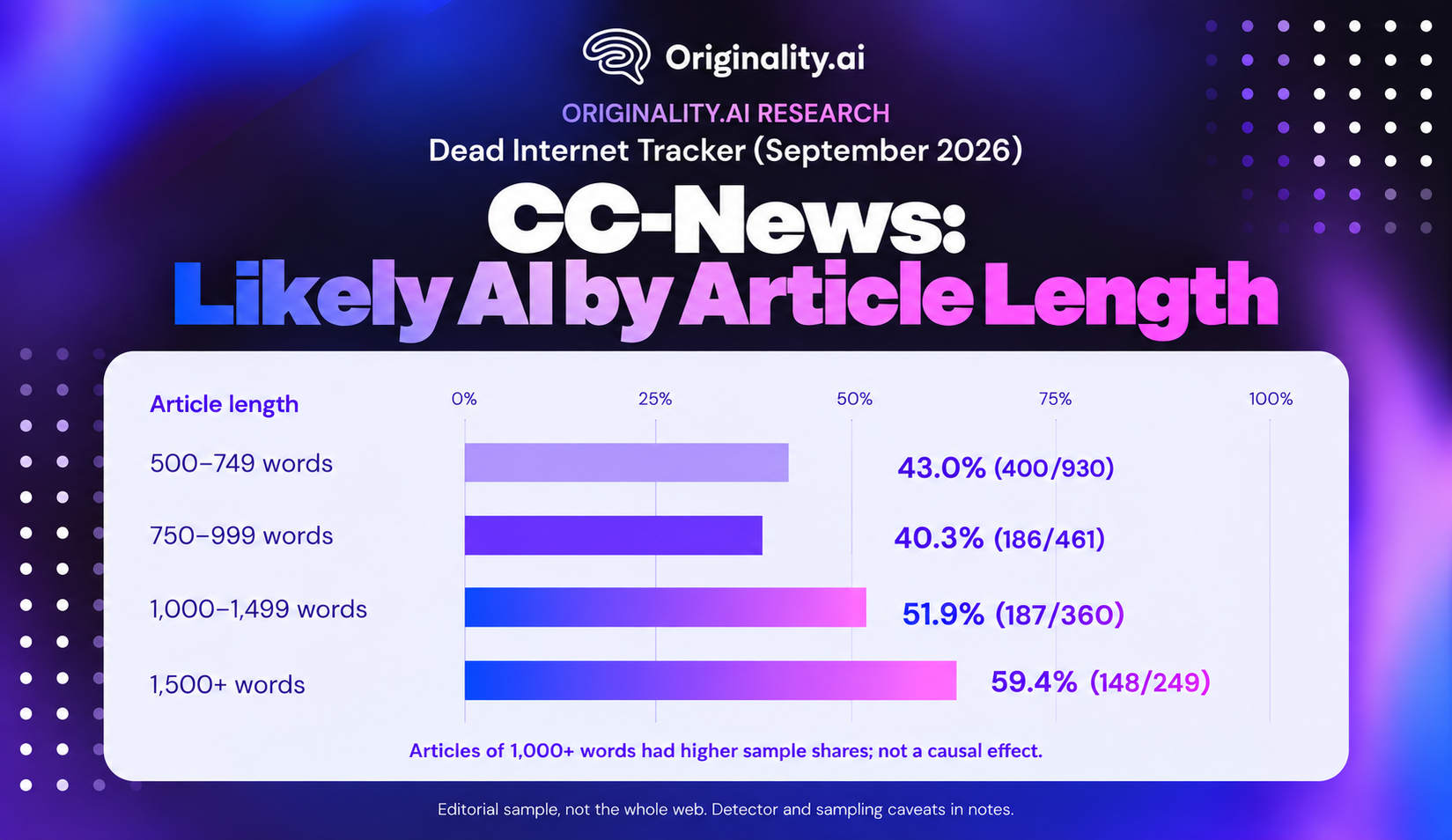
As in previous months, article length remains a generally strong predictor of likely-AI content, with one exception. Unlike previous months, articles of 500-749 words (43%) were slightly more likely to be generated than those of 750 to 999 words (40%).
However, articles of 1,500 words or longer (59%) are still the most likely to be AI-generated, followed by those of 1,000 to 1,499 words (52%), consistent with prior analyses.
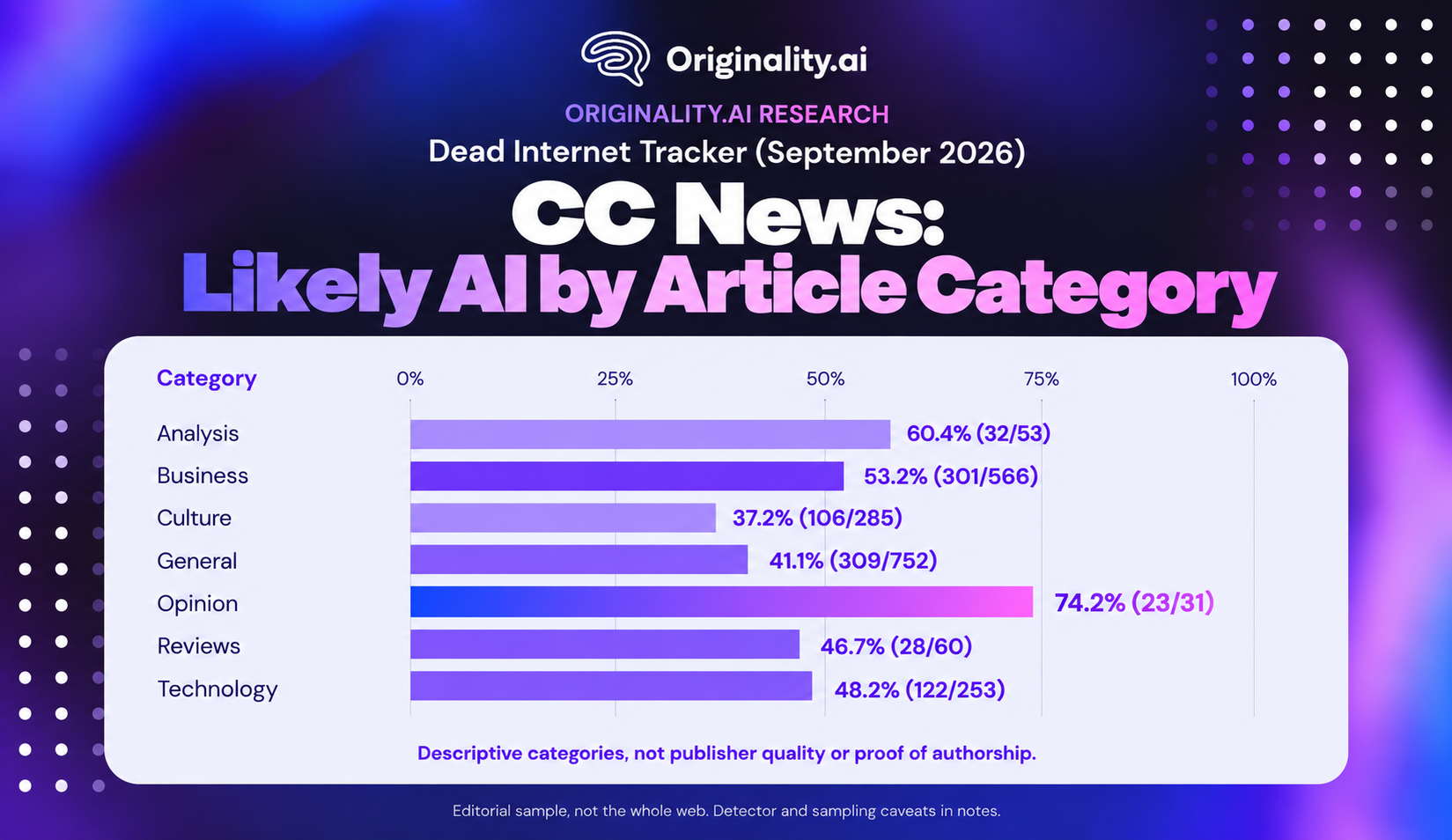
Nearly three-quarters of opinion articles published in September were likely AI-generated, up from 50% in August, continuing the sharp rise we’ve witnessed in this category in recent months.
Opinion articles are now the biggest hotbeds of likely AI content by a sizable margin, leading the next category, analysis, by 14%. Coming in third was business, where 53% of articles were likely AI-generated. All other categories remain below the 50% threshold, though Technology (48%) and Reviews (47%) aren’t far behind.
Culture (37%) and general (41%) articles remain at the bottom end of our analysis, as seen in previous months.
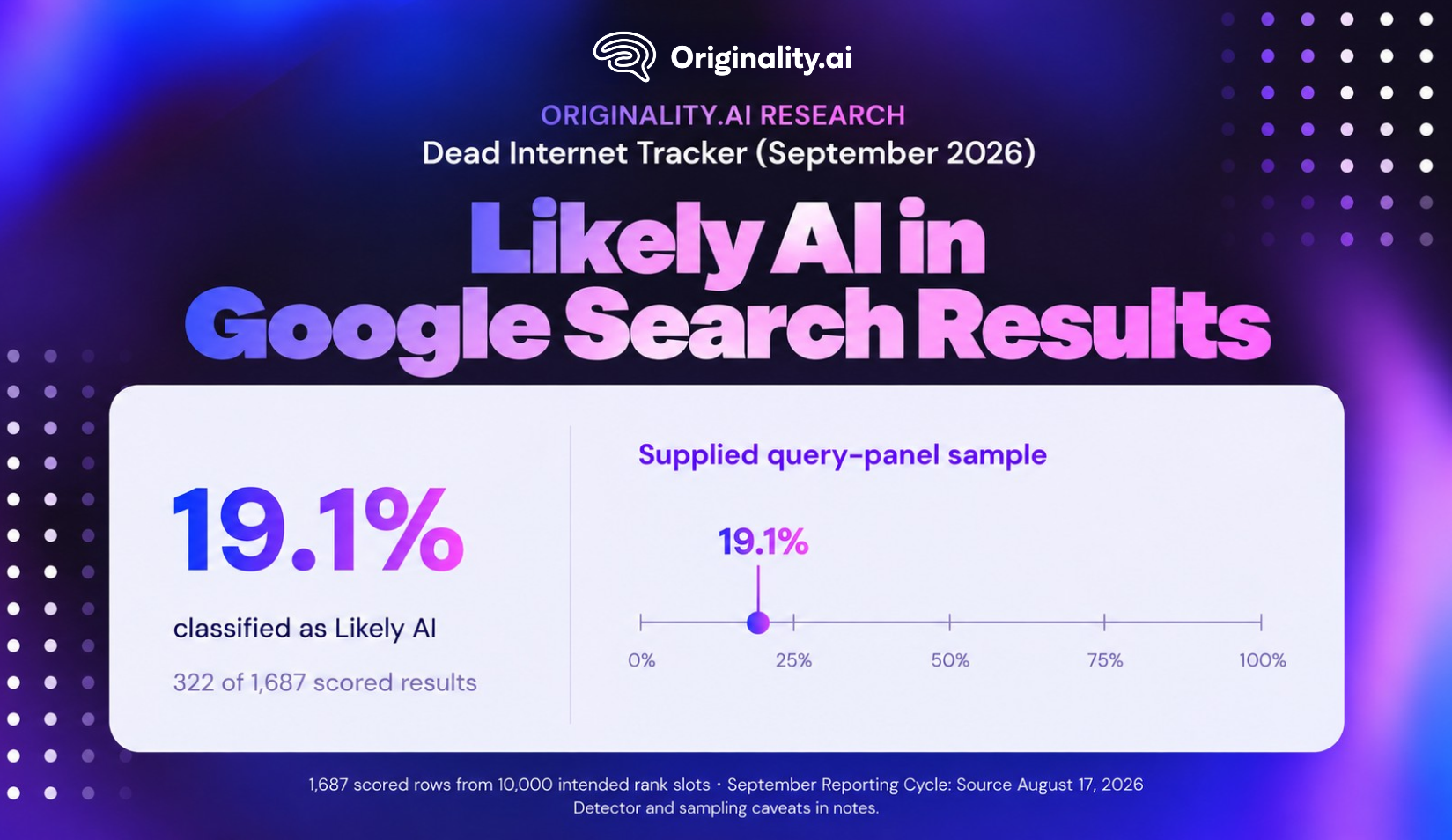
Originality.ai examined 1,687 of the top 20 Google search results for a panel of 500 informational queries created by Semrush on August 17, 2026, and found that 322, or 19.1%, were Likely AI.
This represents a 2.5% decrease since our last analysis on July 11, in which 21.6% of the top 20 search results were Likely AI.
The findings suggest that Google has done an effective job in filtering out AI-generated content, as the top search results contain less than half the proportion of likely AI content compared with our Common Crawl analysis.
Even with that higher bar, Google search results are much less likely to be AI-generated than the average long-form article.
However, the findings still suggest that nearly one-fifth of the top search results to common queries are likely AI-generated, or about four of the top 20 results.
Read July and August’s Dead Internet Tracker Reports:
Methodology Note:
Furthermore, while we only qualified written articles that are at least 15% AI-generated as likely AI for this report, we reduced the allowance to just 5% among Google search results. Note: This analysis was conducted on a previous model. To learn more about our latest AI detection model, visit Originality.ai 5.0.

AI & Plagiarism Detector for Serious Content Publishers
Originality.ai
64 Hurontario St
Collingwood, Ontario
L9Y 2L6