AI Checker
Plagiarism Checker
Grammar Checker
Content Quality
Guideline Checker
Readability Checker
Fact Checker

Extensions

Dead Internet Tracker Report: August 2026
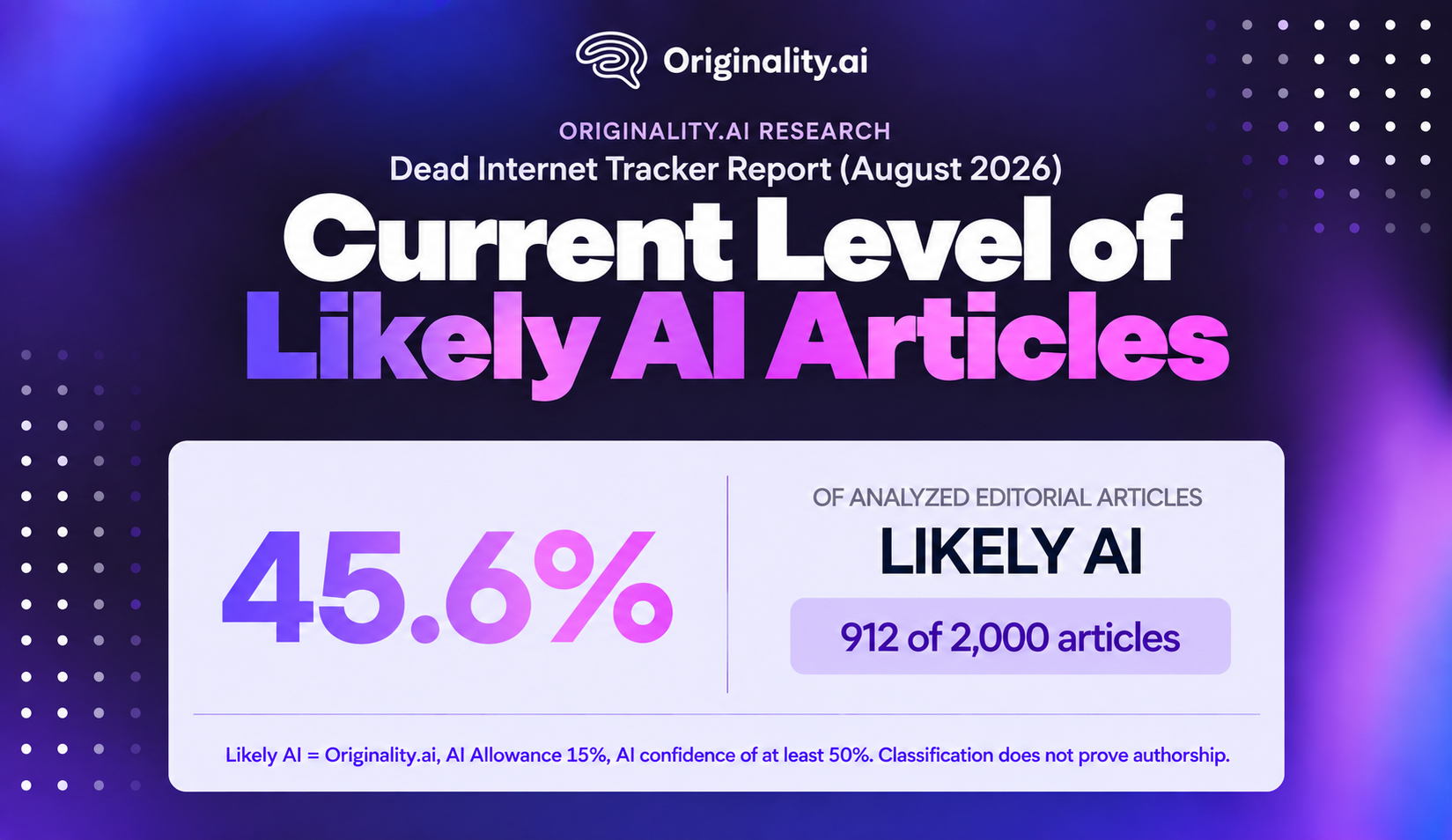
The written internet took a small step back from tipping over the 50% threshold in August but continues to teeter close to the edge.
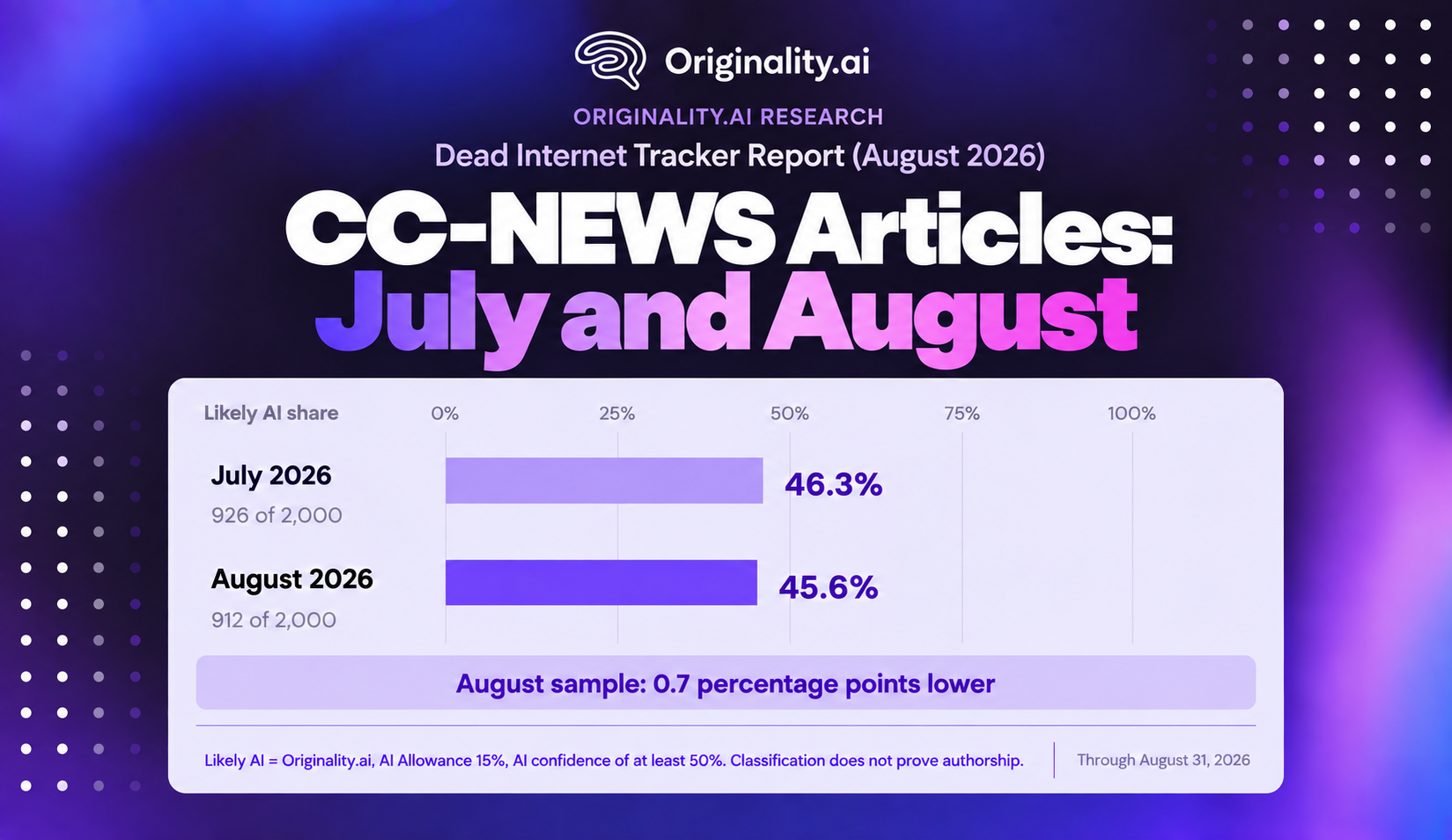
According to Originality.ai’s analysis of 2,000 randomly selected online articles published in August and captured by Common Crawl — a free, online repository of all publicly available internet content — 912, or 45.6%, were more likely than not at least 15% AI-generated.
The finding demonstrates a slight, 0.7% decrease in AI-generated content compared with July, wherein 46.3% of articles were likely to be AI-generated.
Despite the slight overall decline, every article category saw an increase in AI-generated content as compared with 2026 averages, including significant jumps among opinion and essay articles and longer-form articles.
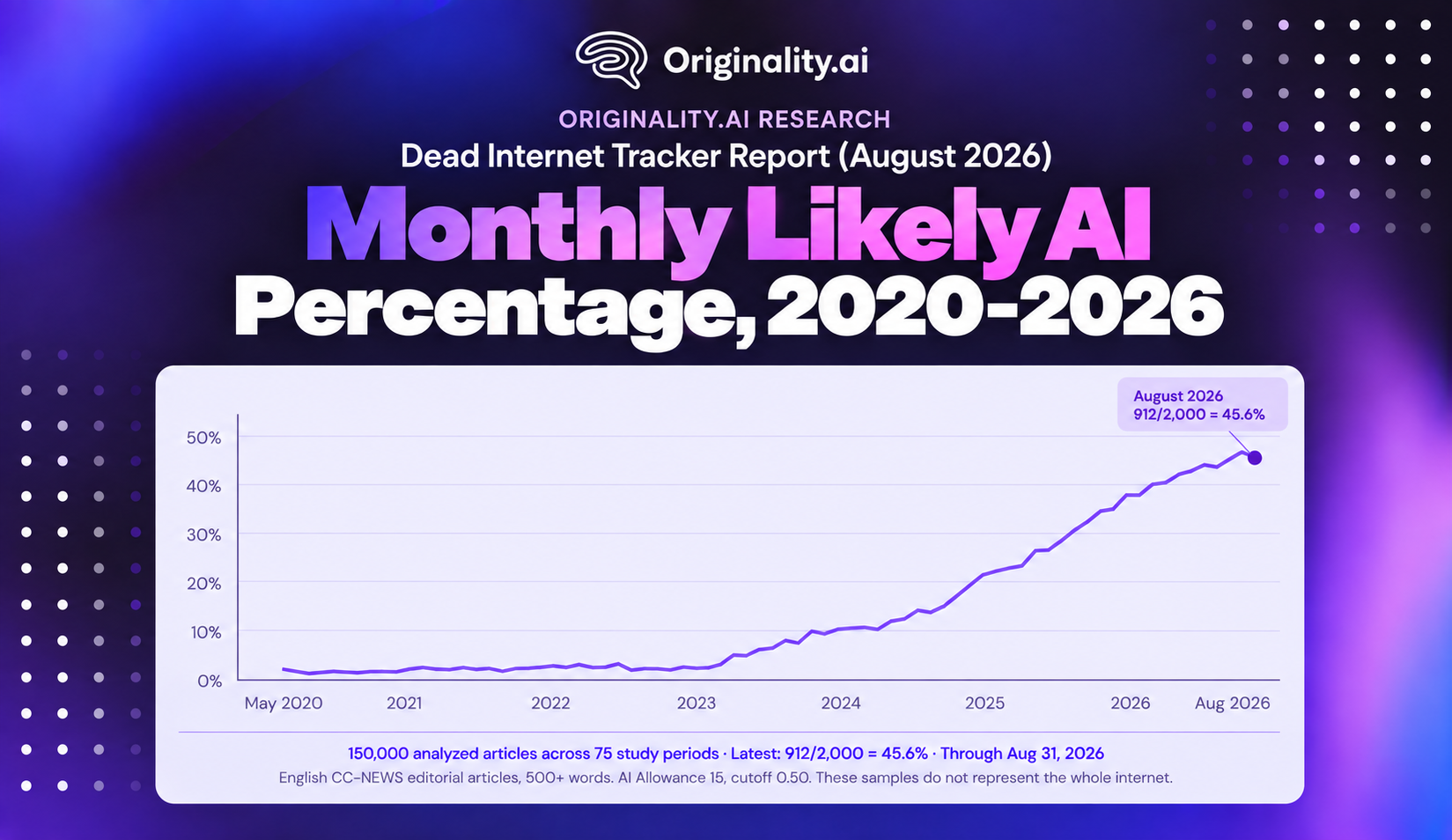
Even as AI content ticks (slightly) downward, the historical trendline (shown in the graphic below) suggests this will be short-lived. If history is any guide, we should expect further increases, tipping the written internet into majority-AI-generated territory in the months ahead.
The first instalment of our Dead Internet Tracker Report in July demonstrated a significant year-over-year jump in AI-generated content across all categories, and the latest edition of the study demonstrates further increases across the board.
The biggest jump was in the opinion and essay category, where half of articles were likely at least 15% AI-generated in the first seven months of the year, compared with two-thirds in August.
That makes opinion and essay the single largest category for likely AI content, and by a significant margin.
Though we can only speculate, the increase may be the result of both a growing comfort among authors with the technology and a growing cultural acceptance of AI usage in opinion articles and essays.
Last month, the category overtook analysis and explainer articles as the largest source of Likely AI content; however, that category also saw a modest increase from an average of 54% in January to July to 58% in August.
Coming in third for likely AI-generated content were business and finance articles, which saw a slight increase from an average of 52.6% from January to July to 53.3% in August.
Overall, the data suggests a gradual increase in Likely AI content through 2026 across all article categories — and a significant increase in the opinion and essay category — despite a slight overall decline between July and August.
Longer Articles are More Likely to Leverage AI
The research suggests that longer articles are most likely to be more than 15% AI-generated. However, articles of most lengths are seeing more AI usage, with some notable exceptions.
In August, articles of 500-749 words were slightly less likely to leverage AI than those of 750 to 999 words, with both hovering around 44%. Both categories are also up about 2% in August as compared with their 2026 averages.
Roughly 46% of articles of 1,000 to 1,499 words were likely to be AI-written in August, down less than a single percentage point from the 2026 average. Likely AI content, meanwhile, tops 53% among articles of 1,500 words or longer, up from an average of 51.5% in the first seven months of 2026.
Greater AI usage may be expected in longer articles, as longer-form content may require more writing assistance. At the same time, however, the detector is proportional, and only designates an article as likely AI-generated if more than 15% is more likely than not AI-generated. While we might expect longer articles to incorporate more AI-written words, that doesn’t explain why they’re more likely to be above 15% AI-generated.
Other factors that might help explain the discrepancy include the higher likelihood of more boilerplate information, like definitions, summaries, tables of content, etc., among longer-form articles, thus inspiring writers to lean more heavily on automated content. Authors may also seek to expand article lengths to achieve search engine optimization (SEO) targets and leverage AI tools to increase word counts or insert popular search terms.
Read the July 2026 Report
Articles were collected from Common Crawl’s CC-NEWS archive and only include English-language editorial pages of at least 500 words, not homepages, navigation, product listings, or other forms of written content. The analysis was also limited to four pages per domain per month to ensure no single publisher skews the results.
For the purposes of this report, Common Crawl content is deemed Likely AI if the tracker is more confident than not (50% confidence or higher) that at least 15% was written by AI.
This methodology helps reduce the occurrences of false-positive readings while providing some leeway for AI-assisted writing and editing.

AI & Plagiarism Detector for Serious Content Publishers
Originality.ai
64 Hurontario St
Collingwood, Ontario
L9Y 2L6