AI Checker
Plagiarism Checker
Grammar Checker
Content Quality
Guideline Checker
Readability Checker
Fact Checker

Extensions

Dead Internet Tracker Report: July 2026
The once fringe “dead internet theory” has found new relevance in the AI era.
The concept, which was born on message boards over a decade ago, suggests that the internet will eventually consist primarily or entirely of inanimate algorithms speaking to each other, replacing human interaction with “bot” activity.
AI has supercharged the march towards the dead internet by dramatically accelerating the pace and scale by which automated tools can develop content. Today, it is not uncommon for an AI agent to autonomously initiate a query and complete that action using materials that were themselves AI-generated.
For example, an AI agent could initiate the drafting of a competitive analysis report without human prompting, which it develops by leveraging online reviews, press releases, and social media content, all of which could be generated by other automated tools. The competitive analysis itself may then be fed into an organization’s internal database and leveraged by other internal AI tools to develop more reports, all without human oversight.
This scenario is already beginning to materialize, and we are still in the early days of the AI revolution. As the technology advances, it’s not hard to imagine a world in which most online activity occurs without human prompting, oversight, or review. In fact, that world may have already arrived.
That is what inspired AI detection platform Originality.ai to develop a monthly breakdown of AI pervasiveness online. The new “Dead Internet Tracker” seeks to provide an ongoing benchmark demonstrating how the internet is evolving in the AI era, and just how close we are to a world in which the internet primarily exists for non-human use.
The Dead Internet Tracker will be paired with Originality.ai’s monthly Social Media AI Tracker Report (read July’s), which similarly showcases the pervasiveness of automated content on some of the world’s most popular social media platforms.
As a text-based AI detector, our findings are limited to written content and do not extend to other forms of media, programming languages, or other uses of AI in developing online content.
To understand how much online content is written by AI, Originality.ai is leveraging Common Crawl, a free, online repository of all publicly available internet content. The use of Common Crawl is also relevant because its dataset is utilized by frontier model providers like OpenAI and Anthropic in developing their AI tools, demonstrating how AI content is often created by leveraging AI content.
Just because something is posted online, however, doesn’t mean that human users will see it. Though our online experience is changing quickly, research suggests that most internet users begin their online journeys with a search engine, and specifically Google. In fact, Google is used by more than 5 billion people, or about 84% of all internet users, with over 16.4 billion search queries each day.
While Common Crawl helps us understand how much AI-generated content is posted online, Google Search data helps us understand how much of that content is ultimately found by humans.
This report will provide a monthly update on both metrics to help internet users understand how much content is being produced by AI, and how much of that content they are being served through the world’s most popular search engine.
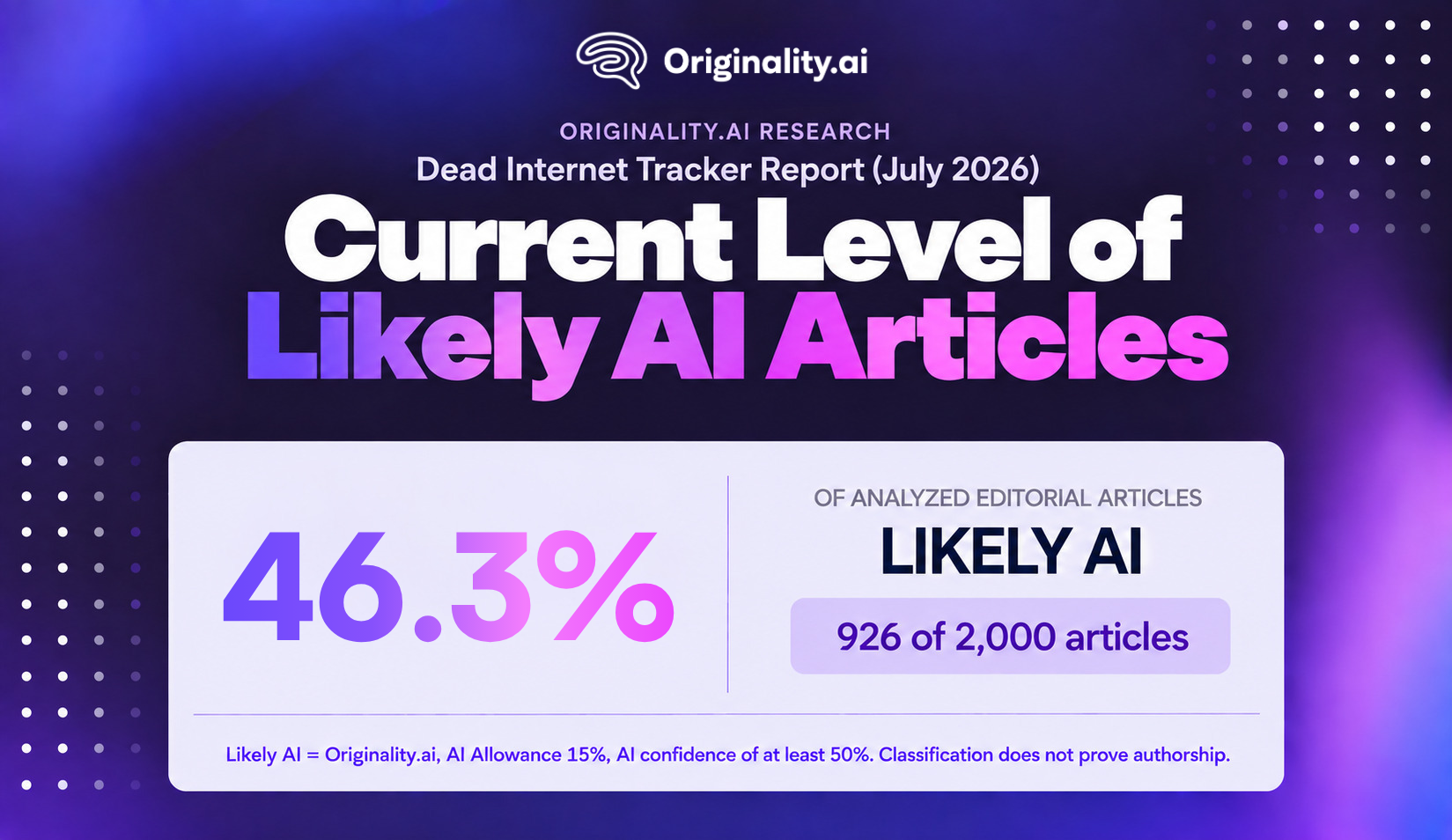
Originality.ai examined 2,000 randomly selected long-form English-language articles published to the editorial web and captured by Common Crawl in the month of July and found that 926, or 46.3%, were more likely than not at least 15% AI-generated.
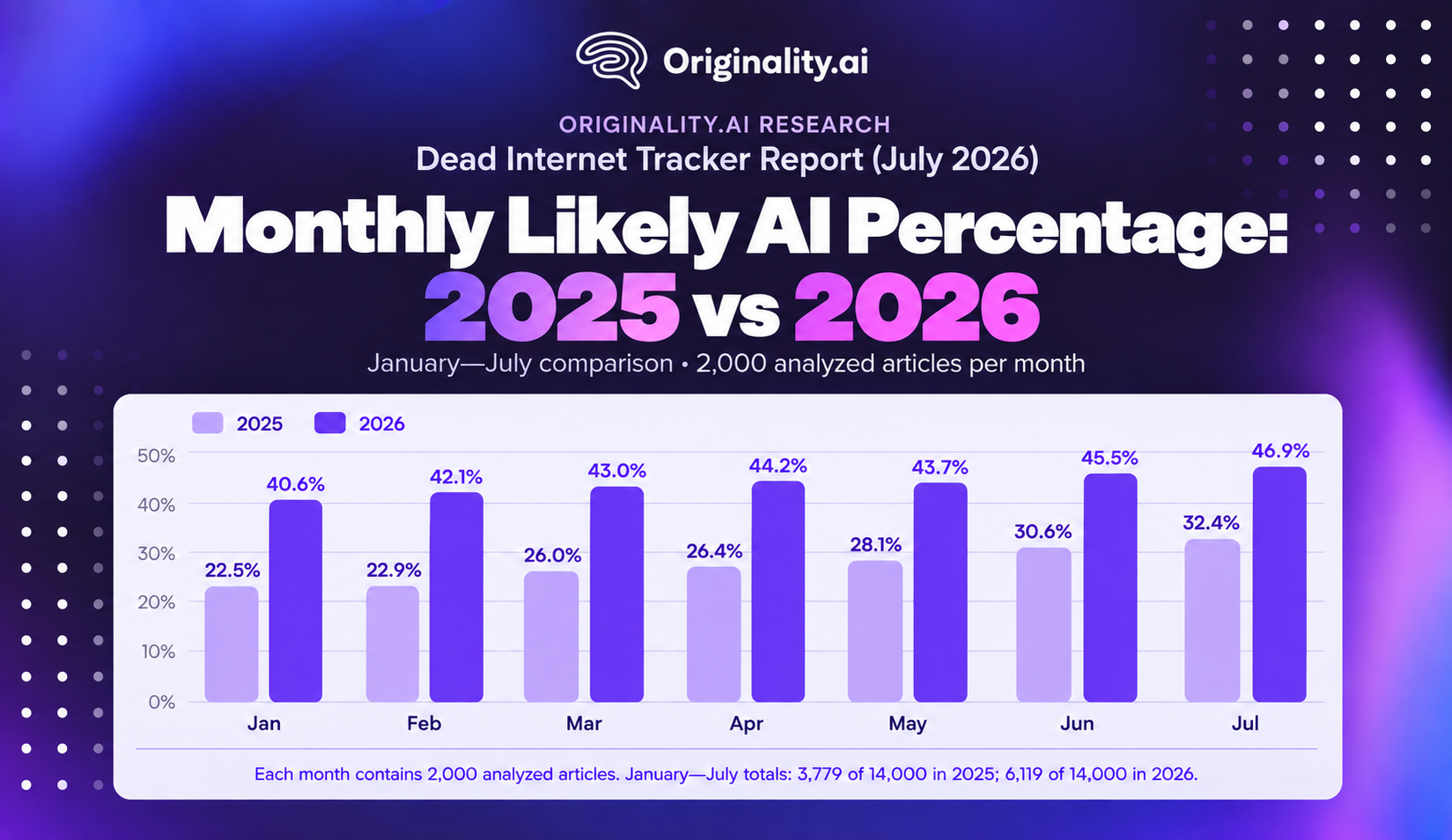
A broader analysis of 14,000 articles published over the last two years also found an increase in the proportion of AI-generated content each month of 2026 through July as compared to the same month in 2025.
An even deeper dive into 148,000 articles published online starting in July 2020 demonstrates the skyrocketing trajectory of Likely AI content since the public launch of ChatGPT in November of 2022. In fact, the proportion of content that is likely at least 15% AI-generated has more than doubled since the start of 2025.
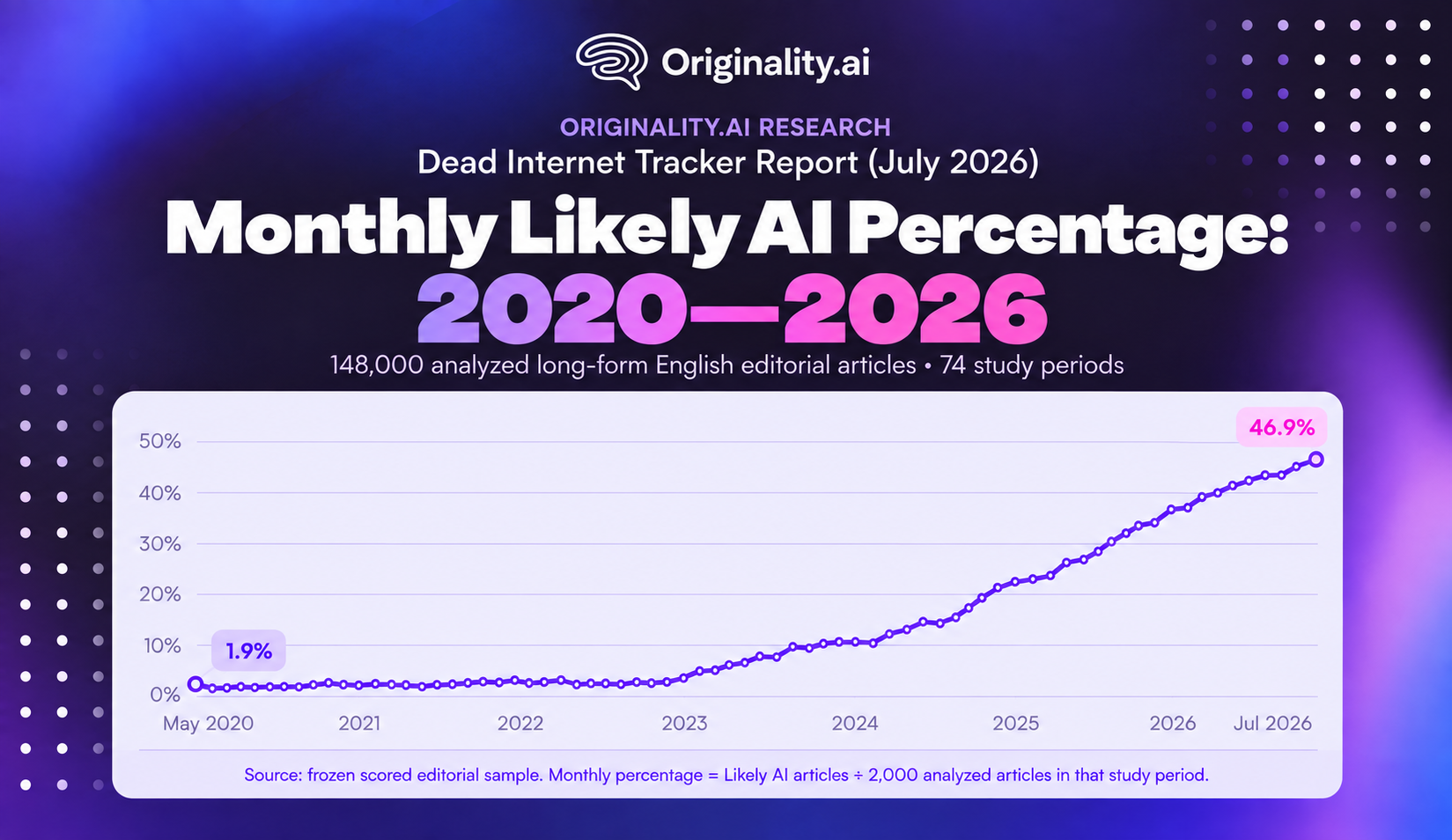
At the current trajectory, it is likely that we have already surpassed the point at which more than half of online articles are AI-generated.
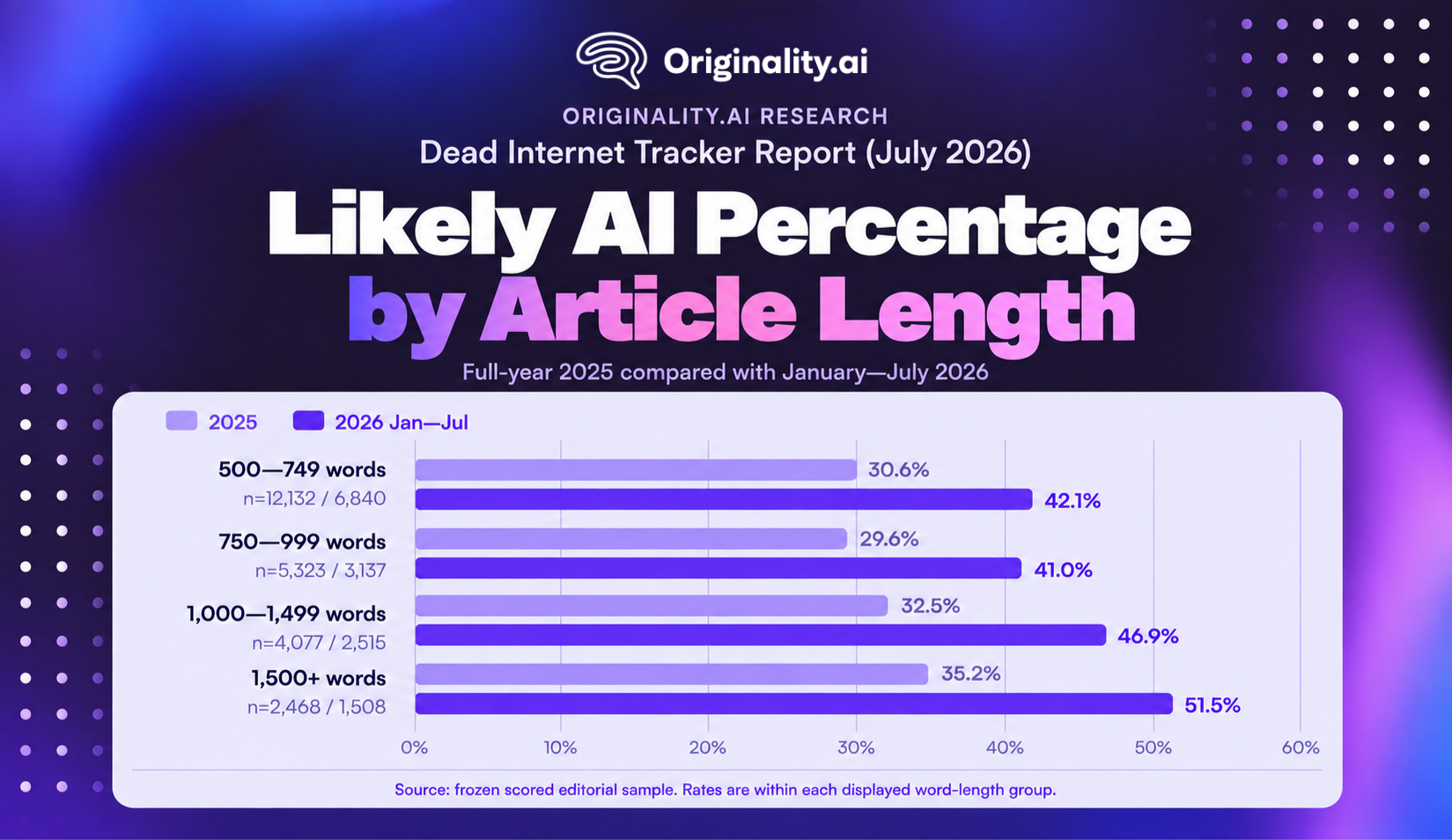
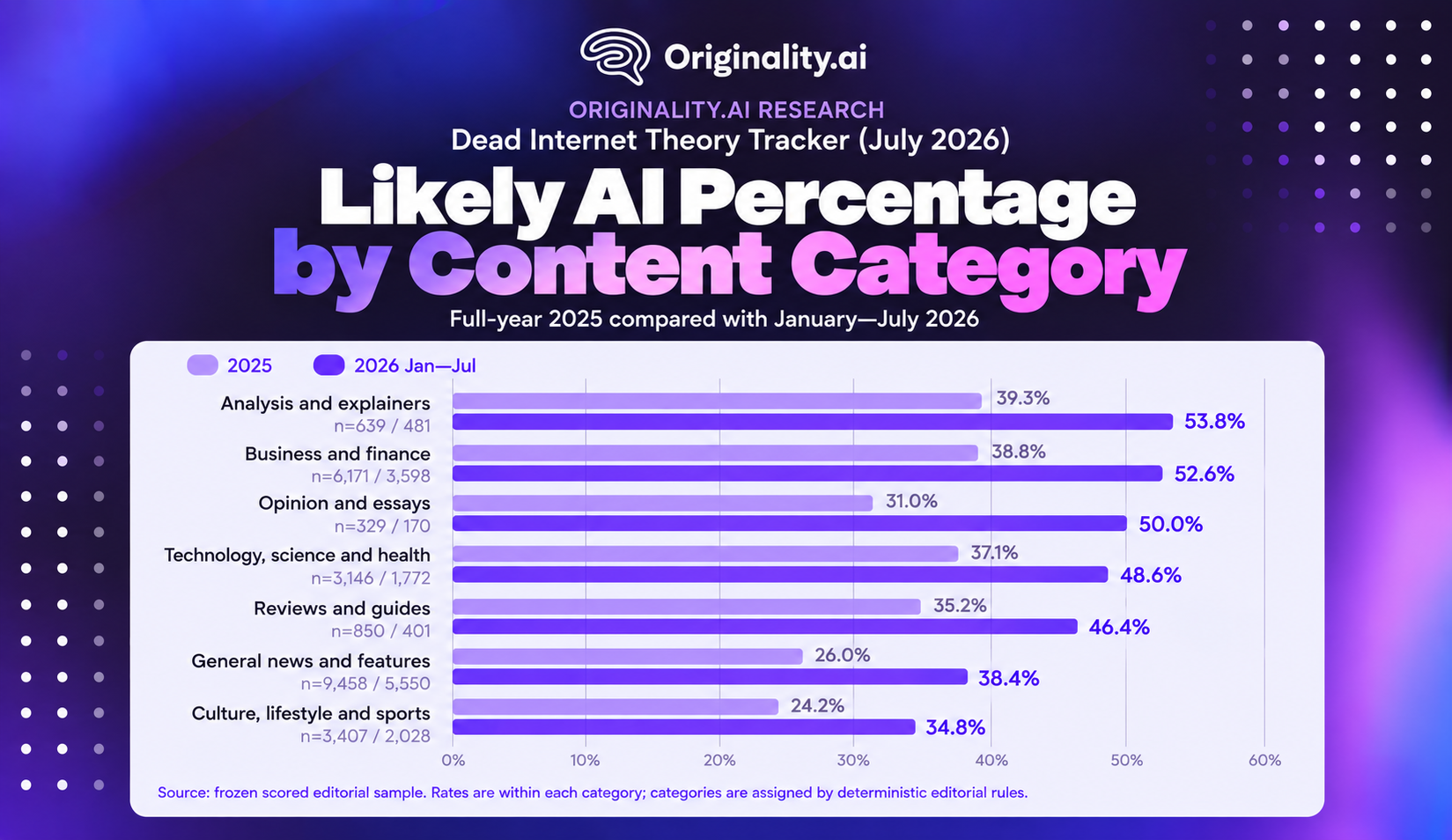
The articles most likely to leverage AI authorship thus far in 2026 were in the analysis and explainer category, or what some might call “thought leadership content.” Within that category, nearly 54% of English-language articles over 500 words were determined to be more likely than not at least 15% AI-generated, up from 39% in 2025.
The second heaviest use of AI content appears to be in the business and finance category, with about 53% flagged as Likely AI, up from 39% last year, followed by opinion and essays at 50%. That category also saw the largest year-over-year jump in likely AI content, from 31% in 2025 to 50% through July of 2026.
The remaining categories — technology, science and health, reviews and guides, general news and features, and culture, lifestyle and sports — remain below 50% likely AI-generated, but each saw a dramatic increase from 2025.
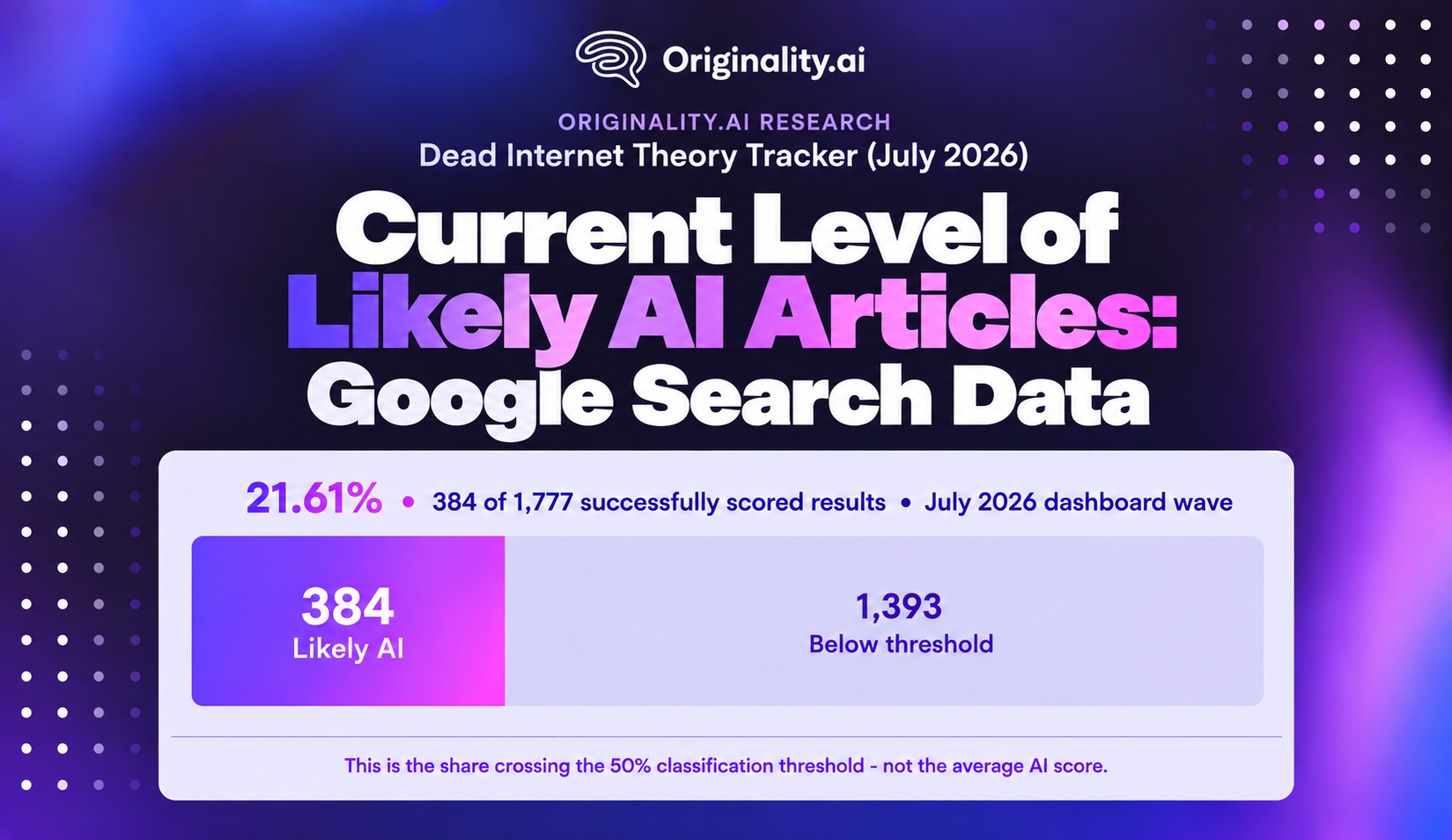
Originality.ai examined 1,777 of the top 20 Google search results to a panel of 500 informational queries created by Semrush in July of 2026 and found that 384, or 21.6%, were more likely than not to be at least 5% AI-generated.
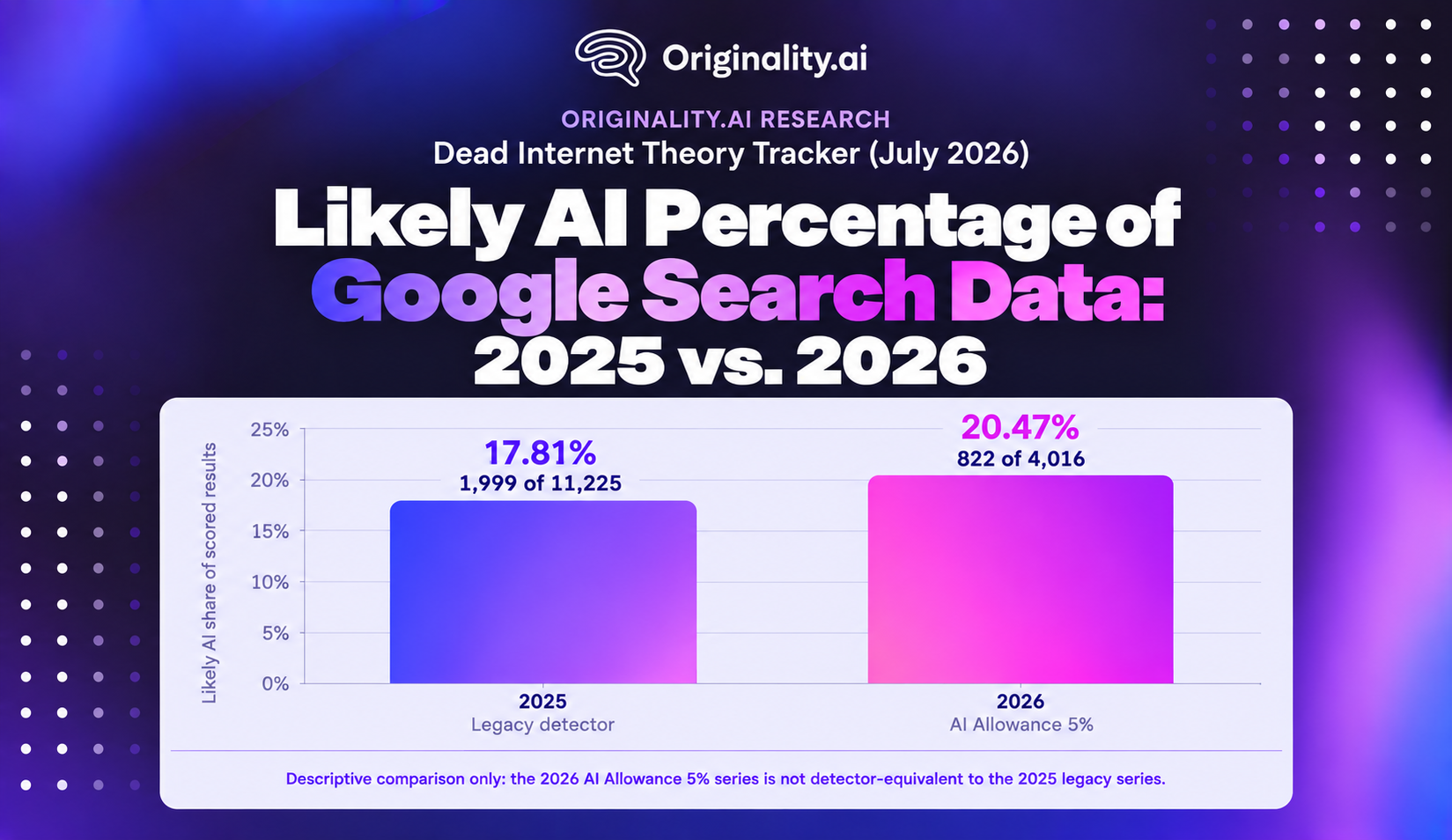
Originality.ai has been tracking a significant rise in likely AI search results on Google since the launch of ChatGPT in late 2022, which saw the most significant increases between late 2024 and early 2025, as Google rolled out its Gemini AI search features.
Prior to August of 2025, Originality.ai qualified search results as Likely AI when the tracker determined content was likely to be at least 15% AI-generated. That month, its Google AI detector was retired and replaced in May of 2026 with an updated version with a 5% Likely AI allowance threshold.
Despite changing the level on what qualifies as Likely AI, our tracker only picked up a 2.66% difference in AI-generated results between 2025 and the first seven months of 2026.
Read the August 2026 Report
For the purposes of this report, Common Crawl content is deemed Likely AI if the tracker is more confident than not (50% confidence or higher) that at least 15% was written by AI.
This methodology helps reduce the occurrences of false-positive readings while providing some leeway for AI-assisted writing and editing. The study also only includes English-language articles of at least 500 words.
Articles were collected from Common Crawl’s CC-NEWS archive and only includes English-language editorial pages of at least 500 words, not homepages, navigation, product listings, or other forms of written content. The analysis was also limited to four pages per domain per month to ensure no single publisher skews the results.
Google search data, meanwhile, is put to a higher standard of no more than 5% Likely AI generated content and limited to the top 20 results based on digital marketing platform Semrush’s fixed panel of 500 common informational queries (mostly “how-to”s). It also only includes pages with at least 100-words of English written content.
Overall, the data suggests that AI-generated content has been skyrocketing since the public launch of ChatGPT in November of 2022, but especially in the last 12 months. While Google has been effective in filtering out AI-generated content, it too has been serving more of it to users over time.

AI & Plagiarism Detector for Serious Content Publishers
Originality.ai
64 Hurontario St
Collingwood, Ontario
L9Y 2L6