AI Checker
Plagiarism Checker
Grammar Checker
Content Quality
Guideline Checker
Readability Checker
Fact & AI Hallucination Checker

Extensions
MCP

We’re excited to share that Originality.ai was ranked the most accurate on humanized AI text in two third-party benchmarks!
This finding demonstrates that Originality.ai continues to be the hardest AI detector to bypass, even when AI text is humanized.
Further, we expanded on the benchmark’s findings by analyzing the quality of humanized content. After all, just because the content has been humanized, does it really mean that it’s high (or even good) quality?
Before we review the findings, first here’s a quick refresher on what humanizing is: an AI humanizer rewrites text generated by another AI tool or LLM (like ChatGPT).
Some humanizer tools promise to make text harder for AI detectors to spot. For an editor or teacher reviewing a draft or essay, that raises two questions.
Now, let’s take a closer look at the findings.
Two benchmarks tested the detection claim.
Each benchmark ran AI passages through several humanizers, then sent the same rewrites to every detector it compared.
A rewrite counted as caught if it fell short of that benchmark’s rule for passing as human.
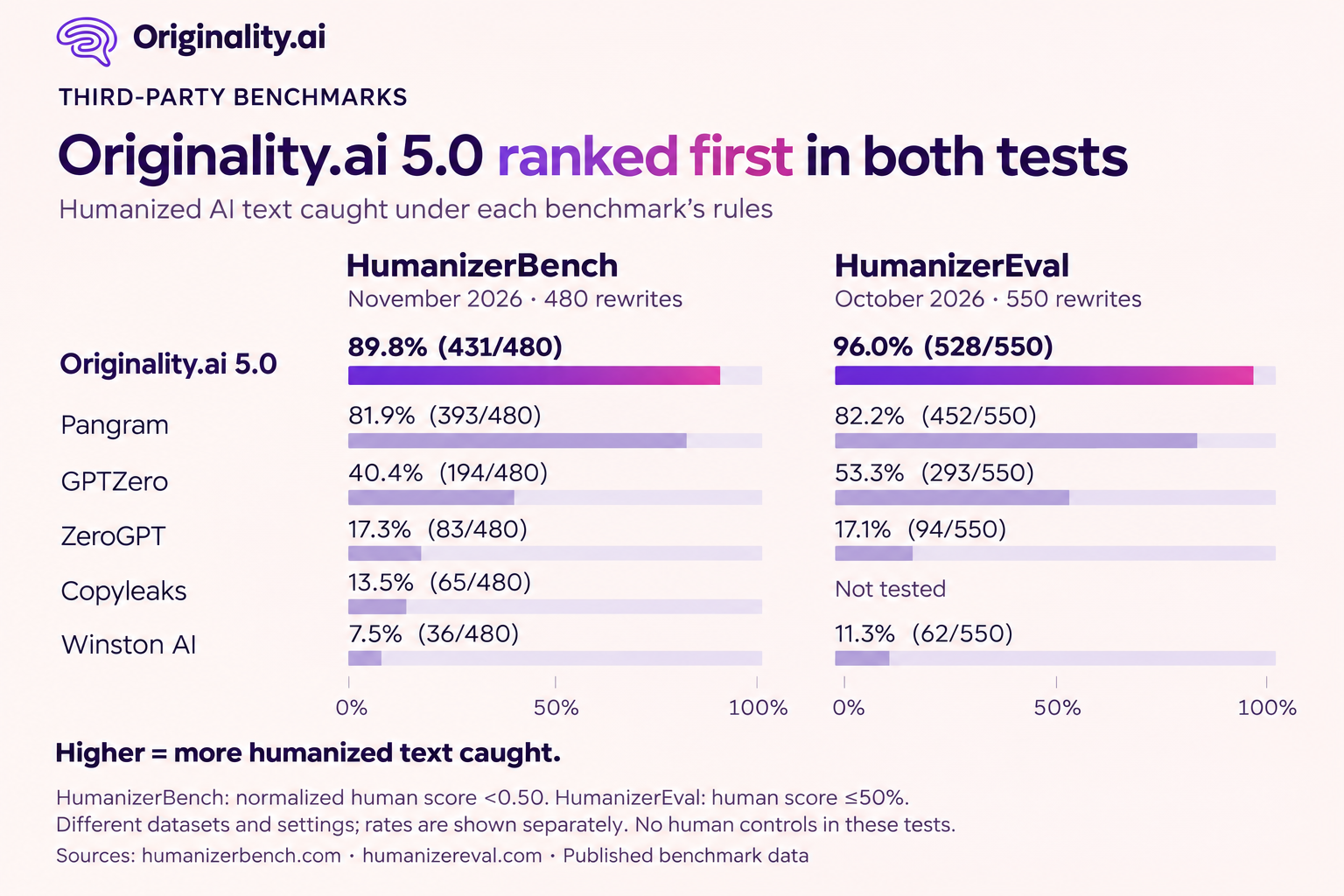
Originality.ai 5.0 led both tests. It caught 431 of 480 rewrites (89.8%) in HumanizerBench and 528 of 550 (96.0%) in HumanizerEval.
See a comparison below of AI detection performance on the benchmarks:
Originality.ai caught every HIX Bypass, Humbot, and Ryne rewrite in both tests.
Phrasly showed the largest difference among the eight tools below. Originality.ai caught 6 of 30 Phrasly rewrites in HumanizerBench and all 50 in HumanizerEval. The two tests used different passages and tool settings.
* The humanizer’s owner ran the study. WriteHuman runs HumanizerBench. The StealthGPT team runs HumanizerEval.
Originality.ai 5.0 catch rates for the eight tools that appeared in both tests. HumanizerBench November data · HumanizerEval October data
HumanizerBench published both the original passages and their rewrites. So, we could then compare the writing quality before and after humanizing.
What happens to the quality of the text that bypasses detection? We followed up by comparing writing quality ratings before and after humanizing to find out.
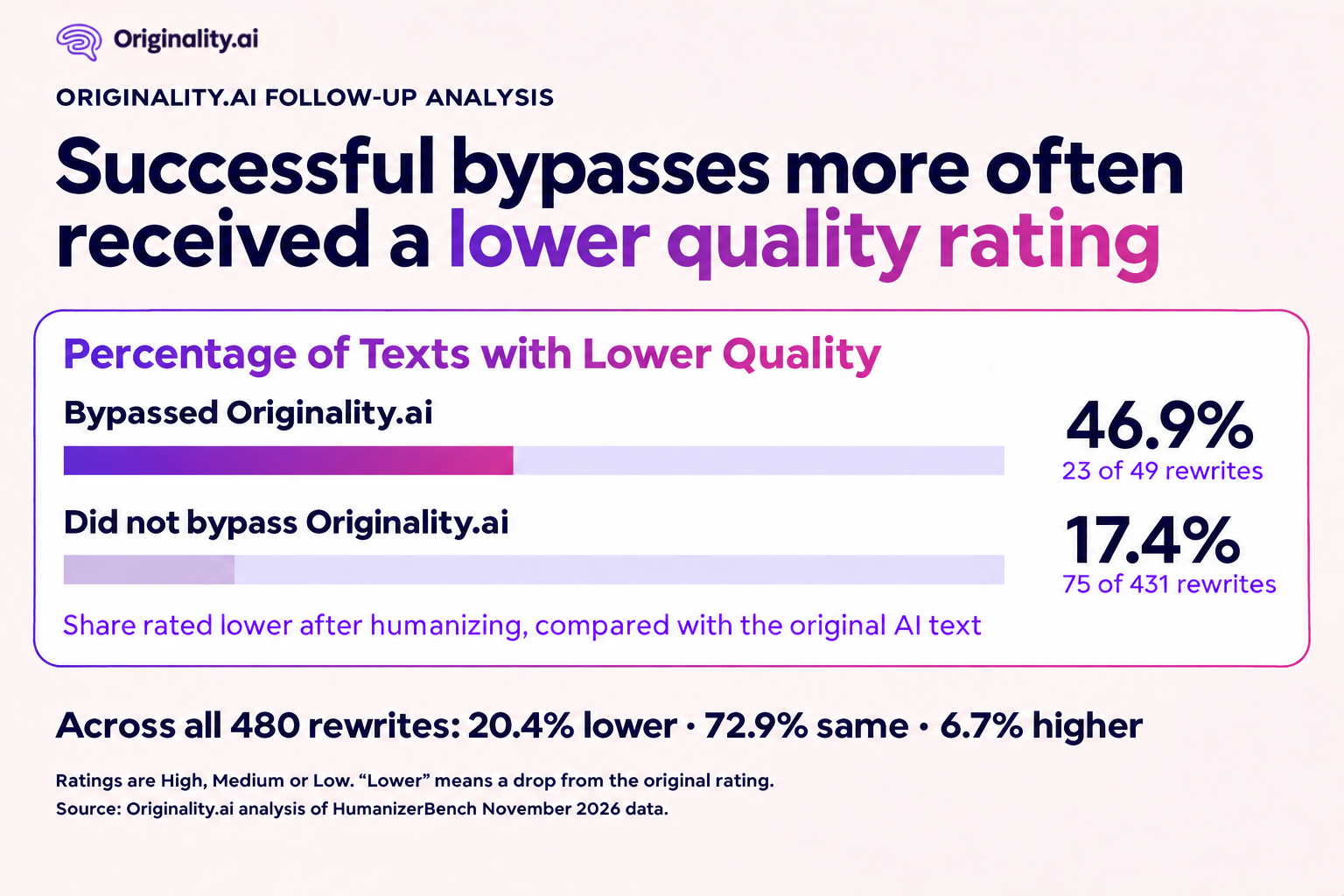
We scored the 30 original passages and all 480 HumanizerBench rewrites with Originality.ai’s Content Quality API. It rated each text High, Medium, or Low. We then compared each rewrite’s rating with the original passage’s rating.
Most rewrites kept the same rating (350 of 480, or 72.9%). Across all rewrites, 98 received a lower rating, and 32 received a higher one.
A drop was more common among rewrites that bypassed Originality.ai. Nearly half received a lower rating (23 of 49, or 46.9%), compared with 75 of 431 rewrites it caught (17.4%).
Our findings reveal that humanizing text can lower its quality.
That raises the question: is humanizing really worth it at the expense of quality?
After all, both humans and even Google prefer high-quality content.
In fact, Google advises that content (such as AI-generated content) that adds no value for readers should be rated as the lowest quality in its Search Quality Rater Guidelines.
So, relying on a humanizer to turn AI copy into quality content could not only disappoint readers, but it also has the potential to impact search ratings.
Originality.ai 5.0 was the most accurate detector at identifying humanized AI content in both benchmarks run by humanizer companies.
Originality.ai caught 89.8% of rewrites in HumanizerBench and 96.0% in HumanizerEval, beating runner-up Pangram by 7.9 and 13.8 percentage points, respectively.
In our follow-up on HumanizerBench, 46.9% of rewrites that bypassed Originality.ai received a lower quality rating than the original, compared with 17.4% of rewrites it caught.
What does this mean for users?
Learn more about AI detection:
HumanizerBench’s November 2026 release covered 480 rewrites from 16 humanizers, tested October 30. HumanizerEval tested 550 rewrites from 11 humanizers on October 22, 2026.
HumanizerBench counted a human score below 50% as caught. HumanizerEval counted 50% or below as a failed bypass. The results measure how often detectors caught known AI rewrites. Estimating false positives would require human-written samples.
We ran the automated quality analysis on November 4, 2026. The 480 rewrites came from the same 30 passages across tools. The mix of tools and the original passages’ ratings may help explain which rewrites received lower ratings. HumanizerBench releases its benchmark data under CC BY 4.0.

AI & Plagiarism Detector for Serious Content Publishers
Originality.ai
64 Hurontario St
Collingwood, Ontario
L9Y 2L6