AI Checker
Plagiarism Checker
Grammar Checker
Content Quality
Guideline Checker
Readability Checker
Fact & AI Hallucination Checker

Extensions
MCP

Just a few days ago, Yahoo published an article with AI content.
It’s not the first time that AI-generated copy has made it into the news, either. Consider the Deloitte AI report scandal or the AI book list scandal.
While humans may struggle to identify AI writing, when common and obvious AI sayings are left in content, they’re a clear giveaway that it’s AI-generated.
As AI becomes increasingly adopted across industries, maintaining transparency about the origins of what you’re reading is becoming more important than ever.
Easily check if an article is Likely AI or Original with Originality.ai, then keep reading for more details on the Yahoo AI Article scandal.
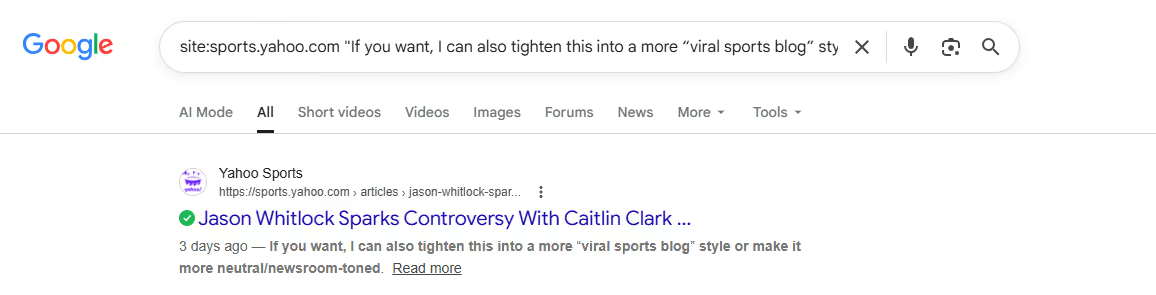
Recently, Yahoo published an AI article that contained a clearly generated sentence, credit to Aires Loutsaris for sharing this article with us via LinkedIn.
The article had a common style of AI sentence, “If you want, I can also tighten this into a more “viral sports blog” style or make it more neutral/newsroom-toned,” a clear giveaway that the article was likely AI-generated.
Although that sentence has since been removed from the article itself, you can still see it in a quick Google Search.
How about the rest of the article? Was it probable AI content?
The result when it was scanned with Originality.ai? 100% Likely AI.
While other AI detectors struggled to identify that the text was AI-generated, Originality.ai correctly identified the AI text.
See a full comparison of AI detector results for the article in Aires’ LinkedIn post.
AI-generated copy is being increasingly incorporated into writing workflows.
Readers deserve transparency around whether the content they’re reading was written by a human or is AI slop.
While AI can support and streamline some parts of the writing process, like checking for grammar, it can also hallucinate (and confidently present incorrect information as fact), which poses several concerns for journalism, where authenticity and factual accuracy are essential.
Unless an obvious AI saying is accidentally kept in an article, or a clear AI hallucination comes up during fact-checking, it can be difficult for humans to tell if writing is AI or not, as studies have shown.
That being said, if you come across phrases like “as a large language model,” “my training data,” or, in this case, “If you want, I can also…” there’s a good chance that at least a portion of the content was created with AI.
AI detection is becoming increasingly important to help readers check the origins of what they’re reading.
Further, AI detectors like Originality.ai with a full suite of tools from AI checks to plagiarism detection and fact-checking, can also support editorial teams in reviewing content to make sure it meets their quality standards before they click publish.
Yahoo’s AI mistake reflects the concerns of the broader adoption and integration of AI-generated content into industries like journalism.
While AI can support journalists, such as by checking for spelling errors or content quality, it’s essential to carefully review content created with the support of AI and maintain transparency with readers about the origins of what they’re reading.
If you’re reading an article and you’re unsure if it’s Likely AI or human-written, use Originality.ai to run a quick AI check and find out.
Follow Originality.ai on LinkedIn to stay-up-to date with the latest.
Further Reading:

AI & Plagiarism Detector for Serious Content Publishers
Originality.ai
64 Hurontario St
Collingwood, Ontario
L9Y 2L6