AI Checker
Plagiarism Checker
Grammar Checker
Content Quality
Guideline Checker
Readability Checker
Fact Checker

Extensions

A review of SEC EDGAR documents found a visible ChatGPT tracking trail, repeated filing-control failures, and one market claim that did not match either of its cited sources.
Someone copied source links from ChatGPT, pasted them into financial documents, and filed those documents with the SEC. The giveaway was utm_source=chatgpt.com, a tracking code attached to links returned by ChatGPT:
It’s important to note that the links prove that source material passed through ChatGPT. They don’t prove that ChatGPT itself invented the unsupported number.
The giveaway wasn’t a supposedly obvious ChatGPT saying or an AI detector score. It was utm_source=chatgpt.com, a tracking code that ChatGPT adds to some of the links it generates for users. When the full link is copied, the code travels with it.
In our investigation, the code appeared in 44 reports on the SEC's EDGAR system.
However, this doesn’t prove that AI wrote the entire filings, but it does demonstrate that ChatGPT-linked source material was incorporated into official documents and survived the filing review process.
A March 2026 report from Cashmere Fund cited venture-capital research from NVCA, Carta, and Cambridge Associates. Four citations still carried the ChatGPT tracking code.
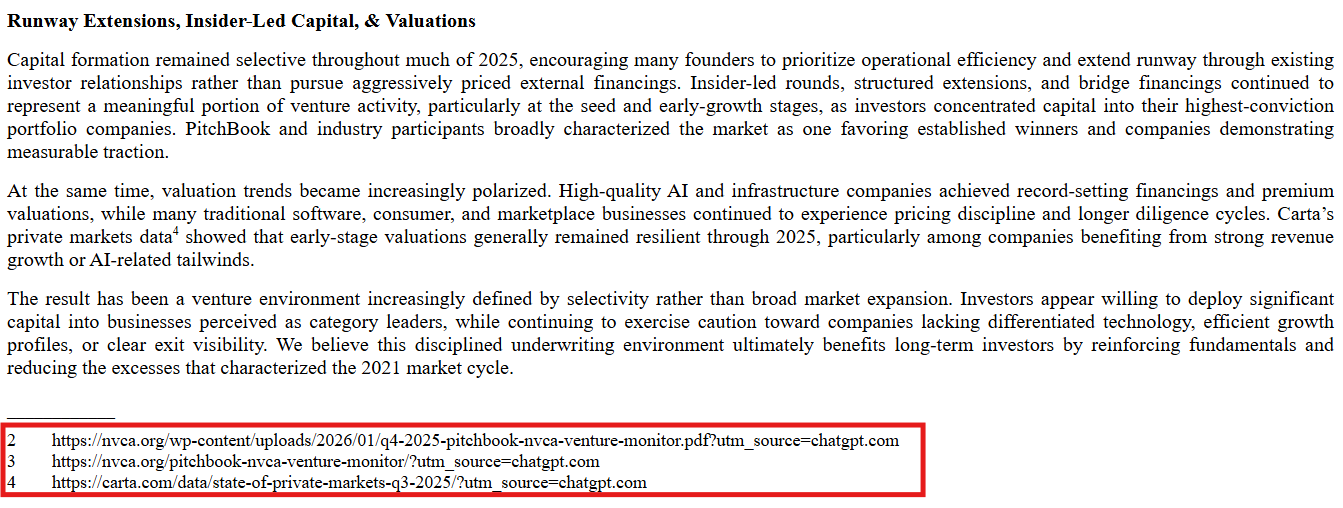

Of course, the code can’t identify who used ChatGPT or what they asked it. But it does show that the links passed through ChatGPT before the report was filed on EDGAR (with a last modified date of June 2026).
The Cashmere report wasn’t an isolated incident. Originality.ai’s search found six to ten documents with ChatGPT tells in every completed month from January through June. March had the most, with ten.
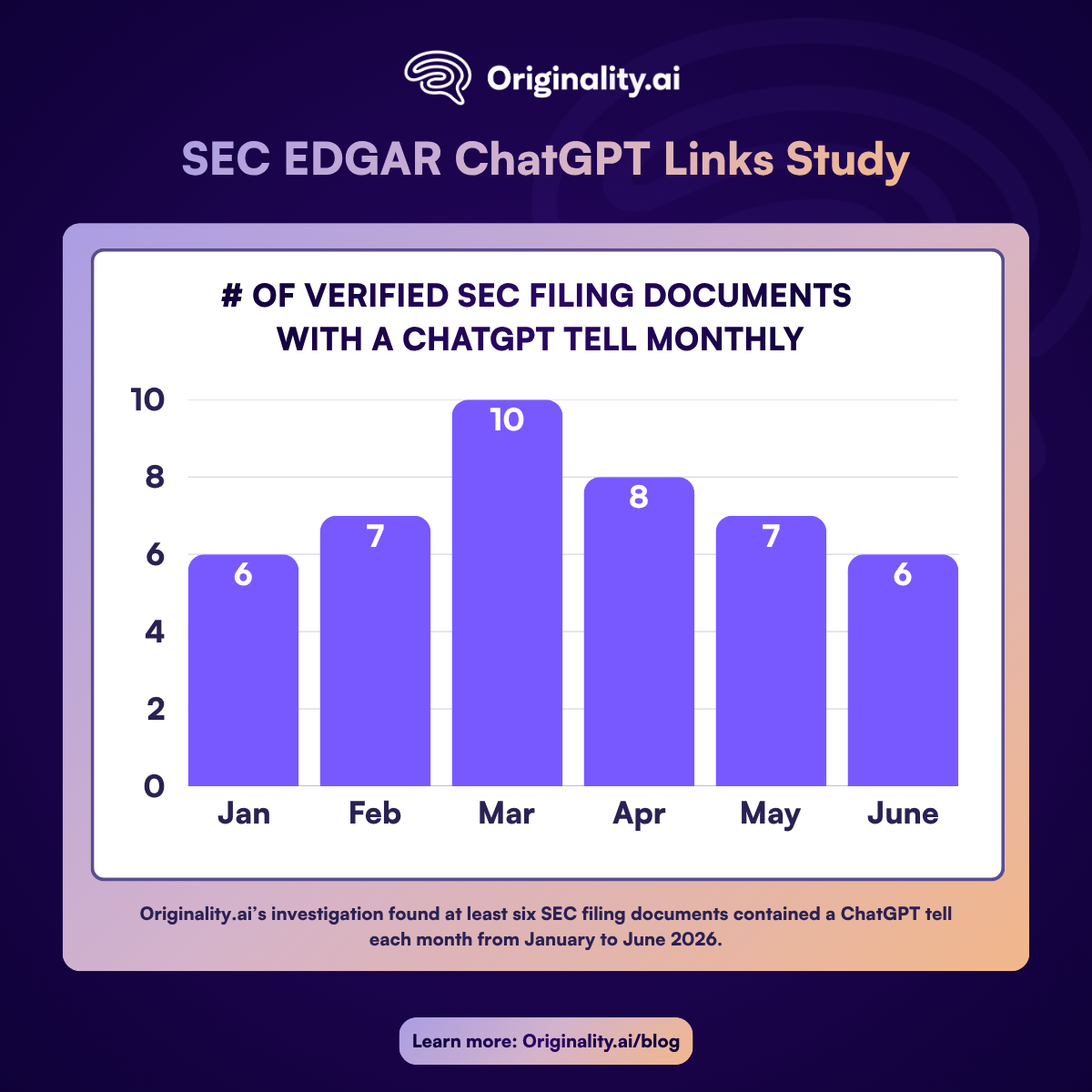
The simplest explanation is a repeatable copy-and-paste failure: someone uses ChatGPT to find sources, copies the links into a draft, and the tracking code survives the review process before the document reaches EDGAR.
In one of BioKey’s (Cayman’s) SEC filings, it told readers that the global nutraceuticals market would grow from about $112 billion in 2022 to $167 billion by 2030. The sentence points to two footnotes containing URLs from Allied Market Research and Grand View Research.
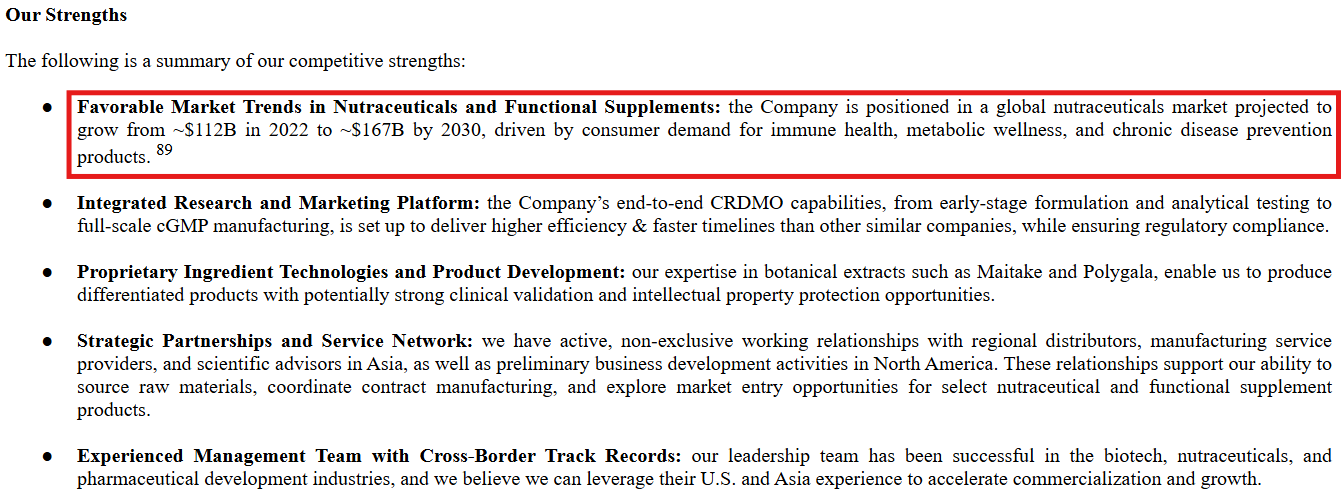
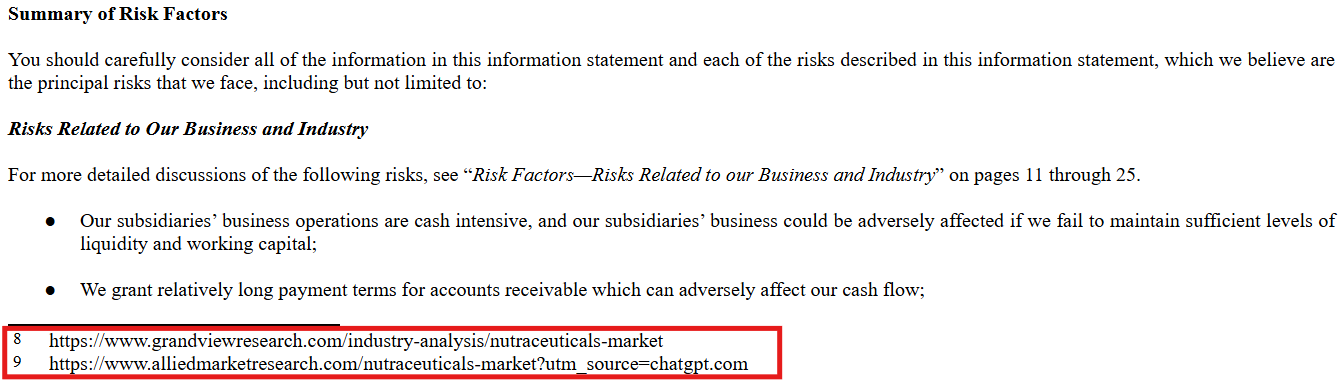
Although only the Allied Market Research link contained the ChatGPT tracking code, neither of the webpages cited in those URLs supports the numbers in the filing:
The filing even contradicts itself later on. It cites Grand View again and gives the correct figures of $591.1 billion in 2024 and $919.1 billion by 2030.


This is something that can happen with pasting an AI-generated or AI-summarized figure into a draft without checking it first, and could therefore be the result of a hallucination. But without the original ChatGPT conversation, it isn’t possible to prove whether ChatGPT invented the number or a human changed it.
Originality.ai tested a visible section of each document containing a ChatGPT tell, as well as a large, randomly selected sample of other SEC documents.
Note: These percentages only include the successfully scanned documents, not the ones that produced errors.
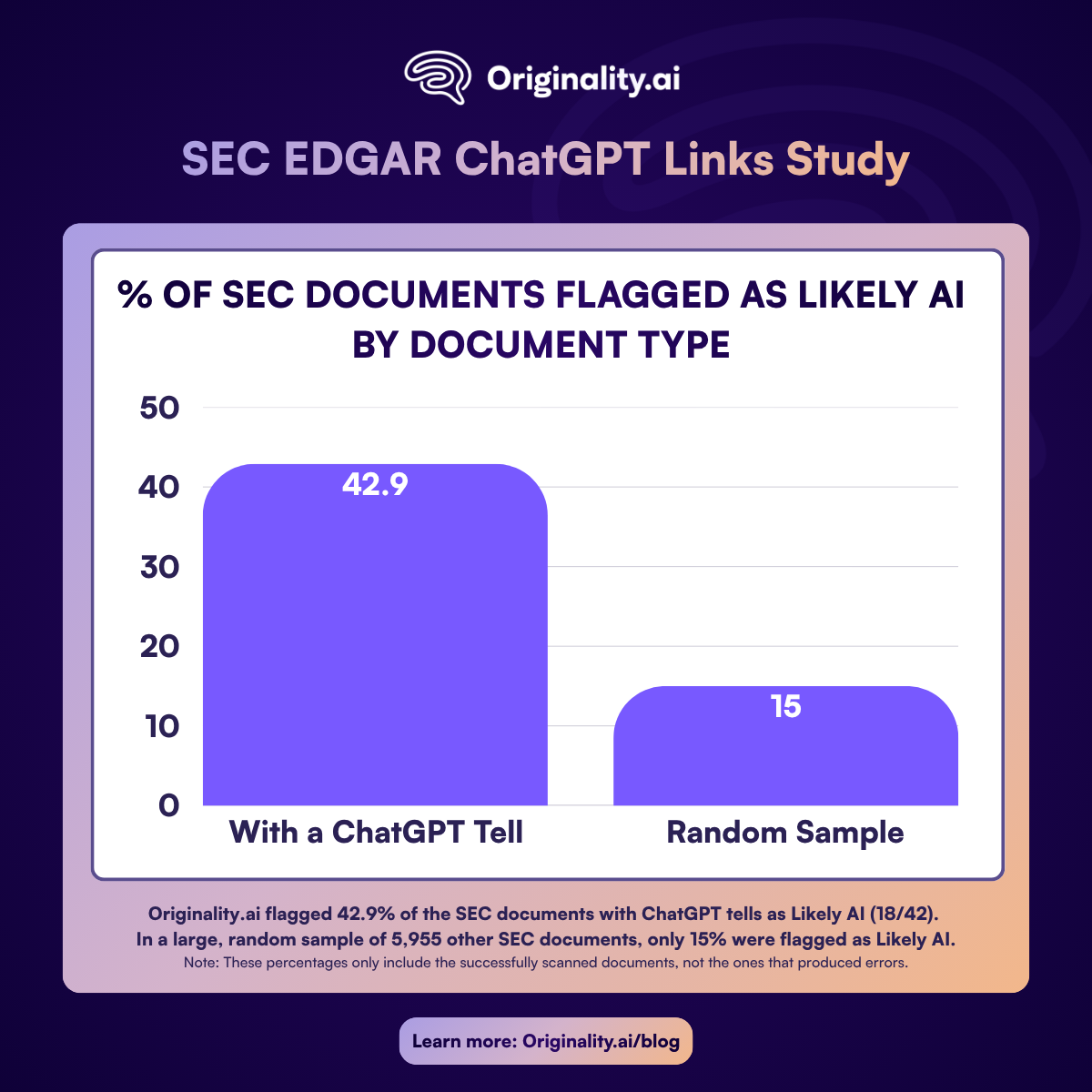
BioKey filed 3 SEC submissions between February and June 2026, with a ChatGPT tell. All three produced an AI flag in separately tested sections of the document, with a Likely AI score.
That’s the useful role of AI detection here: it can flag a document for further human review.
Coolbit Technologies filed three updates to a registration statement in June 2026:
Each one repeated the same ChatGPT-linked Construction Dive citation.

Once the link was added to the document, it was copied forward in subsequent updates. The mistake became part of the permanent public record.
And that’s not all; looking at a broader timeframe from March to June, a ChatGPT UTM code was present in 11 Coolbit Technologies or Coolbit Technologies Ltd (CBAI) filings.
So, what are the market values of the companies publishing Likely AI SEC filings with ChatGPT tells? Let’s take a look:
Note: The figures above are current to the initial publication of the study. Check the sources for the latest valuations.
Using AI for research or drafting isn’t automatically the problem. Publishing its tracking code in an official filing shows that nobody caught an obvious copy-and-paste trail.
SEC filings can pass through company staff, executives, outside lawyers, auditors, consultants, and filing agents.
The documents don’t show who added the links. They do show that the review process failed to remove them and, in several cases, failed to catch weak or unsupported citations.
That is the accountability question for companies and regulators.
A tracking code can look like a harmless formatting mistake. However, in an official SEC filing, that code can be evidence that ChatGPT-linked material moved through the drafting and review process without being caught.
Perhaps the more important question is what else came through the same process without leaving such an obvious clue.
Read more about the impact of AI across industries:
Originality.ai searched the SEC's EDGAR Full Text Search for 19 clear signs of AI use in documents dated January 1 through July 10, 2026. Duplicate results were removed using each filing's unique SEC number and document URL, leaving verified documents from January through June (44 of which contained a ChatGPT UTM tell).
For the detector comparison, Originality.ai tested a single visible section of up to roughly 1,400 words from each document using its Lite model and a 50% AI threshold (note that shorter documents used all available text). The random comparison targeted 1,000 SEC documents per month (although totals varied by month).
Duplicate results, very short documents, and collection interruptions changed the final monthly totals. The published rates use successful scans only: 42 scans from the ChatGPT-tell group and 5,955 scans from the random SEC sample.
PublicWWW was not used for the EDGAR search. The SEC's own search index found the documents, and the original SEC-hosted files were used as evidence.
We believe that it is crucial for AI content detectors reported accuracy to be open, transparent, and accountable. The reality is, each person seeking AI-detection services deserves to know which detector is the most accurate for their specific use case.

AI & Plagiarism Detector for Serious Content Publishers
Originality.ai
64 Hurontario St
Collingwood, Ontario
L9Y 2L6