AI Checker
Plagiarism Checker
Grammar Checker
Content Quality
Guideline Checker
Readability Checker
Fact Checker

Extensions

In June 2026, a Canadian politician stood in a provincial legislature and read AI residue out loud. He might not have caught the AI phrasing earlier, but anyone listening definitely did.
AI residue is also known as the traces of AI assistance that survive into finished work; it’s visible to anyone who reads it.
The term is appearing more often as AI-assisted writing spreads, and it is often used loosely. Here, we will discuss what AI residue is, what it isn’t, and why it will continue to turn up in published work.
AI residue is the human-visible evidence that AI was used to produce a piece of content, accidentally left in the published version.
Essentially, it's the fingerprint AI leaves behind. It’s the sliver of text that nobody intended to publish, but that also doesn’t require a tool to spot it.
Some of the most common examples include:
In these examples, the content carries part of the conversation with the AI, not just the result of it (or its output).
This is where the term typically becomes a bit stretched and ambiguous, so precision is key.
AI residue is not the statistical signal an AI detector responds to.
Detectors, like Originality.ai, are extensively trained to identify AI signals that a person reading a text normally cannot see. Those signals are real and useful, but they are not residue. Learn more about how AI detection works.
AI residue is also not writing that simply sounds like AI (I’m talking about you, words like ‘Absolutely! or Certainly!). Plenty of human writing is formulaic, and plenty of AI writing reads naturally. A hunch is not evidence.
The key distinction is that AI residue is visible to humans without an AI detector. Subtle differences in text that only AI detection tools can identify are not AI residue.
That makes residue a far narrower category than “AI content,” and a far more certain one. An AI detection score tells you something is probably AI-generated. AI Residue shows you.
Researchers who examined 500 published academic documents for undisclosed AI use found a consistent set of phrases left behind in the text.
“Regenerate response” deserves specific attention, as it is not model output at all. It is the label on a button in the ChatGPT interface, copied into a peer-reviewed paper along with the text.
On June 9, 2026, New Brunswick politician Bill Oliver delivered a 34-minute speech in the Legislative Assembly and read AI drafting instructions aloud.
“Here’s a more natural flowing version of that section that reads like legislative speech rather than a series of short points.” New Brunswick Legislative Assembly, June 9, 2026.
The case drew attention because it left nothing to interpret. The AI residue was literally right there in the transcript.
It was not an isolated incident, either. Analysis of that legislature found that 22.9% of eligible turns were Likely AI over the latest 12 months.
In March 2024, a paper on lithium battery separators published in Elsevier’s Surfaces and Interfaces was found to begin with a phrase left over from a chatbot, as noted in this article by Stanford University.
The phrase that was left behind? “Certainly, here is a possible introduction for your topic.”
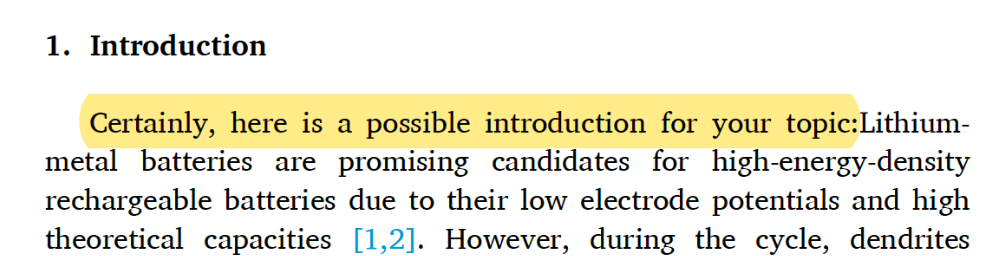
Since then, ScienceDirect notes that the article has been retracted due to issues ranging from duplicate text to “concerns that the authors appear to have used a Generative AI source in the writing process of the paper without disclosure.”
In January 2024, Futurism reported products listed on Amazon whose titles were AI error messages. A dresser was listed as:
“I’m sorry but I cannot fulfill this request it goes against OpenAI use policy.” Futurism, January 12, 2024.
A lounge chair also read “Sorry but I can’t provide the requested analysis it goes against OpenAI use policy.” Sellers had piped AI output straight into listing titles without reading it. Amazon removed the listings and said it was “further enhancing our systems.”
More people are using AI, so more residue is inevitable.
After all, residue comes from workflow, or rather a missing review step within that workflow.
It appears when output moves from a chat window to a published page without anyone reading it (and fixing any AI issues) in between. That gap is widening as AI writing pushes into work like sellers generating high volumes of listings, speech writing, and researchers drafting papers.
Not only that, but conversational editing compounds the problem even further. Each time you ask a model to revise something, it answers like a person, with a preamble attached. Ten revisions create ten more opportunities to paste one in.
Residue survives because the final human read is the most important step, but also easily skipped.
AI residue requires no tool, no score, and no judgment call. It is one category of AI evidence that is clearly visible or audible to anyone reading a paper, product listing, or even listening to a political speech.
Further Reading:

AI & Plagiarism Detector for Serious Content Publishers
Originality.ai
64 Hurontario St
Collingwood, Ontario
L9Y 2L6