AI Checker
Plagiarism Checker
Grammar Checker
Content Quality
Guideline Checker
Readability Checker
Fact & AI Hallucination Checker

Extensions

By Jonathan Gillham, Founder and CEO, Originality.ai
Coverage: 2020 through August 2026
Likely AI language rose sharply in public congressional material after 2022.
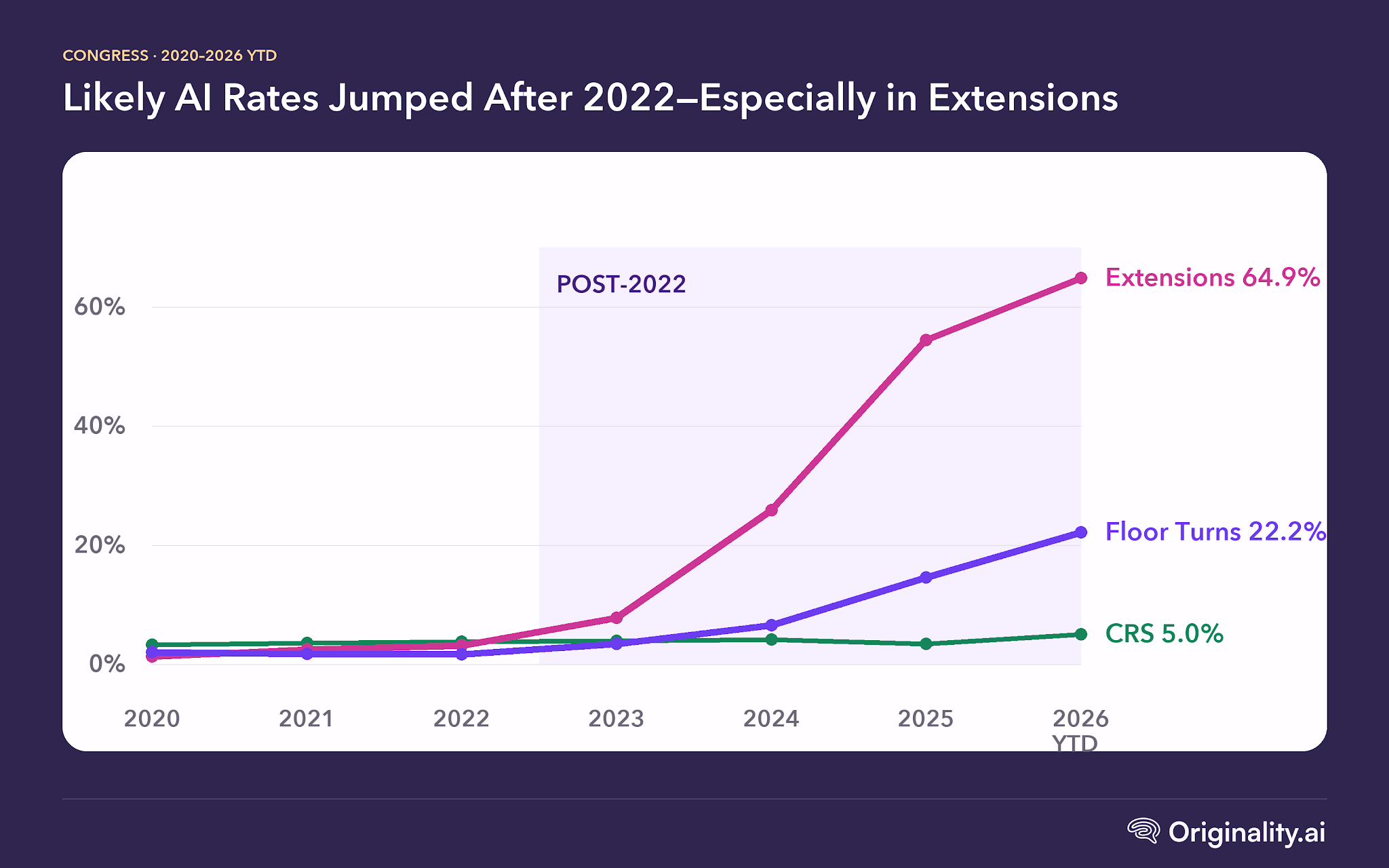
In 2026 YTD, 64.9% of estimated Extensions of Remarks and 22.2% of estimated Floor Speaking Turns were classified Likely AI, compared with 5.0% of CRS bill summaries.
The pattern crossed party lines and was substantially stronger in House Floor Turns than Senate Floor Turns.
We found two clear disclosures of politicians querying AI, but no disclosure of AI drafting congressional language and no exposed AI residue like the instructions found in our earlier New Brunswick investigation.
The New Brunswick investigation centered on one politician and exposed AI residue—drafting instructions apparently read aloud. This study measures broader patterns across 115,089 U.S. congressional texts, comparing document types, chambers, politicians, and changes over time. It found two disclosures of politicians querying AI, but no verified disclosure of AI drafting and no exposed AI residue.
This investigation began with Politico's reporting on AI-shaped requests reaching the Office of Legislative Counsel. It also follows our New Brunswick investigation, where a politician appeared to read AI drafting instructions aloud.
Extensions of Remarks are supplemental material House members submit for publication in the Congressional Record. They can include tributes, policy statements, constituent material, and event recognitions. They are not necessarily spoken aloud and may be prepared by a member, staff, constituents, organizations, or other contributors.
The estimated Likely AI rate rose from 1.3% in 2020 and 3.1% in 2022 to 25.9% in 2024, 54.5% in 2025, and 64.9% in 2026 YTD—the sharpest increase in the study.
Floor Turns are the closest public dataset to words delivered during House and Senate proceedings. We segmented the Congressional Record into member-attributed speaking turns and retained English passages of at least 100 words.
The estimated Likely AI rate stayed near 2% through 2022, then reached 6.6% in 2024, 14.5% in 2025, and 22.2% in 2026 YTD.
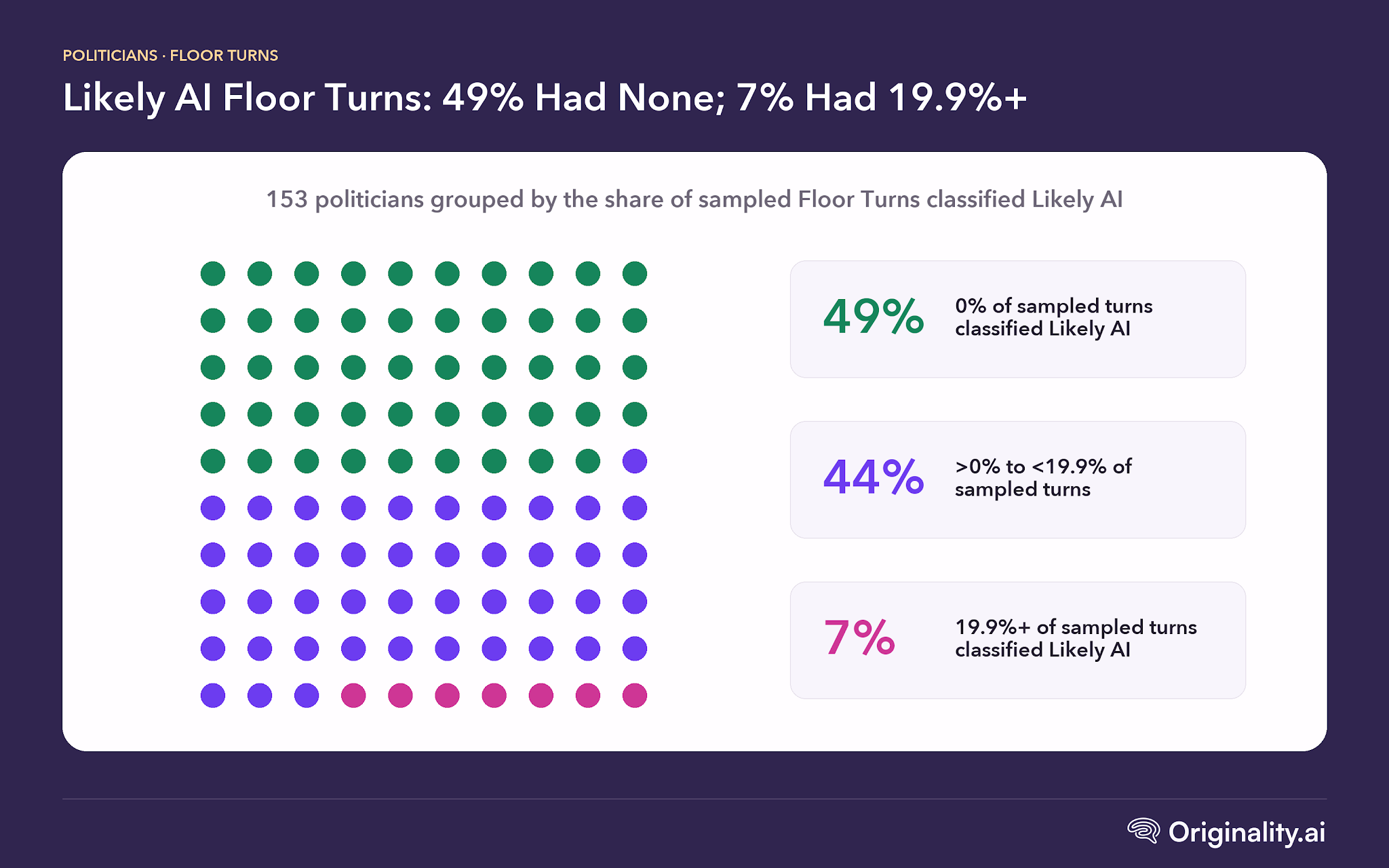
Among 153 politicians with at least 10 sampled Floor Turns, the estimated share of turns classified Likely AI ranged from 0% to 46.9%. Seventy-five had no sampled turns classified Likely AI, while the tenth-highest share was 19.9%.
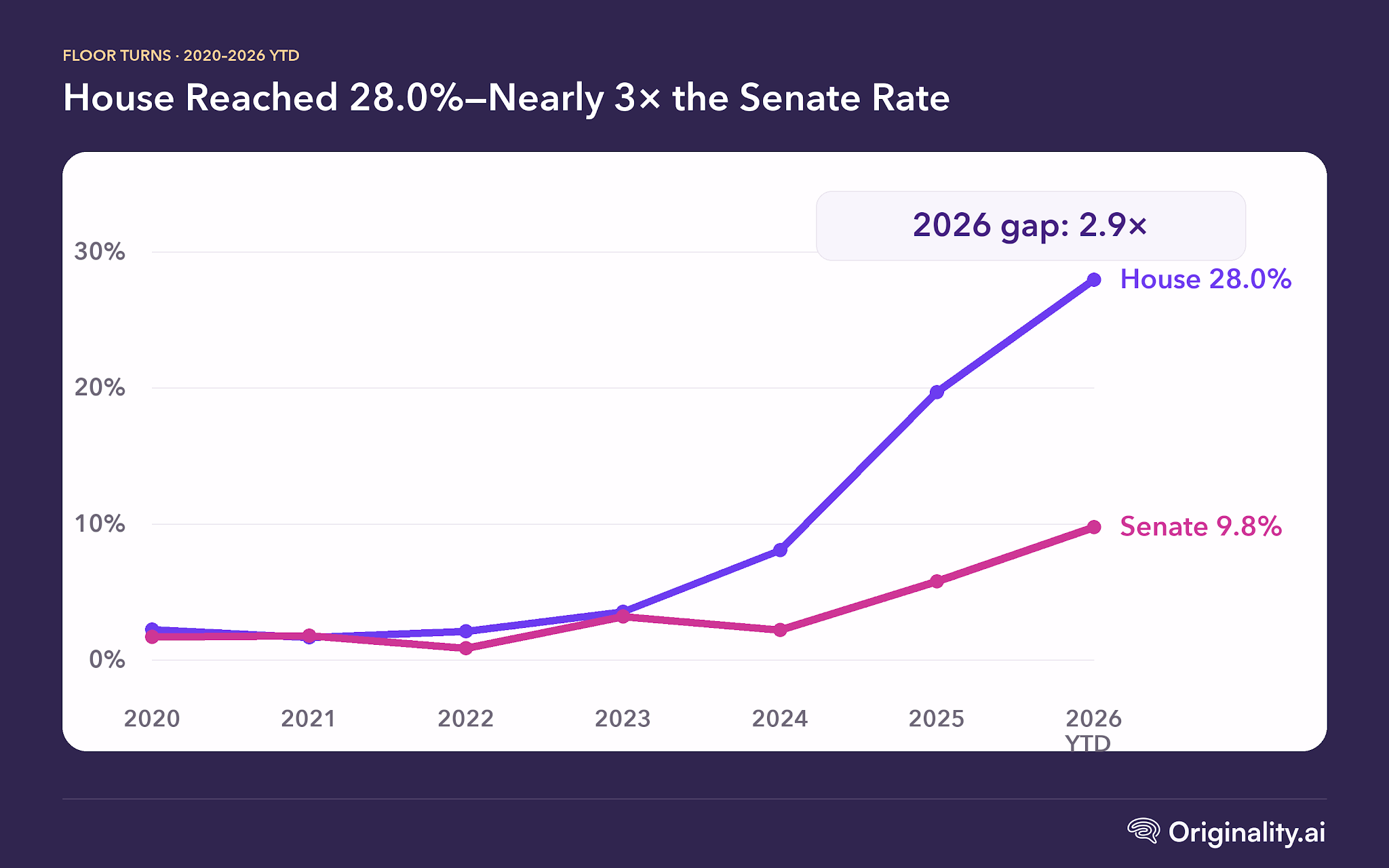
In 2025, an estimated 19.7% of House Floor Turns were classified Likely AI—1,659 of 8,427—compared with 5.8% of Senate Floor Turns, or 286 of 4,943.
In 2026 YTD, the House estimate rose to 28.0%—1,539 of 5,503—while the Senate estimate was 9.8%, or 250 of 2,562.
We independently recalculated the chamber-year estimates from the weighted sample. The public record does not identify why the gap exists; speaking formats, office workflows, staff support, and the mix of prepared remarks may all contribute.
We searched the full eligible corpus for direct AI references, first-person AI-use disclosures, exposed prompts, assistant preambles, and editing instructions. Thirty-seven candidates were manually reviewed.
We found two clear disclosures. Senator Marsha Blackburn said she queried Google's Gemma about herself and described the model fabricating an allegation. Senator John Cornyn said, “I asked my friendly AI assistant,” before presenting material connected to a request about parole programs. Neither senator said AI drafted the congressional language.
We found no AI-drafting disclosure and no hard AI residue in the U.S. corpus. That differs from the New Brunswick investigation, where apparent drafting instructions were read aloud.
If AI is used to draft or materially shape words entered into an official legislative record, a simple disclosure would let the public distinguish AI-assisted language from member- or staff-written text.
Likely AI language is no longer an isolated feature of the Congressional Record.
Its sharp growth in Extensions of Remarks and Floor Turns—while CRS summaries changed comparatively little—suggests AI is becoming part of how congressional material is prepared.
This shows that AI is materially shaping words entered into the public record.
Further Reading:

AI & Plagiarism Detector for Serious Content Publishers
Originality.ai
64 Hurontario St
Collingwood, Ontario
L9Y 2L6