AI Checker
Plagiarism Checker
Grammar Checker
Content Quality
Guideline Checker
Readability Checker
Fact & AI Hallucination Checker

Extensions
MCP

In the midst of the pandemic, remote work took center stage. Today, it’s part of a serious business strategy,
What does the remote work landscape look like in 2026? Are applicants still looking for remote work?
Then, considering the popularity of AI tools like ChatGPT, how is the rise of AI shaping remote productivity?
The following 20+ remote work statistics offer insight into the state of remote work and what you need to know to stay up to date with the latest workplace trends in 2026!
Let’s take a closer look.
Maintain transparency, whether you’re working remotely, hybrid, or in-office, in the age of AI with Originality.ai’s best-in-class patented content quality tools, including the most accurate AI detector.
Check out our pricing page for insights on features like team management to help your team publish with confidence, even as AI adoption continues across industries.
Source: Study available via ArXiv
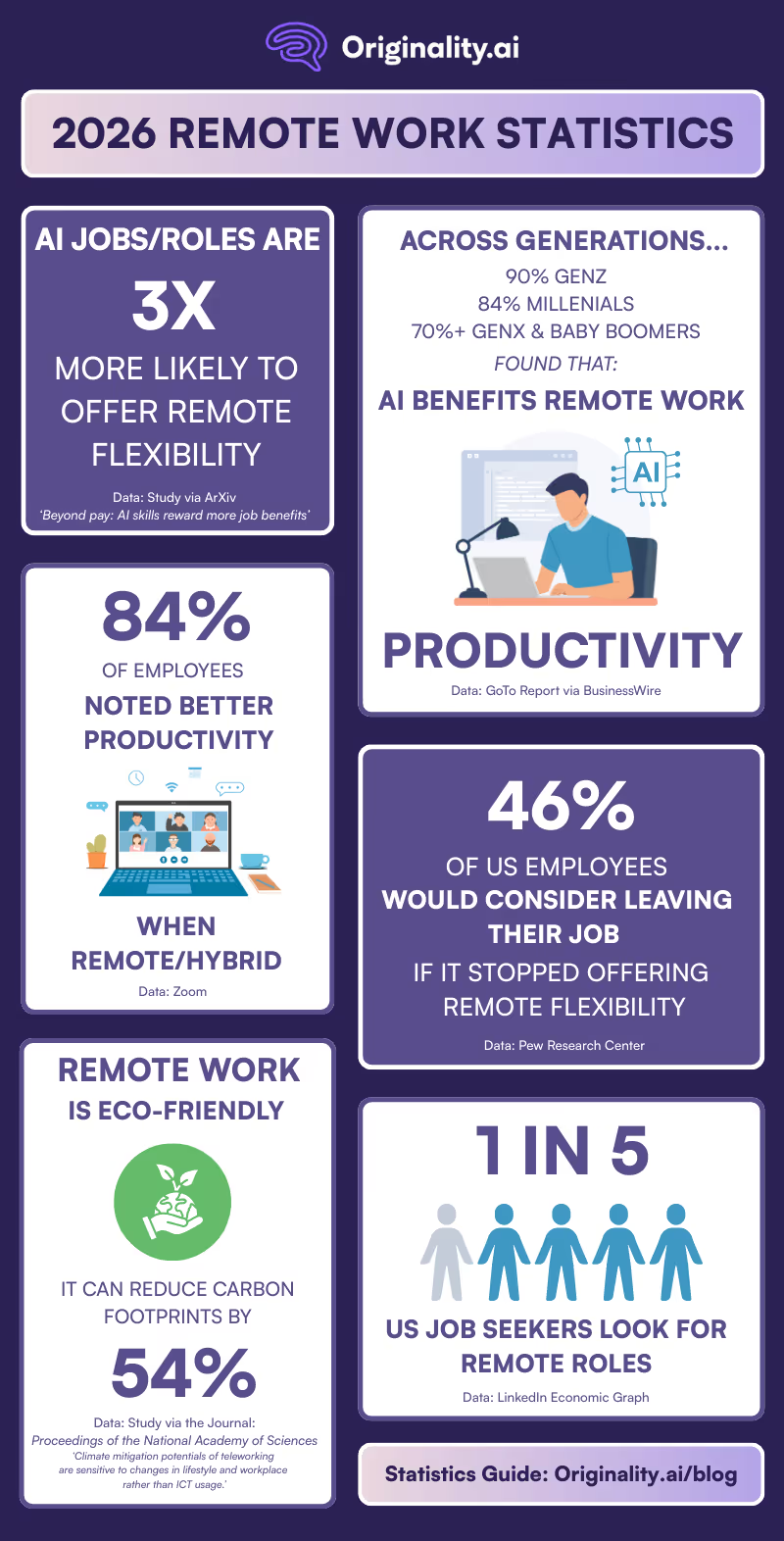
In a study that analyzed a dataset of approximately 10 million online job vacancies in the United States labor market (Jan 2018 - June 2024), researchers found that roles for AI jobs were about three times more likely to provide remote working choices.
Source: GoTo Press Release via Business Wire
The key takeaway here? Remote/hybrid workers across generations are finding that AI is beneficial for productivity.
Source: Pew Research Center
Remote work has gone mainstream, and it’s doing its best not to be relegated to a memory from the pandemic. A survey published in 2025 by Pew Research (data collected in 2024) highlighted this, noting that for 75% of those who can do their job remotely/at home, they are opting for that remote option — at least for a portion of the time.
Source: Gallup
Employers want on-site, while many employees want remote. To bypass the impasse, many businesses have settled on a hybrid work model as a compromise. More than half of the people who can go hybrid in the US do so (52% as of November, 2025). Around a quarter (26%) are fully remote.
Source: Statistics Canada
According to Statistics Canada, a high percentage of jobs can actually be done remotely or from home, about 4 in 10 of them (39% to be specific), as noted by a report published in 2024.
Source: Statistics Canada
While 4 in 10 Canadian jobs can be done from home, there has been a dip in recent years in how many Canadians actually work from home, from 40% in 2020 to 20% in 2023.
Source: Accenture
Accenture’s report highlights that people enjoy the flexibility of both home and office. Most knowledge workers prefer both.
Source: Slack
In 2020, during the pandemic, when workplaces transformed, Slack polled thousands of workers and found that a clear majority prefer hybrid; some time in the office, some time from home.
Source: Pew Research
According to Pew Research, US workers place a high value on flexibility. RTO (return-to-office) could cause companies to lose people, considering that 46% of employees in the US would be ‘unlikely’ to stay if remote and flexibility options were removed.
Sources: Zoom
There’s a high preference for remote or flexible work across several different surveys and reports, and employees are finding that those hybrid/remote roles are improving their productivity, too.
Source: NBER
The National Bureau of Economic Research published a paper in 2023, highlighting that remote workers save a notable 72 minutes each day… and they’re investing at least a portion of that time back into their jobs (40%).
Time saved often gets funneled back into work or activities that support it, like rest or exercise. That saved time adds up and is one of the biggest ways that remote work delivers a consistent ROI.
Source: ActivTrak
ActivTrak, a productivity tracker and workplace analytics platforms found that remote workers were more productive than the other work locations studied, with nearly half an hour of extra daily productivity.
Source: Owl Labs
Owl Labs (a brand that provides speakers/hardware to bridge hybrid/remote meetings) surveyed 2,300 full-time employees located in the United States and found that 51% are more creative remotely, and 49% are more likely to meet deadlines.
Surveys focused on creativity and deadlines show that many employees feel they get more creative space and can meet deadlines more reliably at home.
Keep in mind that the results for this particular survey were self-reported, but still, even the perception that they’re more creative and able to hit deadlines more consistently can help companies improve employee retention and loyalty.
Source: Cisco
It’s no surprise for many workers that productivity is 40%+ for those who have full flexibility about where they work vs. 34% reporting a positive productivity impact for 5-day in-office mandates.
Source: Statistics Canada
For remote workers in Canada, 9 in 10 (90%) felt they were just as productive working at home as they were at the office. This looked at Canadians who didn’t primarily work remotely before the pandemic and reported they were mainly working remotely in 2021.
Source: RobertHalf
Job posting reports show that remote listings in the US are still a minority in 2025 (12%). Hybrid roles, meanwhile, have been growing to nearly a quarter of new job postings:
In contrast, although fully on-site roles still make up the majority of listings, they are declining (64% in Q3 2025, down from 68% in Q3 2023).
Source: Fortune
In 2025, Fortune reported on LinkedIn data that found approximately 20% of US job postings on LinkedIn offer remote/hybrid options, while closer to 50% of UK job postings offer remote/hybrid roles.
Source: LinkedIn Economic Graph
The job distribution versus applicant intent is skewed. Although there are fewer remote postings out there, they draw high interest. With this in mind, recruiters and talent-sourcing agencies need to adjust accordingly. Prospective employees are filtering for remote/flexibility before they even read the title.
Source: FlexJobs
According to the FlexJobs Remote Work Index, 85% place remote work as the #1 consideration when they’re looking to apply to a position.
Source: Proceedings of the National Academy of Sciences, Journal
Remote work isn’t just better for people, it’s also good for the planet. A study by authors from Cornell University and Microsoft found that full-time remote work could reduce carbon footprints by 54%.
Source: Cornell Chronicle
The same study as above (this time referenced by Cornell) also showed that climate gains scale as remote work increases. Hybrid (2 to 4 remote days) still helps (reducing greenhouse gases by 11-29%). Every day not spent commuting equals emissions avoided. Multiply that number by a company’s headcount, and you’re looking at some seriously green goodness for the planet.
You could just look at these numbers as numbers…or you could look at them as signals.
While the pandemic might have marked a major shift in the remote work landscape, people buckled down, and they leveraged tools like Zoom, Slack, Teams, and more to keep collaboration going.
They automated what they could despite not being in the office, and key surveys found they maintained or improved productivity and had the potential to help out the planet with new flexible work arrangements.
As 2026 begins, AI adoption is the latest factor influencing and shaping remote work. Early signs indicate that the remote employees (across generations) are seeing it as beneficial to productivity.
Plus, with best-in-class content quality tools like Originality.ai, teams can navigate the impact of AI, maintain AI transparency, and continue to publish with confidence.
Try the Originality.ai AI detector today, or check out our pricing page for more insights on team management features to streamline remote editorial collaboration.
Check out our latest statistics guides:

AI & Plagiarism Detector for Serious Content Publishers
Originality.ai
64 Hurontario St
Collingwood, Ontario
L9Y 2L6