AI Checker
Plagiarism Checker
Grammar Checker
Content Quality
Guideline Checker
Readability Checker
Fact & AI Hallucination Checker

Extensions
MCP

It’s a pitch every publisher has heard by now.
AI lets you publish more content, faster, for a fraction of the cost.
Brown Brothers Media (BBM), for example, owns or operates dozens of websites, and it has made extensive use of AI to produce articles.
But did more articles actually translate to more readers? What did embracing AI actually mean for the media publisher?
To find out, we examined 37 BBM properties, recovered 96,914 article records, tested article samples for Likely AI content, and tracked how the sites’ traffic changed.
Here, we’ll take you through what we found, from the sites that grew to the ones whose search estimates fell to zero…
…and what other publishers should measure before scaling up AI content.
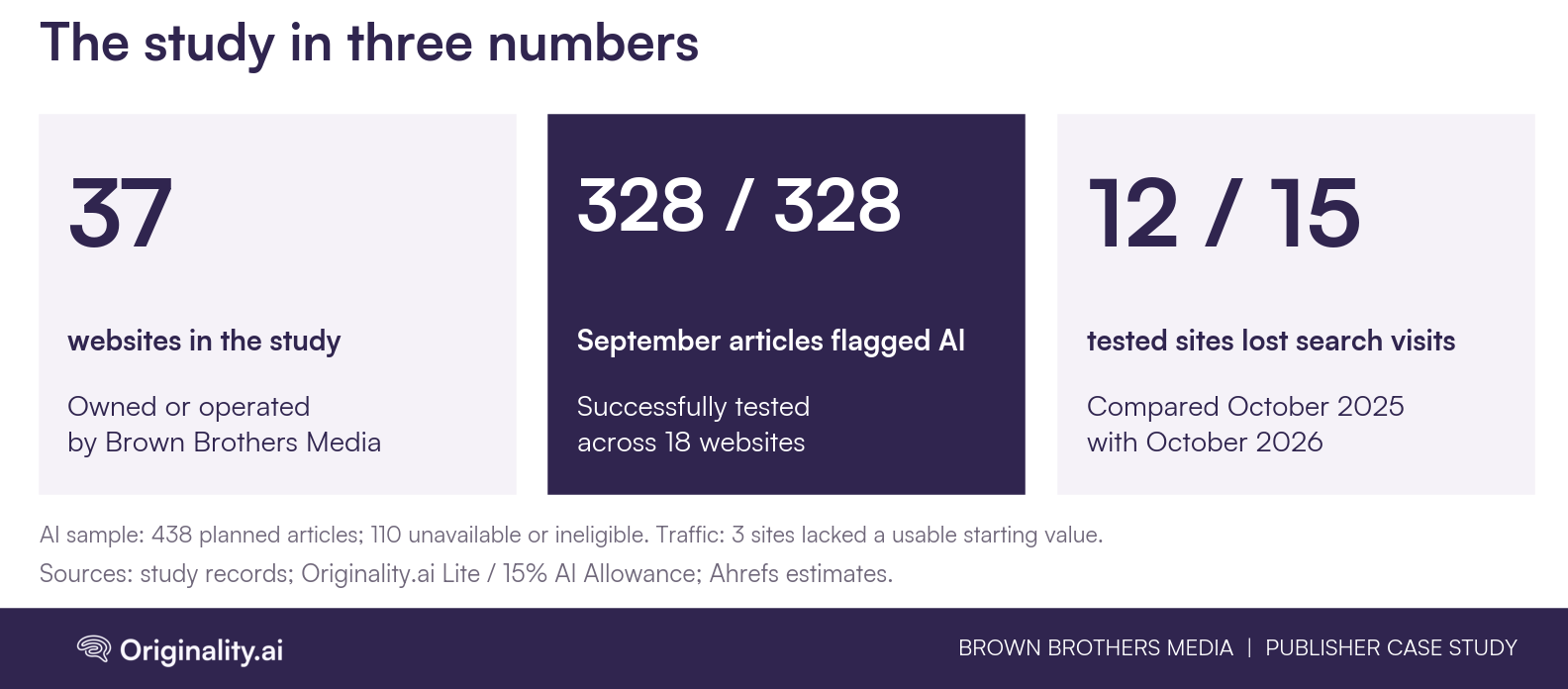
A quick note on what we mean by ‘Likely AI’. It’s a classification from Originality.ai’s AI detector (using the Lite model with 15% AI Allowance), not a measure of how much of an article AI wrote. Search traffic figures are Ahrefs estimates, and the article and traffic histories include periods before BBM owned some of these sites.
Before we analyze the impact of AI, let’s review what Brown Brothers Media is.
Essentially, Brown Brothers Media is a Singapore-based publishing company founded in 2020.
According to its company history, the brothers behind it already had businesses of their own. Brendan Brown built an editing business, Lachlan Brown founded Hack Spirit, and Justin Brown is listed as a Co-Founder of Ideapod.
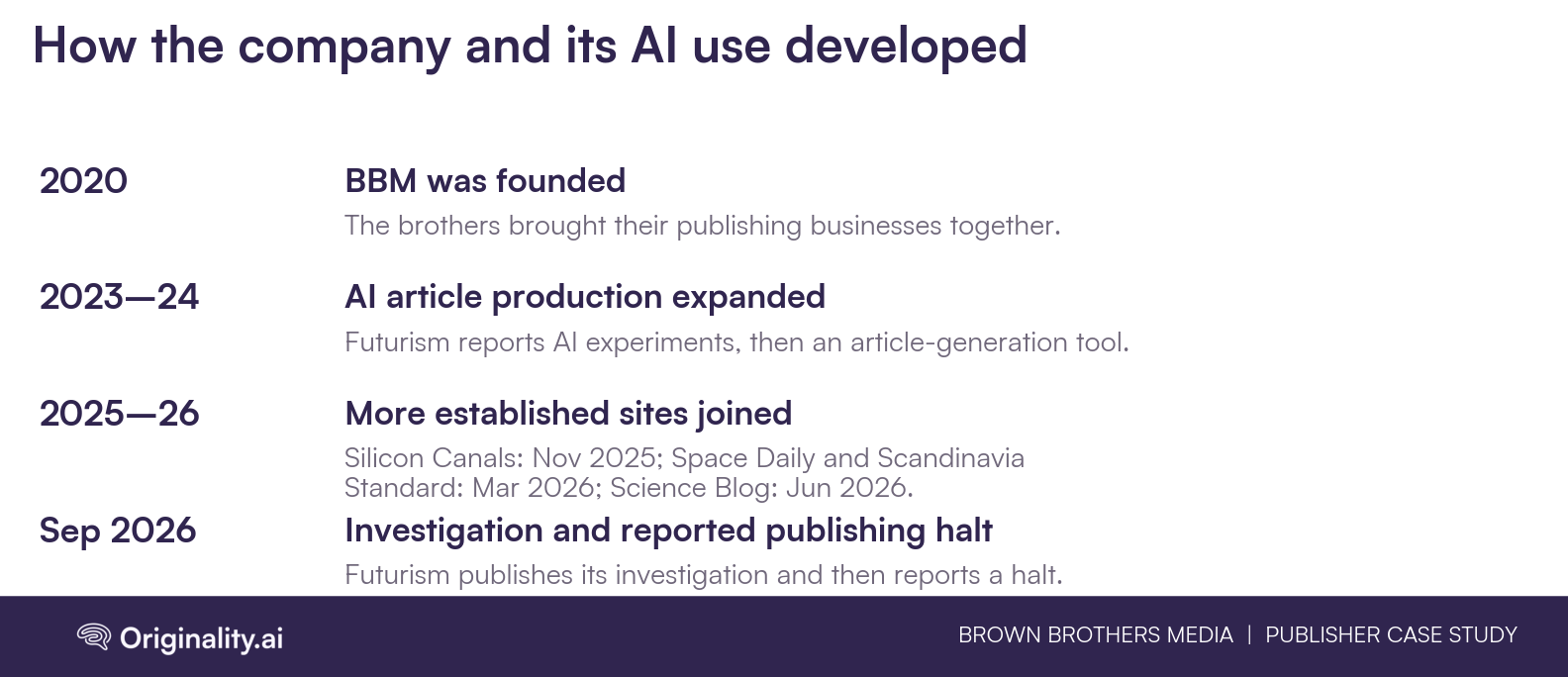
From there, BBM expanded by buying established publications with readers and years of articles behind them.
More titles joined in 2025 and 2026, according to the company’s updates blog, including Silicon Canals in November 2025, Space Daily and Scandinavia Standard in March 2026, and Science Blog in June 2026.
In its editorial guidelines, BBM states that it makes money primarily through display advertising, alongside affiliate products in some articles and pages. In other words, the bigger the audience, the more chances there are to earn from ads.
According to a Futurism investigation by reporters Maggie Harrison Dupre and Jon Christian, BBM experimented with AI in 2023, or what the company reportedly called “robot” content.
The investigation further noted that by 2024, the company started using a WordPress AI tool that it had built internally.
Futurism cited former contractors and internal records, including a spreadsheet they obtained that listed more than 60 active writers in December 2023. By December 2024, that number had dropped dramatically, according to the same spreadsheet, and fell to just 12 writers, all generating content with AI.
Futurism’s reporting also raised questions about who was actually getting credit for the work.
In a separate piece on Space Daily, Futurism examined profiles that claimed NASA and European Space Agency (ESA) expertise. However, the ESA reportedly had no record of one of the claimed employees.
In a September 2026 update to its editorial framework, BBM acknowledged using fictional contributor profiles, made-up credentials, and even stated it “attributed experiences to people who did not exist.” The statement noted that those profiles were retired in May 2026, and that their review of older articles is still in progress.
As for new articles, they say those now require approval by a team member.
ChatGPT launched in November 2022, but adoption has varied across industries, including within the world of web publishing.
So, when did AI become commonplace at Brown Brothers Media? Let’s take a look.
The graphic below compares earlier and later samples from four of them:
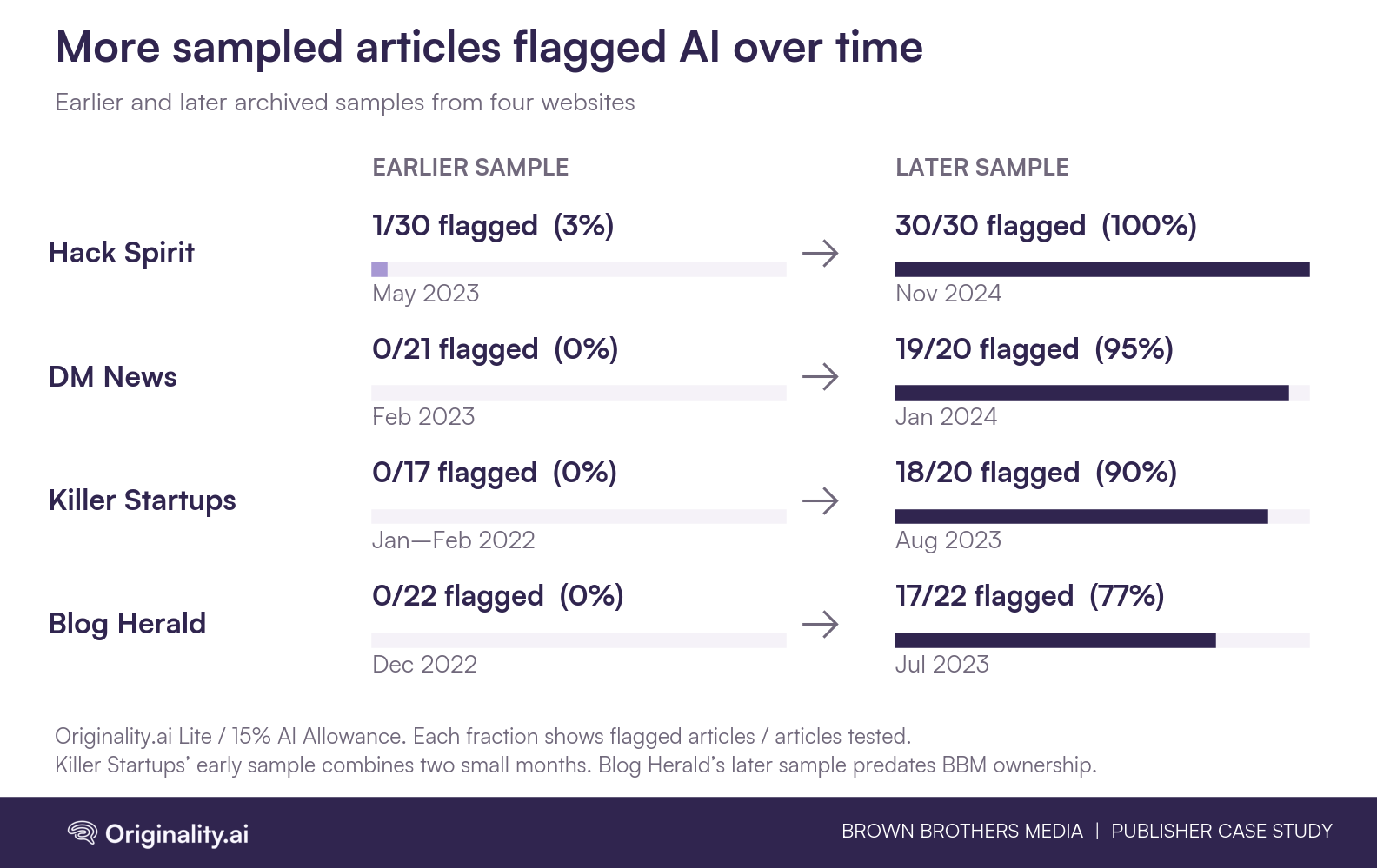
Hack Spirit (founded by Lachlan Brown in 2016) offers a clear example. Just one of the 30 articles from May 2023 was flagged as Likely AI, but by November 2024, all 30 tested articles were flagged.
DMNews and KillerStartups followed a similar path, moving from samples with no flagged articles to a majority of tested articles being Likely AI.
Blog Herald’s results need a different explanation.
Seventeen of the twenty-two July 2023 articles we tested were flagged as Likely AI, more than a year before the October 2024 acquisition date stated on its about page. That means the earlier results can’t be attributed to BBM’s ownership.
It’s worth being clear about what these comparisons can and can’t tell us.
They show changes in the samples we were able to recover, but the gaps in the archives mean we can’t name an exact month when each site started using AI.
Across the study, we tested 1,300 historical articles from 13 sites.
Let’s take a closer look at Hack Spirit, where AI signals crept up gradually through 2023. In May, one of 30 articles was flagged, rising to 15 of 30 in September, and all 30 tested articles by November 2024.
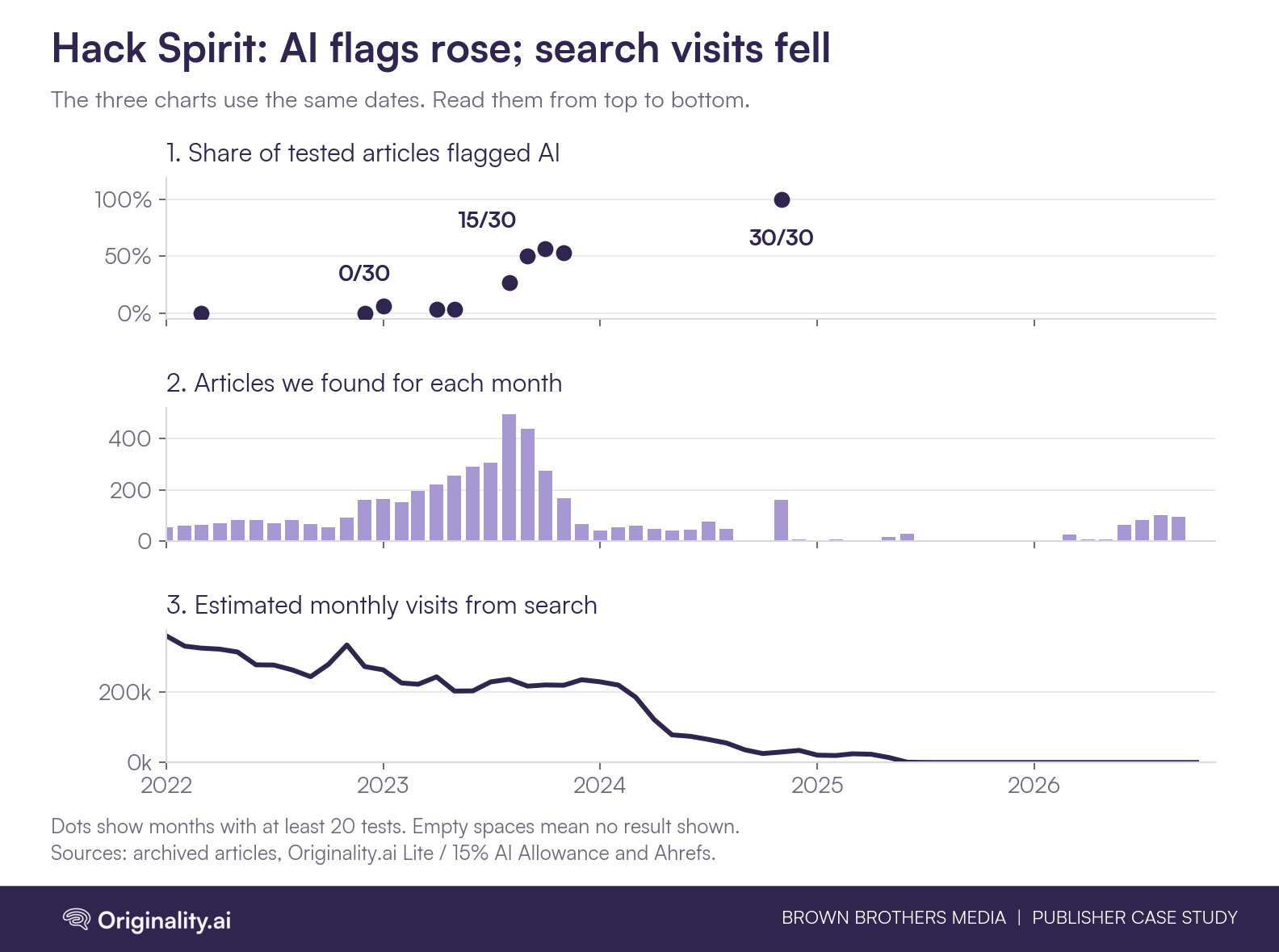
Over the same period, estimated monthly visits from search fell 85.4% from 201,722 in May 2023 to 29,536 in November 2024.
By October 2026, the estimate was zero.
Did AI content cause the drop? Not necessarily.
The full timeline shows that Hack Spirit’s traffic had already started falling before most sample articles were flagged as AI.
There’s another detail worth noting. We found 4,966 dated articles for Hack Spirit, and 4,440 of them were missing from the site’s current article listings.
Without archived copies, we simply couldn’t have reconstructed this history.
If Hack Spirit shows a gradual shift, Small Biz Technology shows what publishing at full volume looks like.
It should be noted that unlike some of its other publications, with clear acquisition dates, for SmallBizTechnology, its About Page clearly states it’s part of Brown Brothers Media, but not when it was acquired.
Between January and March 2025, the site published at least 1,166 articles, or about 13 a day.
We tested 30 articles from each month, and all 90 were flagged as likely AI.
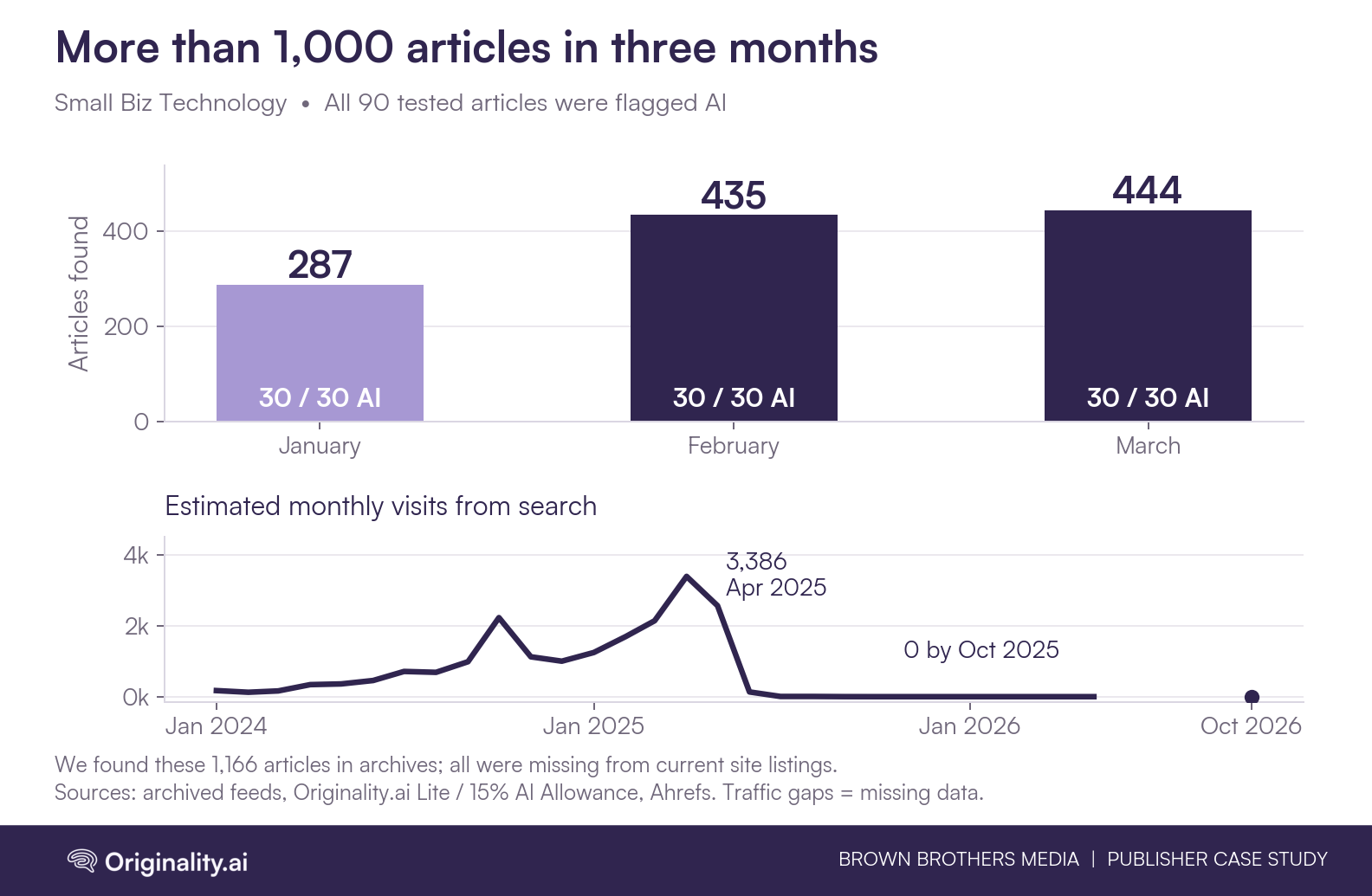
At first, search traffic rose, with the highest estimate we observed reaching 3,386 monthly visits in April 2025, just after that quarter.
Then it fell off a cliff.
By October 2025, the estimate had fallen to zero, and it was still zero at the study’s October 2026 endpoint.
Of the articles themselves, all 1,166 were absent from the site’s current article listings when we collected our data.
Interestingly, when a user navigates to SmallBizTechnology’s homepage, the articles featured are from 2024. Something that stands out, even at a glance, considering most publishers highlight their most important and recent articles on the homepage.
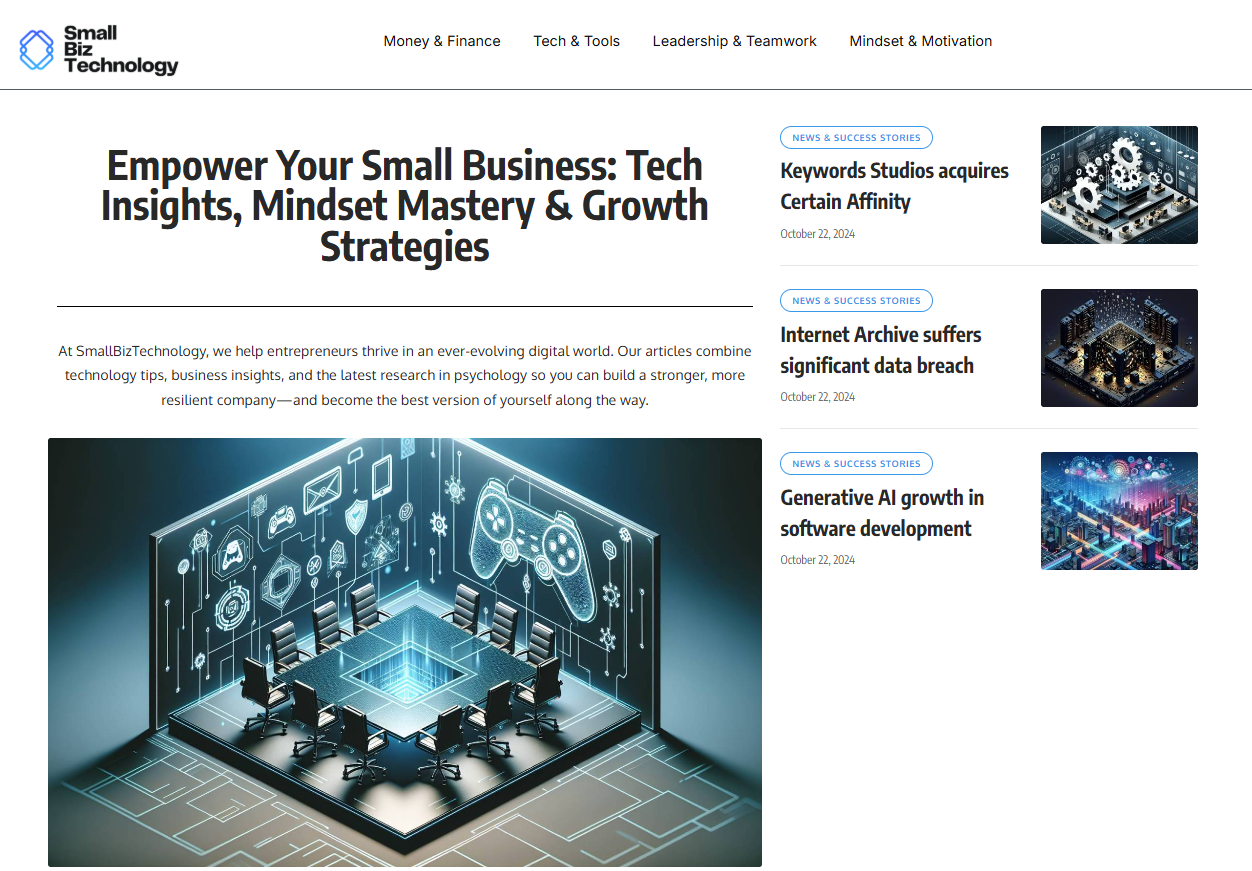
Screenshot of SmallBizTechnology’s Homepage Captured October 10, 2026
Archived feeds preserved their publication records, but we don’t have a removal date for each article.
This is exactly why article output and audience need to be measured separately. Higher volumes of publication don’t always translate to higher traffic.
Other sites lost search traffic too.
We compared October 2025 with October 2026 for all 18 sites with September AI results, which had a starting search estimate above zero.
Of those 15: 12 declined, two grew, and one changed little.
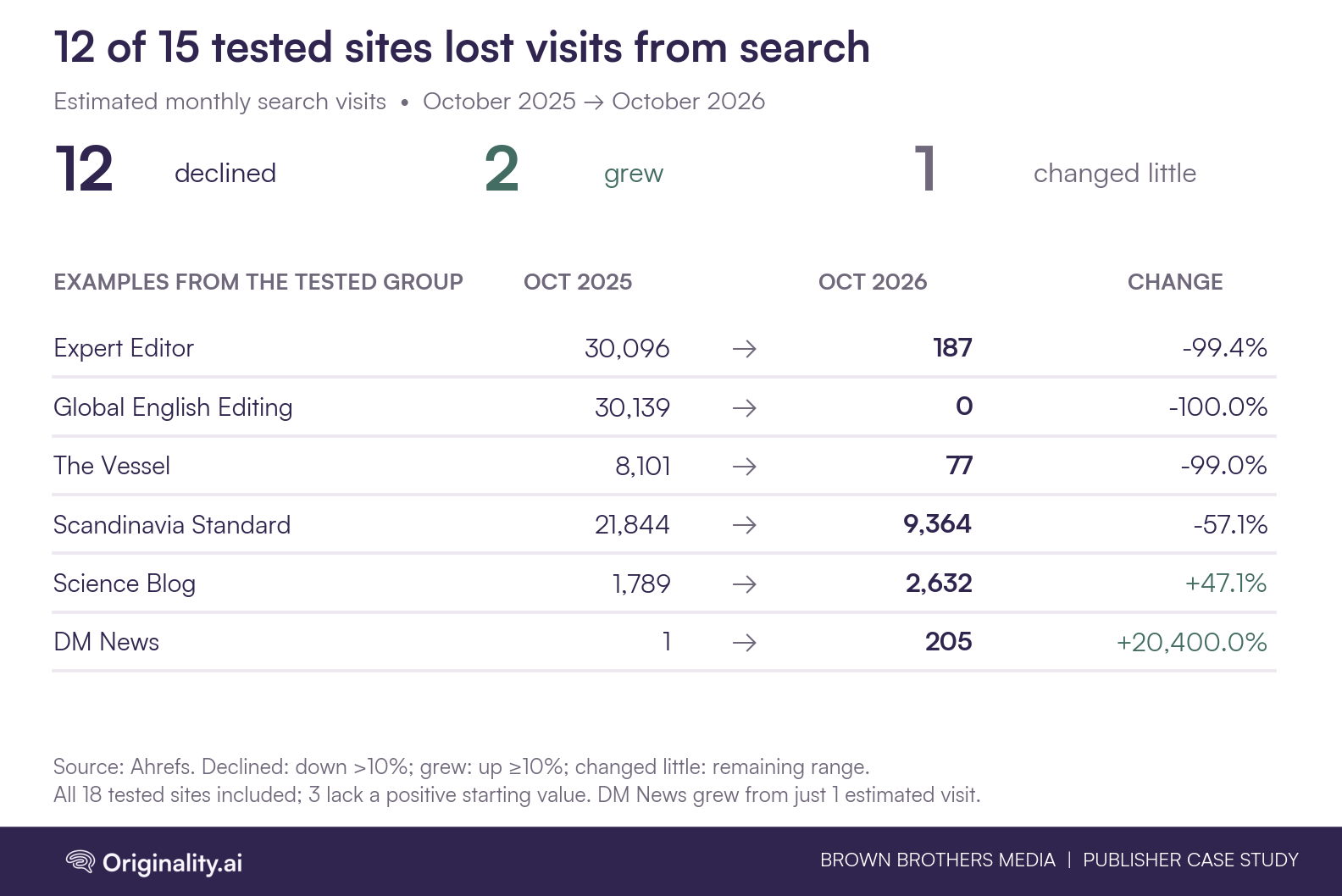
Science Blog was the clear exception. All 30 of its tested September articles flagged AI, while its search estimate grew 47.1%, from 1,789 to 2,632.
DMNews also grew, although from a very small starting point, going from one estimated visit to 205.
Other BBM sites grew too, with Make Tech Easier increasing 369.2% to 47,067, and Space Daily increasing 62.4% to 14,017. However, we didn’t obtain usable September AI test results for either site, so they are outside the comparison above.
Zoom out to the wider group of 27 BBM sites with usable starting values, and the picture looks much the same: 21 declined, five grew, and one changed little.
Note: Some sites joined BBM during that year, so the comparison describes traffic across the whole year, including any time before acquisition.
Of course, search is only one way readers reach a website.
Similarweb’s estimates for August 2026 show that several BBM sites still attracted very large audiences across all traffic sources.
Space Daily alone had an estimated 30.8 million visits that month, while Science Blog had 12.2 million.
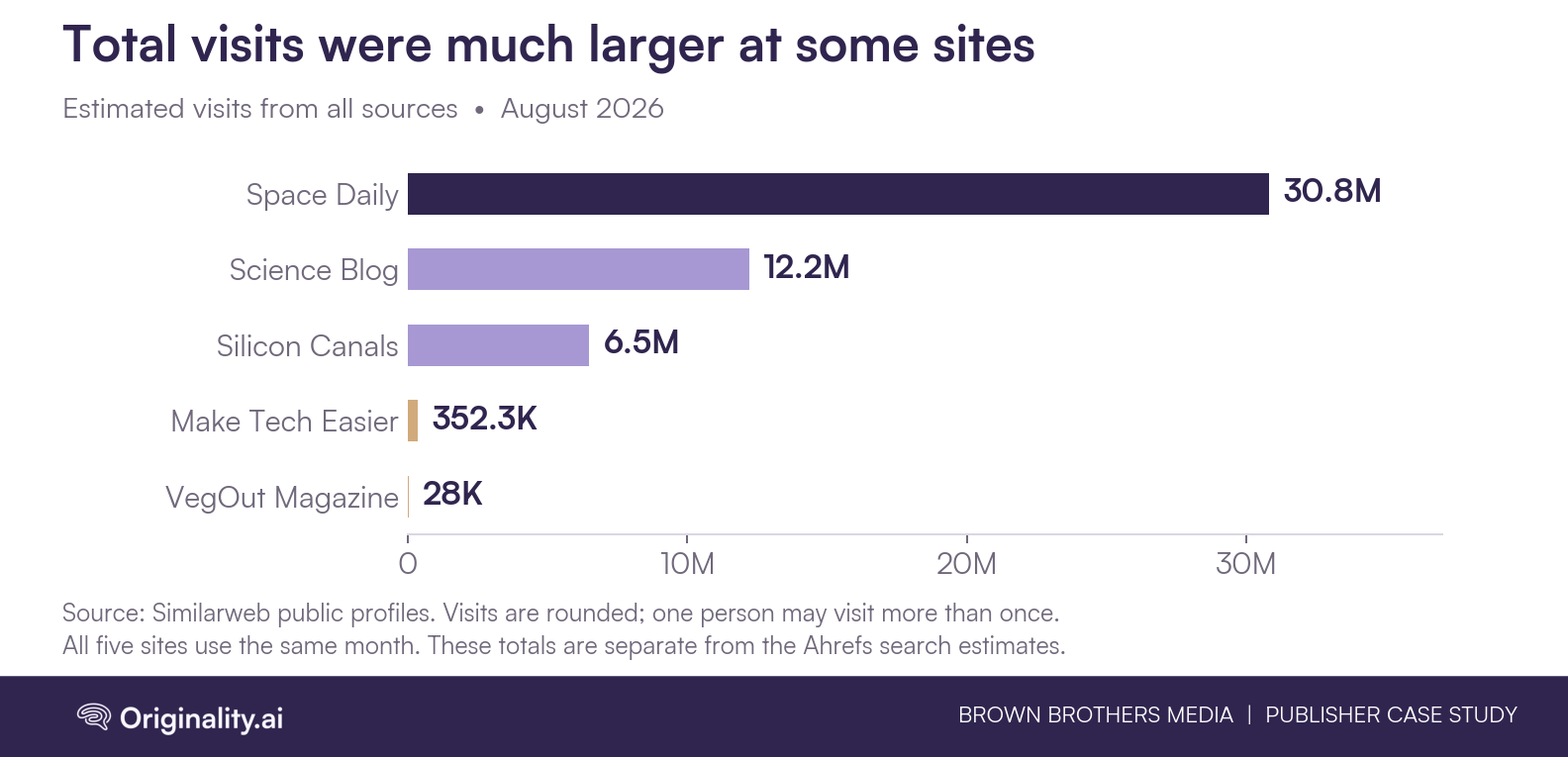
Ahrefs and Similarweb measure different things. Ahrefs estimates visits from unpaid search results, while Similarweb estimates total visits, including sources such as search, links, social media, and direct visits.
Think of it like a shop. Ahrefs estimates the visits that come in from search results, while Similarweb tries to estimate every visit through the door, regardless of how it arrives.
That’s why a site can have a small search estimate and a large total-visit estimate at the same time.
Bear in mind, too, that a visit is not the same as a unique reader.
Where is the rest of that audience coming from?
Unfortunately, our data can’t tell us how much came from Google Discover or Google News.
Futurism reported that BBM sites appeared prominently on Google’s platforms. Google’s own guidance says Discover traffic is less predictable than traffic from keyword searches.
BBM has made big audience claims of its own. In its 2025 year in review, the company claimed more than 200 million readers crossed the network that year, including more than 100 million at VegOut. Keep in mind, those are company claims, and we are not given the underlying analytics.
For publishers, the distinction matters, because failing search traffic can sit alongside a large audience elsewhere.
The bit that actually matters is which of those sources bring readers back reliably.
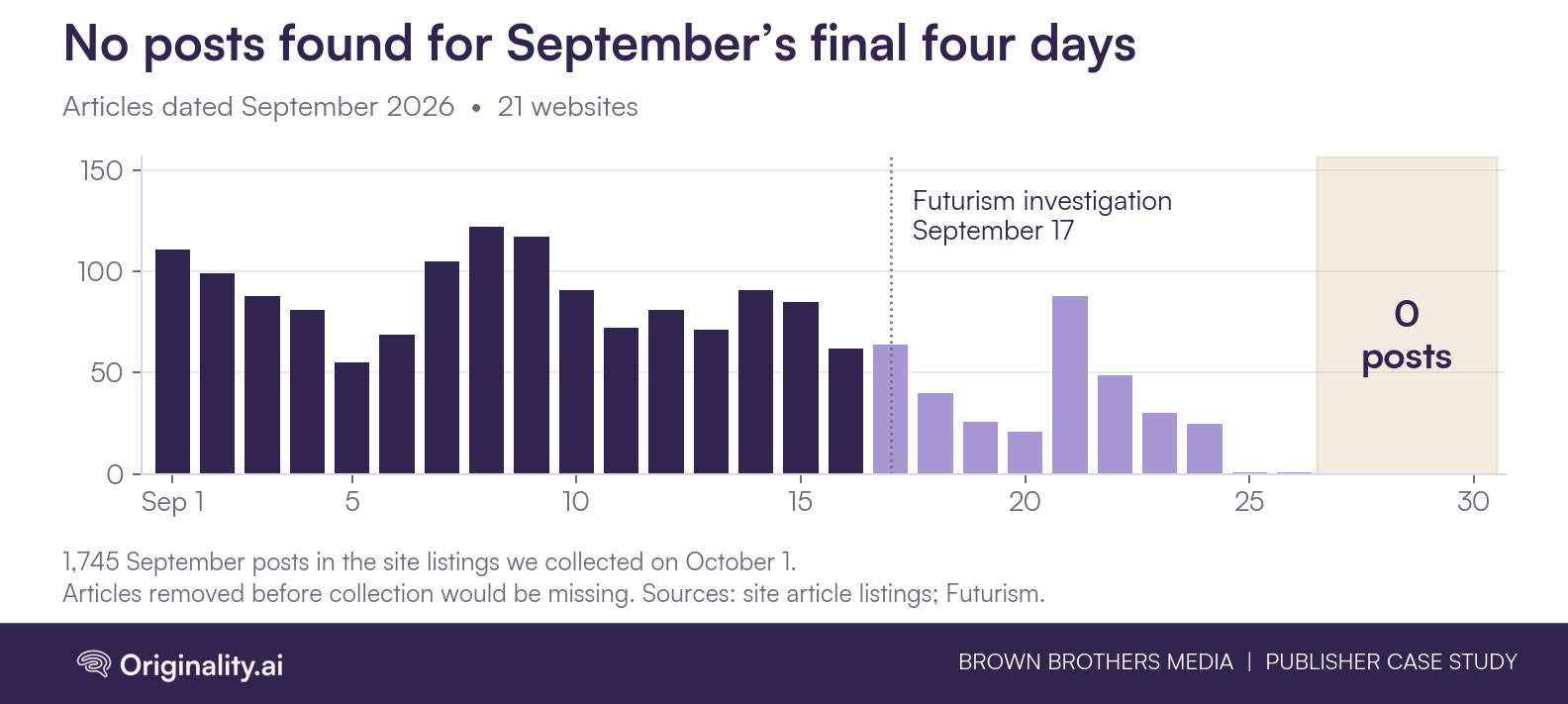
We found 1,745 September articles in the current article listings of 21 BBM sites, with 122 on the busiest day.
By the end of the month, that had slowed to a trickle.
There was only one article dated September 25, 2026, one dated September 26, 2026, and none at all in the final four days.
Here’s how those dates line up with the reporting.
Futurism published its initial investigation on September 17, 2026.
Then, in a follow-up on September 30, 2026, it reported that BBM had halted publishing and that many of its sites had become difficult to find through Google, even when searching for the sites by name.
Our article counts support the reported publishing pause. They only cover posts that were still visible when we collected the data, though, so any articles removed before then would be missing.
Importantly, the reporting did not confirm a specific Google enforcement action.
For context, Google’s scaled-content policy prohibits generating large amounts of content primarily to manipulate rankings rather than help users, regardless of how it’s produced, including with AI.
The sequence, at least, is clear.
BBM built a large group of publications, made extensive use of AI, faced public scrutiny, and then published very little in the final week we measured.
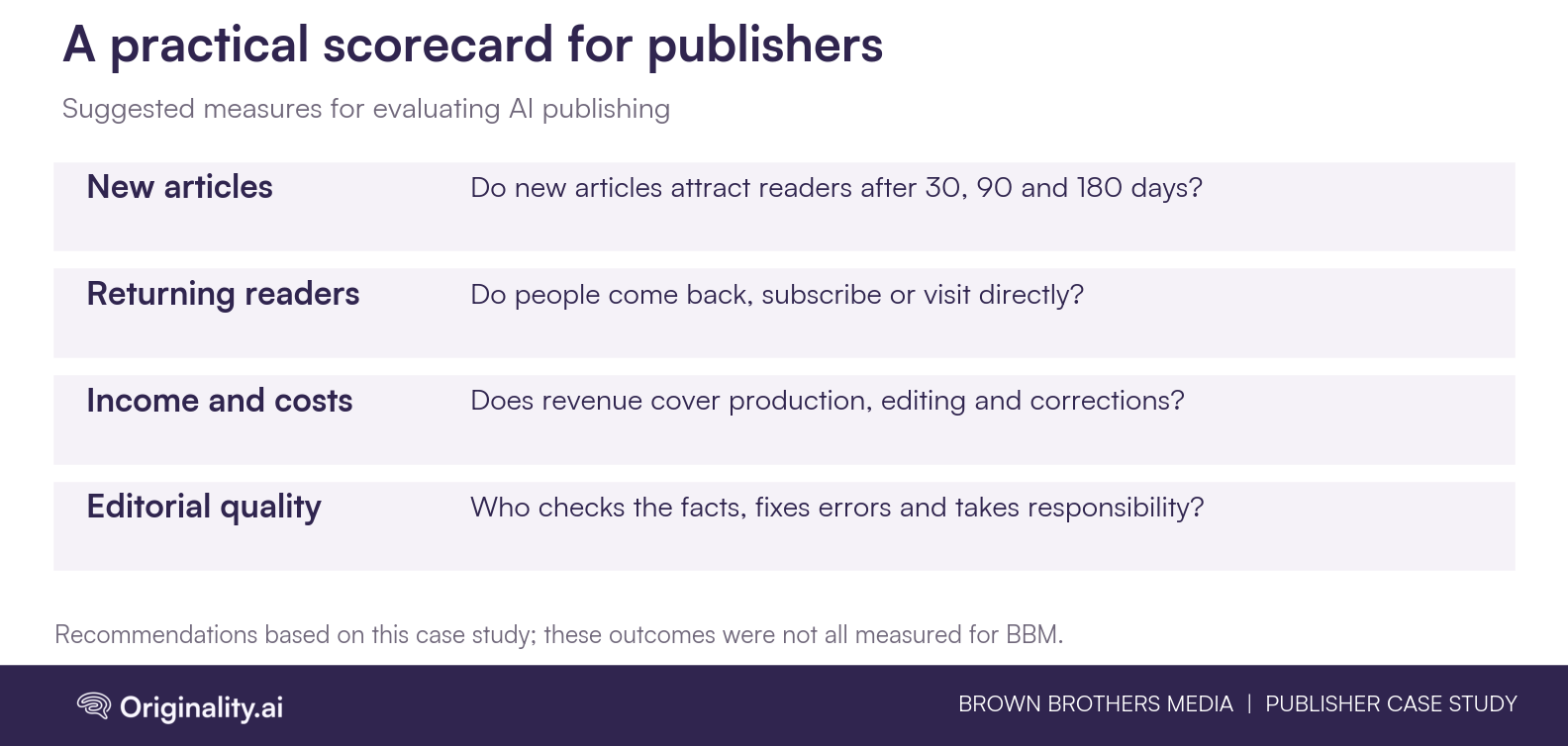
If there’s one lesson to take from BBM, it’s to measure what new articles contribute over time.
Article counts alone can’t tell you whether an AI publishing strategy is working, and SmallBizTechnology’s 1,166-post quarter shows exactly why.
The numbers that matter aren’t how many articles you published this month. They’re what those articles are still doing 30, 90, and 180 days later.
Take The Law Dictionary, whose about page says articles published since its October 2025 acquisition use AI assistance.
Its average search estimate rose 33.7% in the next three observations compared with the previous three. On the surface, that looks like a win for AI content.
The catch? Seventeen of the 19 distinct leading pages we checked had archived copies from 2022, years before the acquisition.
So, a whole-site traffic increase doesn’t show how much the new articles actually contributed.
It’s a bit like judging a new chef on a restaurant’s total sales when the best-sellers are still old favorites.
The site’s search estimate later fell from a January 2026 peak of 201,906 to 100,535 in October. Tracking new and older articles separately would show which group gained or lost readers.
Dotdash Meredith, renamed People Inc. in 2025, announced an OpenAI partnership in May 2024 covering content licensing and advertising technology.
Yet, its rebrand emphasizes human experience and expertise, “People Inc. boldly reflects the company's enduring commitment to content and experiences – made by people for people…” - People Inc.
Axel Springer’s 2025 strategy also emphasized AI, alongside stronger direct relationships with readers and less dependence on search and social platforms. They emphasized that humans still had a key hybrid role, alongside AI: “This isn’t AI versus human intelligence—it’s AI with human intelligence.”
Brown Brother Media’s results show why those details matter.
Some sites gained traffic, but many lost it, and more articles did not consistently mean a larger search audience.
One caveat: this study measures publishing and traffic, not BBM’s revenue or profit.
Brown Brothers Media shows that publishing a lot and building a lasting audience are two very different outcomes.
AI use was widespread in the articles we tested, but the traffic results were mixed. Most comparable tested sites lost search visits, a few grew, and some still attracted large audiences from other sources.
So, if you’re banking on AI volume alone to build a lasting search audience, BBM’s numbers don’t make that case.
For publishers considering AI, the practical test is whether new articles stay useful, bring readers back, and earn enough to pay for careful editing.
Article volume alone can’t answer those questions.
Want to transparently check your content? Run it through Originality.ai’s AI Checker, the same detector used for this study.
We investigated 47 domains and verified 37 distinct BBM-owned or operated properties. Artful Parent and The Artful Age count as one property; Ideapod’s partnership is tracked separately. Sitemaps, site listings and archived pages and feeds supplied 96,914 dated articles from January 2022 through September 2026. These minimum recovered counts include 6,903 articles absent from current listings and periods before BBM ownership.
Historical testing covered 1,300 articles across 132 monthly samples at 13 sites. Each text was archived within 45 days of publication. A fixed, reproducible order selected up to 30 eligible English-language articles per site per month. One hundred monthly samples had fewer than 20 articles and remained descriptive.
The September sample included 438 planned articles from 21 sites. We successfully tested 328 articles from 18 sites; 110 were unavailable or ineligible. We used the Originality.ai API, Lite, with AI Allowance set to 15%. Returned AI confidence of at least 0.50 counted as Likely AI. That classification is not the percentage of words generated by AI.
Ahrefs estimates are compared as of October 1, 2025 and October 1, 2026. Decline means a fall greater than 10%; growth means an increase of at least 10%; other changes are classed as little change. Zero or missing starting values are excluded. Missing observations stay missing. Similarweb figures measure total visits in their stated calendar month.
The report was adapted to the evidence collected. No site met our original complete-evidence rule for an exact AI start month. The traffic comparison was added after collection and includes all 18 sites with successful September tests.
Originality.ai commissioned the research and sells the detector used. AI assisted with research organization, code and drafting. Public company responses and earlier reporting are linked. No new requests for comment have been sent; this draft remains subject to final editorial review.
Research Source List:

AI & Plagiarism Detector for Serious Content Publishers
Originality.ai
64 Hurontario St
Collingwood, Ontario
L9Y 2L6