AI Checker
Plagiarism Checker
Grammar Checker
Content Quality
Guideline Checker
Readability Checker
Fact & AI Hallucination Checker

Extensions
MCP

It’s no secret that artificial intelligence tools like ChatGPT and Claude have rapidly become an indispensable layer of modern business (just check out these stats on AI adoption).
Beyond business, what is rapidly becoming apparent is that generative AI also has the potential for institution-wide influence on education as well.
This was further highlighted with both Anthropic’s Claude and OpenAI’s ChatGPT launches of education-specific solutions, aimed specifically at universities and colleges.
In this article, we will look at how AI tools, specifically Claude and ChatGPT, are expanding into academia. Then, we’ll discuss how AI tools are expanding into academia.
Maintain transparency as AI is being increasingly adopted into education with Originality.ai.
In April 2025, Anthropic formally launched Claude for Education, an AI assistant designed specifically with universities and colleges in mind.
Claude for Education is designed to emphasize academic integrity, thoughtful learning, and privacy.
At first glance, it would be easy to think Claude for Education is just another chatbot.
However, unlike most chatbots that focus on providing answers, with features like Learning Mode, the tool is designed to guide users to get there on their own.
As part of the launch announcement, Anthropic also noted specific campus agreements (such as with Northeastern University and Champlain College) that would make Claude accessible to students at those institutions.
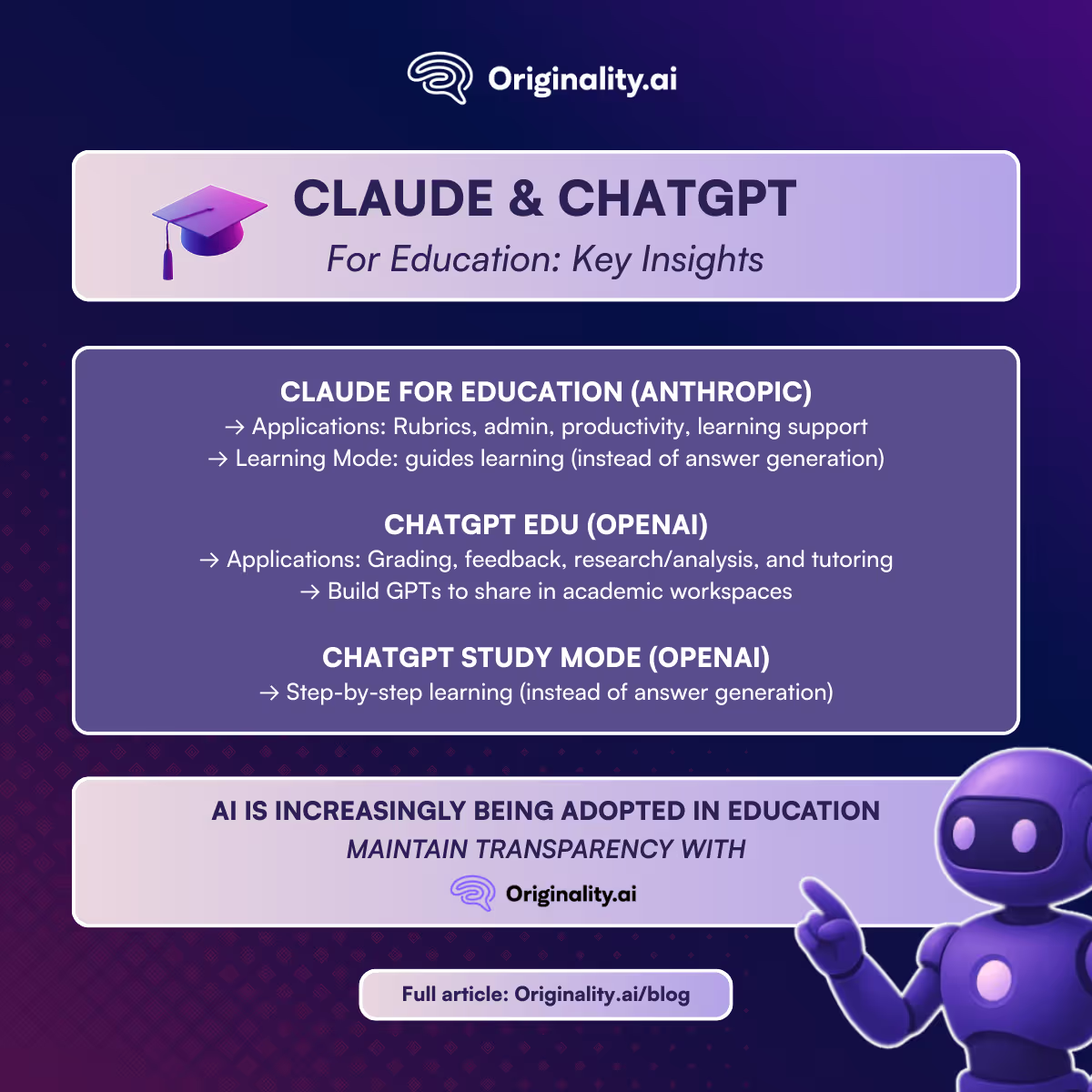
Claude for Education Applications: Rubrics, admin, productivity, learning support
Launched almost one year prior (May 2024), OpenAI’s ChatGPT Edu represents the company’s tailored solution for higher education, formalizing the academic usage of AI tools through custom GPTs, privacy features, and scalability for colleges and universities.
Initially built with GPT-4o, ChatGPT Edu was designed to enhance productivity and creativity, allowing students and staff to do more with less friction.
As of writing this article, ChatGPT Education now offers expanded access to GPT‑5.
ChatGPT Edu Applications: Grading, feedback, research/analysis, and tutoring
As well as ChatGPT Edu, designed for higher education, OpenAI also released ChatGPT Study Mode in July 2025. When launched, ChatGPT Study Mode was made available to a wide user base, including on Free and Pro plans, and more.
The use case for ChatGPT Study Mode is similar to Claude’s Learning Mode, both of which highlight that they provide support for learning rather than just quickly generating an answer.
ChatGPT Study Applications: Step-by-step learning (instead of answer generation)
With two major players in the generative AI space moving into education, what does that mean for the role of AI tools in academia?
Here are seven key insights.
When generative AI first burst onto the mainstream back in late 2022 (when ChatGPT launched), it quickly entered the spotlight.
Today, Claude and ChatGPT are becoming embedded in the daily academic routines of students, and are quickly becoming as routine a learning tool as textbooks or tutoring.
Learn even more about AI’s impact on education with 70+ AI in education statistics.
It isn’t just students who are becoming more familiar with AI tools, as many educators are now incorporating AI into their teaching workflows.
Professors can now use Claude for Education for everything from drafting rubrics to generating equations about chemistry.
Then, ChatGPT Edu has potential use cases for faculty, such as feedback and grading. It also offers researchers advanced analytical capabilities.
As you would imagine with education, both Anthropic and OpenAI have taken significant steps to address compliance and privacy for university policies. This is to help address privacy concerns.
For instance, Anthropic notes that Claude for Education has “enterprise-grade security,” while ChatGPT Edu highlights “data encryption” and that “No data or conversations used to train OpenAI models.”
AI fluency is rapidly becoming a foundational skill, with universities now rapidly building curricula around AI literacy.
Universities are now looking into ways that they can teach students not just how to use AI, but also how to question it, understand its challenges, and integrate it ethically into their work.
For instance, Anthropic noted that Northeastern University developed an academic plan focused on AI and how it could potentially impact learning.
Given how readily available generative AI tools now are, traditional assignments may be rethought as educators are looking into assessments that allow them to evaluate student understanding.
As with many use cases of generative AI, some of the main concerns revolve around academic ethical integrity. While both ChatGPT and Claude have the potential to support learning, they also have the ability to shortcut it.
Institutions now need to draw clearer lines on acceptable use, creating a clear approach and policy that students can then stick to.
The releases from Claude and ChatGPT are just the beginning of what’s to come regarding AI in education. As more AI education tools continue to emerge, it is unavoidable that academia will become a place of experimentation, disruption, and even reinvention.
As Claude and ChatGPT continue to gain traction across university campuses, there is one thing that is clear.
AI’s role in education is quickly becoming foundational:
But with that foundation must come a commitment to responsible, transparent, and ethical use.
Any university that opts to adopt AI tools must do so with one eye on student integrity and transparency, allowing them to differentiate between genuine effort and AI-assisted shortcuts.
That’s where Originality.ai can support students and teachers. Our industry-leading AI detection for education is crucial for providing transparency in academia around whether writing is Likely AI or human-written.
Further Reading on AI in Education:

AI & Plagiarism Detector for Serious Content Publishers
Originality.ai
64 Hurontario St
Collingwood, Ontario
L9Y 2L6