AI Checker
Plagiarism Checker
Grammar Checker
Content Quality
Guideline Checker
Readability Checker
Fact & AI Hallucination Checker

Extensions
MCP

AI now helps write, edit, summarize, and translate large swathes of what we read online.
Increasingly, sites are starting to be transparent about their AI use, with lines like “this article was created with the assistance of AI.”
But how often does that actually happen?
That’s a much different question from how much AI content is out there, and one that our new AI content disclosure dashboard is built to analyze.
In this study, we’ll look at what AI content disclosure is, the many ways it’s worded, and why it matters.
AI content disclosure is a public-facing statement that AI was involved in producing a piece of content, whether that’s drafting the text, editing it, or even generating an image.
It helps to clarify three things people tend to merge together:
As it’s still in its infancy, there is no official wording for AI disclosure, meaning it can range from a quick couple of words to a full editorial statement.
There are a few common approaches to writing an AI disclosure noted in the table below:
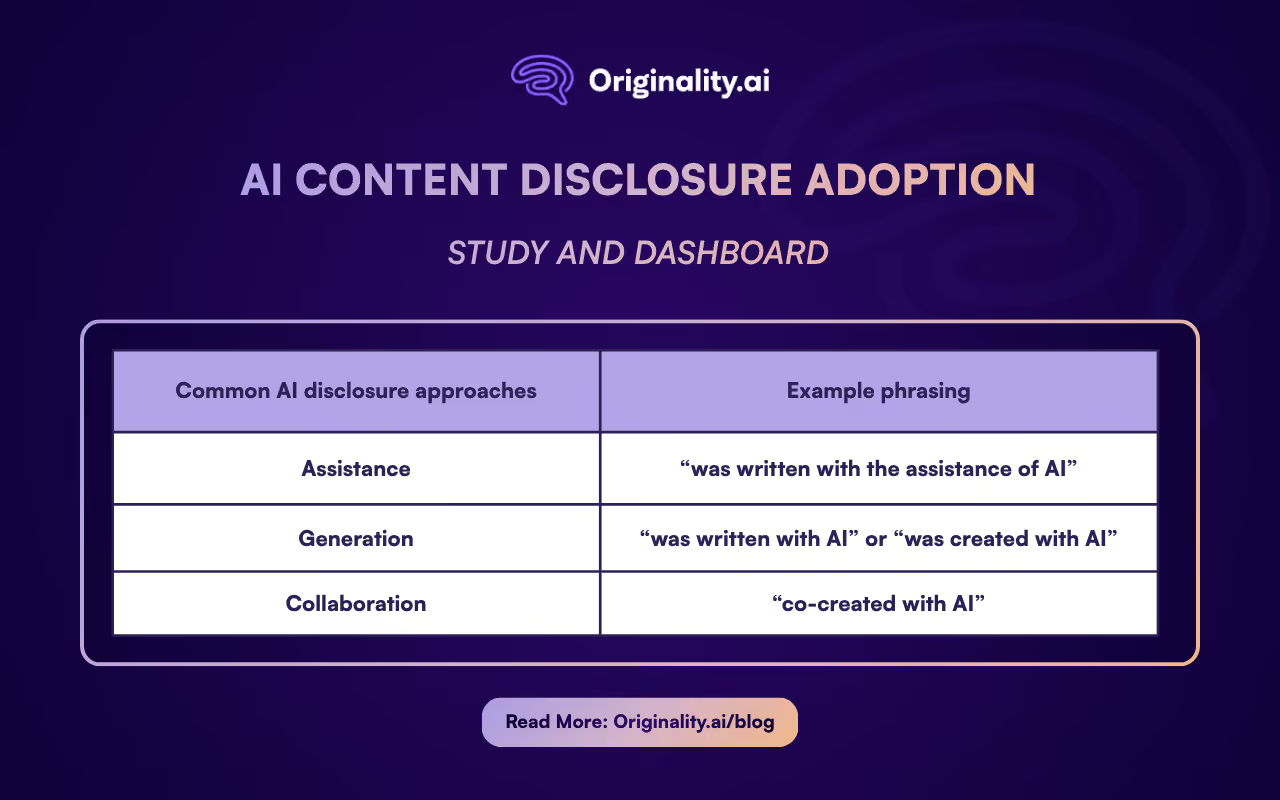
Here’s the full list of queries we tracked for this dashboard:
Just as important as the wording is the placement; an AI disclosure may be placed in the following:
Where a web publisher chooses to place an AI disclosure can vary depending on the website’s publishing standards and guidelines.
Disclosing AI use is becoming increasingly important as the technology begins to weave itself into all aspects of content.
At the same time, consumer trust in online content is being impacted as concerns rise over the source of that information or how it was created.
While AI usage itself isn’t always an issue, a lack of clarity and disclosure is. Here’s why it matters so much.
You may think that disclosure builds trust, but research suggests the relationship is a little more complicated than that.
A 2026 study titled The transparency dilemma, conducted by researchers from the University of Arizona, analyzed the impact of disclosing AI use on trust.
Their findings noted that when AI use was disclosed, trust dropped.
Yet, to further complicate things, scholars emphasize that, nonetheless, AI disclosure and transparency are essential at multiple levels, from the individual to the organization to nationally and globally.
Newsrooms are writing the rules in real time. The Associated Press (which has a partnership with OpenAI) allows limited, careful AI use but not AI-written publishable copy. Reuters, on the other hand, will disclose where AI use is material to the result. The norms are emerging, but they’re not uniform across the board.
Schools, academic journals, and research platforms increasingly ask writers, students, teachers, and editors to disclose their AI use.
Many major academic publishers now have AI-disclosure policies. Further, research at the national level may also require AI disclosure, such as in the case of the U.S. Geological Survey, which notes transparency is essential for maintaining public trust, and provides examples of disclosures that authors or researchers can use.
Yet, a 2026 study suggests that actual in-paper disclosure remains rare and limited at best, creating a real gap between policy and practice that mirrors what we see online.
In 2025, Google updated its Search Quality Rater Guidelines, which noted that if the majority of a page’s content was “copied, paraphrased, embedded, auto or AI generated” without any additional value or even with little added originality or value, the “Lowest” rating should apply.
Additionally, its very own guidance on generative AI content even asks publishers to provide clear context on how content is made.
Interested in learning more? When it comes to SEO and Google, we routinely monitor the amount of AI content in Google and have studied whether Google applies penalties to AI content.
This is the area that’s had the biggest shift in recent years, most notably with the EU AI Act’s Article 50 “Transparency Obligations for Providers and Deployers of Certain AI Systems”, which comes into effect August 2, 2026.
This requires AI-generated or altered content to be disclosed and machine-readable marked.
“Providers of AI systems, including general-purpose AI systems, generating synthetic audio, image, video or text content, shall ensure that the outputs of the AI system are marked in a machine-readable format and detectable as artificially generated or manipulated.” - EU Artificial Intelligence Act, Chapter IV, Article 50
Our dashboard scans a large sample of the web’s source code (via PublicWWW) for the disclosure phrases site owners actually use, then counts the unique domains where they appear.
From our initial findings, the biggest thing to note is how rare AI disclosure still is.
In our May 2026 scan, only 236 unique domains carried AI-disclosure language; in our June 2026 scan, this number rose marginally to 278 domains.
For all the noise surrounding AI content, almost no one is claiming usage yet.
Right now, household names are not the ones disclosing usage. Instead, the adopters are overwhelmingly sites like niche pages and blogs.
From our study, it’s too early to say that disclosure is growing, but there is a small trickle towards more usage.
Longer term, it will be interesting to see whether or not the new EU policy has an impact, but there is likely to be slow take-up unless entities like Google reward this type of transparency, for example.
The good news is our dashboard keeps scanning, so you can check back as the dataset grows and the real shape of adoption becomes clear. So, stay tuned to find out!
As you can imagine, AI content disclosure is genuinely useful to track, but the signal does come with limits to be aware of.
For all the policy debate around AI and transparency, machine-readable disclosure is still very rare across the web. For now, it is inconsistent, non-standardized, and hard for readers to compare one site to the next.
But that may be set to change, with new EU rules set to take effect this year.
Our live dashboard will keep tracking how often, where, and how sites disclose AI involvement, so you can watch that shift happen rather than guess at it. Check back as the dataset grows.
Check out other Originality.ai dashboard studies:
A disclosure is a public statement that AI helped write, translate, edit, summarize, or generate the content, whether that’s a one-line footer note to a full editorial-standards page.
No. It measures how often sites disclose AI involvement. Disclosure and prevalence are different questions, and a page can be AI-made with no disclosures at all.
Not everywhere, but transparency guidelines are being pursued. The EU AI Act’s transparency rules apply from August 2026, the FTC applies its rules around AI advertising, and many educational policies are now also being created.
Use this free interactive demonstration to see how Google DeepMind’s published SynthID-Text method samples candidate tokens, applies context-specific key values, and builds a detectable statistical pattern across a passage. The tool is an educational simplification with illustrative values and thresholds. It does not generate text with Gemini or Claude and does not run Google’s or Anthropic’s detector.

AI & Plagiarism Detector for Serious Content Publishers
Originality.ai
64 Hurontario St
Collingwood, Ontario
L9Y 2L6