AI Checker
Plagiarism Checker
Grammar Checker
Content Quality
Guideline Checker
Readability Checker
Fact & AI Hallucination Checker

Extensions
MCP

When people talk about AI crawlers, most of the focus is on robots.txt and whether or not tools like GPTBot, ClaudeBot, and Google-Extended are allowed or not.
But that’s not the only way to control AI crawlers' access; there are also noai and noimageai tags. These solutions are placed inside pages, telling AI tools that, sure, they may be able to look at the content, but they can’t train on it.
So, as you can imagine, the more brands that discover this solution, the more room there is for noai tags to be adopted.
That’s why we’ve created our own noai tag adoption dashboard, which tracks how many sites are using these tags.
In this study, we will look at what noai and noimageai tags are, where they appear, why they are getting added to so many sites, and one important catch.
First off, let’s dive into more detail about what noai and noimageai are.
Noai and noimageai are two directives (tags) that you can add to your standard robots meta tag (or its HTTP-header equivalent) to ask AI systems not to use the content on your page as training data.
They sit alongside more familiar robots values like noindex and nofollow, which is why many people are unaware of them, but they target a different use.
Rather than preventing search indexing (like noindex) or following links on the page (nofollow), these tags ask the AI crawlers not to use the data for training, but still allow the content to be indexed on Google and AI search for rankings and organic traffic.
Some sites that use them use both together like this:
<meta name=“robots” content=“noai, noimageai”>
The tags themselves are actually relatively new and trace back to DeviantArt, an art-sharing platform. The platform introduced them in November 2022 to help protect AI image generators from training on artists’ work.
This is the distinction our dashboard draws between “meta” and “header” adoption, and it matters because the two placements behave differently.
Learn more about X-Robots-Tag and meta tag capabilities in Google’s Robots Meta Tag Guide.
As you can imagine, there are several reasons why creators, publishers, and platforms might want to implement the noai tags.
As of June, 2026, we identified 88,000+ different domains carrying a noai or noimageai tag across our testing pool.
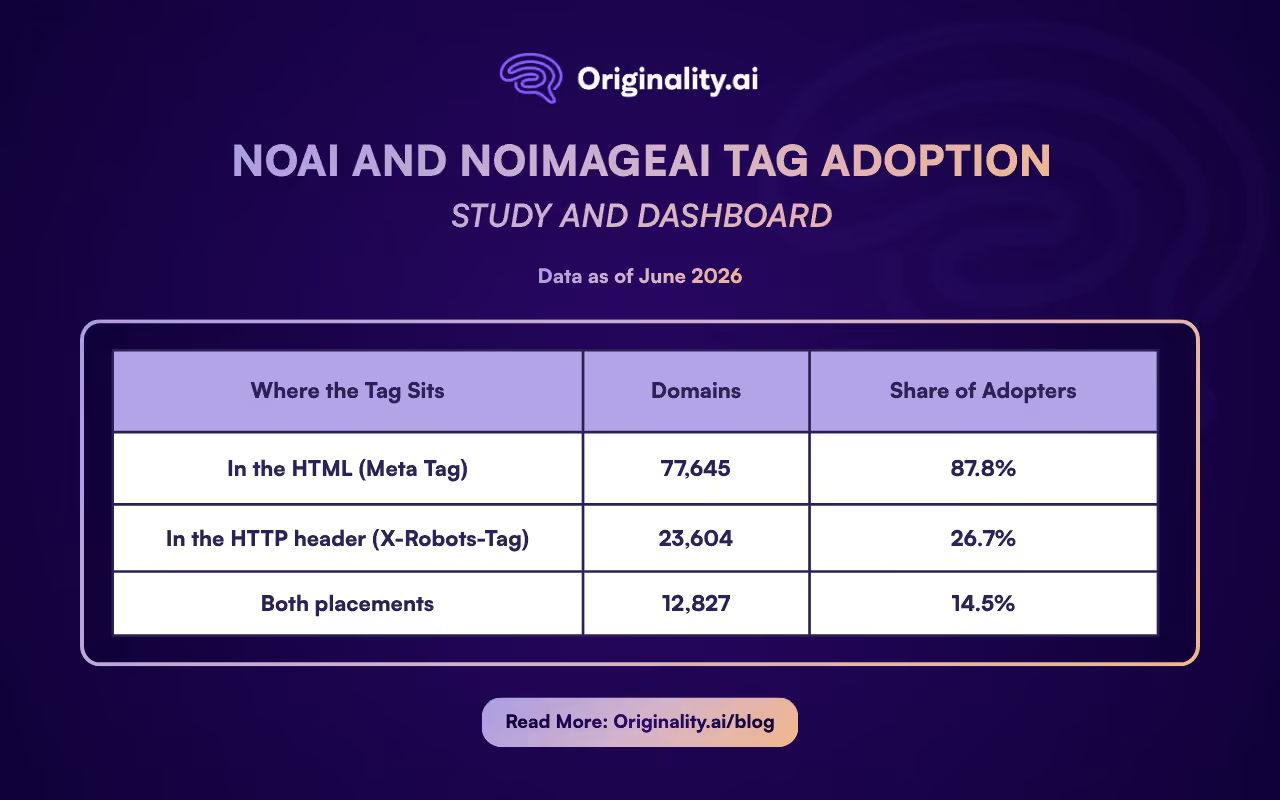
The noai tags can live in two different places, either in the HTTP response or as an X-Robots-Tag header. Sites adopt the two very unevenly, even though HTTP (x-robots-tags) is what covers non-HTML files like raw images and PDFs.
As of June 2026:
It means a lot of sites are flagging their pages while leaving their actual image files and documents without the same signal.
Among the recognizable adopters from our test, a clear pattern is emerging. The websites applying the tags included websites for:
These are websites with the most to lose from a model training on their imagery, editorial, or code, so it makes sense they’re among the first to plan a flag.
Cautiously, yes, though it’s early days for our data.
Between our first scan in May 2026 and our most recent scan in June 2026, meta-tag adoption rose from 61,403 to 77,645, up 26.5%.
At the same time, the header version was essentially flat, ticking from 23,123 to 23,604 (+2%).
As this dashboard is still in its early days of data analysis, this moderate increase reflects a starting point, not a trend.
But that’s exactly why our dashboard keeps scanning, so that you can check back as the dataset grows, and the real shape of adoption will become clear over the coming months.
For many reading this, noai and noimageai sound like the perfect solution, especially for publishers wary of losing their tone of voice to AI tools.
However, there’s one main issue that users need to be aware of.
A noai tag is a request, not a lock.
Our study tracks public use of NoAI-style tags, which express the site owner’s preference, but don’t technically prevent scraping or guarantee compliance.
Even with these tags in place, a crawler is free to read the tag and ignore it, and nothing about the tag physically stops the content from getting scraped.
Two things make the gap concrete:
There’s also a timing problem that the tags can’t solve.
Many of today’s foundation models were trained long before a given page ever carried a noai tag. Adding one now signals intent for future crawls, but it cannot retroactively pull content out of databases that already exist.
With all that said, it’s still understandable why there is a continued rise in popularity of these tags, as publishers and website owners become more and more wary of AI scrapers taking their content, packaging it up into an LLM, and taking away their organic traffic.
So whilst the two tags do have their drawbacks, it is an important step forward in AI transparency and equality.
Our dashboard will continue to track noai and noimageai trends as they evolve, allowing you to see whether or not these requests become more prominent as AI is used by more and more people. You can check back any time to see the live data.
Check out other Originality.ai dashboard studies:
The noai tag is a machine-readable request asking AI systems not to use a page’s content for model training. You add it to the robot's meta tag or the X-Robots-Tag HTTP header. Crucially, this action does not remove the page from search results, block scraping, or impact rankings.
noai covers the page’s content, whereas noimageai focuses specifically on images. Sites that want to signal both may want to consider using both tags.
No, not as a documented standard. Google’s robots meta specification does not list noai (or noimageai), and major AI firms have generally directed opt-outs through robots.txt templates such as Google-Extended and GPTBot instead. Treat noai as a preference signal, not an enforceable control.
No. robots.txt aims to block named crawlers from fetching the pages at all, whereas noai allows the page to be crawled and indexed but asks it not to be used for training.
Our noai and noimageai dashboard is live and will update as adoption changes. You can check back to see updates over time.
Use this free interactive demonstration to see how Google DeepMind’s published SynthID-Text method samples candidate tokens, applies context-specific key values, and builds a detectable statistical pattern across a passage. The tool is an educational simplification with illustrative values and thresholds. It does not generate text with Gemini or Claude and does not run Google’s or Anthropic’s detector.

AI & Plagiarism Detector for Serious Content Publishers
Originality.ai
64 Hurontario St
Collingwood, Ontario
L9Y 2L6