AI Checker
Plagiarism Checker
Grammar Checker
Content Quality
Guideline Checker
Readability Checker
Fact Checker

Extensions

Our UCP adoption dashboard is meant to help those across the e-commerce ecosystem understand where agentic commerce is actually headed.
After all, Google’s UCP announcement is one of the clearest signs yet that agentic commerce has moved past the “what if” stage and is being taken seriously by major platforms.
The only question is whether merchants and websites will take it just as seriously, too, and actually implement it, or if it won’t have as much impact on the industry as industry leaders like Google expect.
If you’d like more context after checking out the latest UCP adoption numbers in our tracking study, read on to learn more about what the standard is, why it matters, and the advantages, disadvantages, and implications of participating in UCP (Universal Commerce Protocol) and agentic commerce.
UCP, or Universal Commerce Protocol, is an open-source standard designed to streamline communication between AI agents, merchants, and payment providers. Basically, it makes it easier for everyone to participate in agentic commerce.
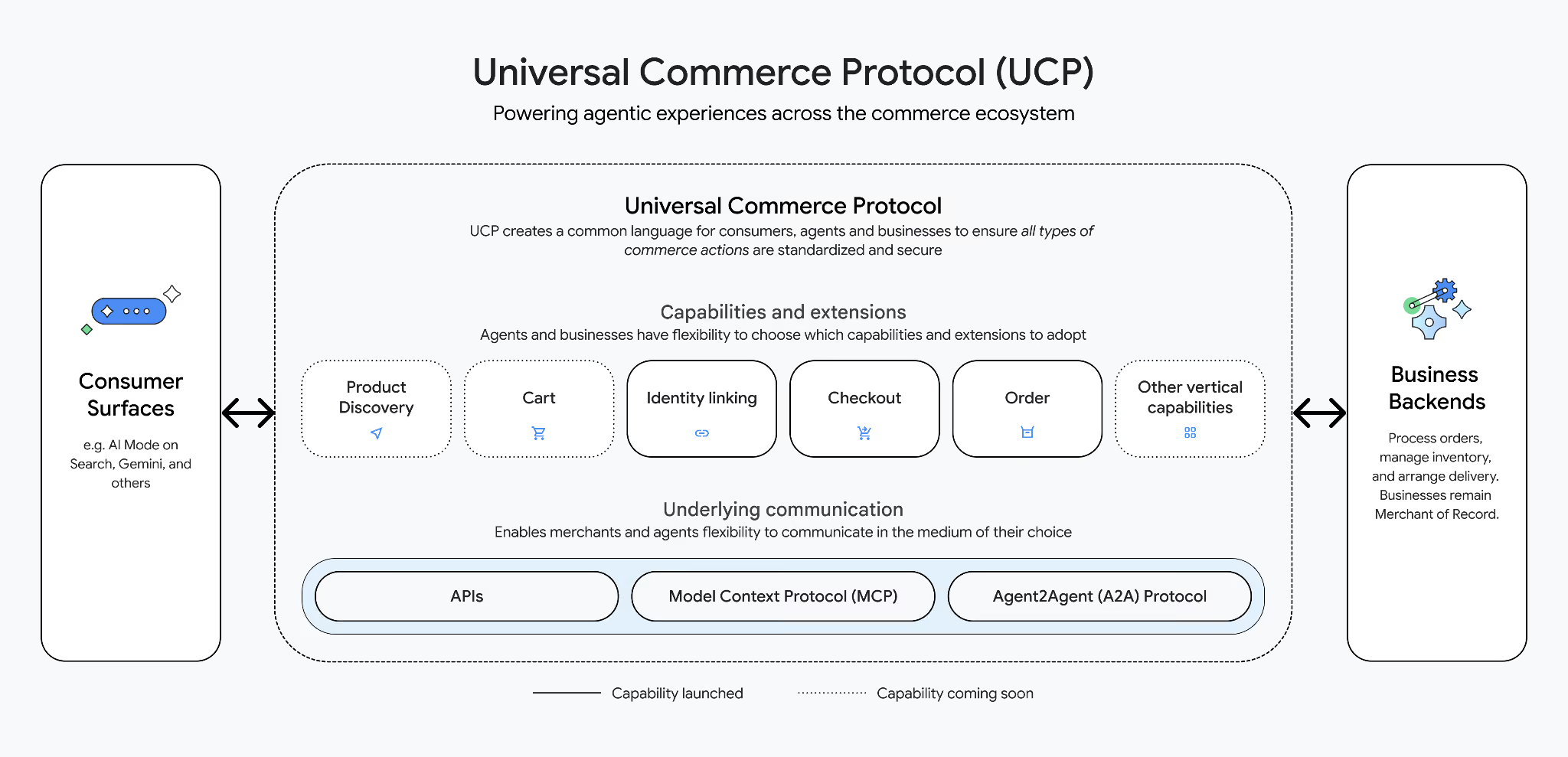
In practice, that means UCP provides a standard way for:
UCP was announced in January 2026 by Google and co-developers such as Shopify, Target, and Etsy.
At first, it may seem a little soon to introduce a web standard for agentic commerce when AI traffic to e-commerce sites overall is still relatively low. For instance, an e-commerce study, published online in 2026, found that organic LLM traffic accounted for less than 0.2% of all e-commerce sessions in its dataset. In comparison, that was “200 times smaller than Google’s organic search,” according to the study.
However, when you consider where AI-assisted shopping appears to be heading (check out more agentic commerce stats below), that could change in the future.
UCP matters for two key reasons: it addresses interoperability and scaling issues associated with agentic commerce, and it helps merchants prepare for the rise of AI-assisted shopping.
On a practical level, UCP matters because it helps solve the interoperability problem between AI agents and merchant systems.
In their current form, these systems were just too fragmented.
Before UCP, if merchants wanted to sell on every AI platform, they would need to develop separate custom integrations for each one. And if AI agents wanted to shop at a bunch of different merchants, they’d need to understand each one’s unique requirements, from checkout processes to authentication methods.
With a shared standard, though, the whole process can avoid turning into a classic N×N integration problem. Merchants only need to implement UCP once for agents to shop effectively on their websites.
And if that one-and-done convenience isn’t enough, UCP is flexible too. It’s designed to work across different retail categories and with existing standards, such as REST, JSON-RPC, and A2A.
Of course, the agents would need to be UCP-compliant as well for this to work (it’s not all on merchants). But if everyone does their part, the standard takes much of the work out of preparing both sides for agentic commerce.
It also makes scaling easier if there’s a sudden rise in demand.
This brings us to perhaps the bigger picture of why UCP matters: AI-assisted shopping is likely on the rise.
Not only did AI and agents drive about $67 billion in sales during Cyber Week 2025, but agentic commerce may help generate up to $1 trillion in revenue for the US B2C retail market alone by 2030.
And really, an upward trend wouldn’t be too much of a surprise considering the impact AI is already having on the industry. Retail sites have already seen a staggering 4700% year-over-year growth in generative AI traffic as of 2025.
Of course, the results from that traffic aren’t matching non-AI sources quite yet, but the gap is narrowing fast.
In January 2025, AI traffic sources were 49% less likely to convert, which dropped to just 23% in July 2025. Over the same period, AI-driven revenue per visit increased by 84% compared with non-AI sources.
AI agents may not be mainstream yet, but it certainly seems like shoppers are becoming more comfortable using AI to help with the buying process. As more retail traffic and revenue move through AI systems and agents, key players will benefit from a practical, straightforward way to participate.
And that’s exactly why UCP adoption is worth tracking over time. If adoption rises, it could be one of the clearest early signs that agentic commerce is more than just a prediction.
It’s not like it’s just a couple of researchers and industry insiders talking about UCP and agentic commerce. The topic has been attracting a lot of attention, and a look at the latest numbers may make it easier to see why.
In addition to the current UCP adoption numbers from our tracking dashboard, here are some UCP and agentic commerce statistics that help explain why interest is growing:
Even if UCP adoption starts off slow and steady, it’s easy to see why it may take off among those who wish to participate in agentic commerce. Not only has it been developed and endorsed by major platforms like Google, but it also undoubtedly fills a few gaps in the market.
At such an early stage in the agentic commerce industry, UCP offers advantages for key players in e-commerce:
That said, UCP isn’t a perfect standard. It’s not designed to solve all the potential issues associated with agentic commerce, and may even present a few extra challenges itself.
Due to the potential benefits of UCP and agentic commerce, and the possibility that it could make the whole agentic shopping experience easier, why wouldn’t all key players implement it as soon as possible?
Well, there are several good reasons why merchants in particular may feel hesitant about adopting UCP and even the idea of agentic commerce as a whole.
Here are some of the key challenges associated with UCP and agentic commerce.
Of course, not everyone immediately adopts something like UCP. As demonstrated in our llms.txt tracking study, implementation can take some time to grow as people discover and learn about any new web standards.
This can be especially tricky for UCP as it’s linked to agentic commerce, which is still also very much in its infancy.
Implementing UCP isn’t exactly common sense. And if there are major fees or resources associated with doing so, it could slow or prevent small businesses from benefiting from UCP’s role in facilitating agentic commerce.
As a result, if they decide to implement it, smaller businesses in particular may find themselves relying on larger platforms like Shopify to handle it.
If many businesses decide to let major platforms handle their UCP needs, a few powerful companies may end up having a lot of — perhaps even too much — influence over how the entire UCP and agentic commerce system works.
Those who become dependent on these platforms would then be expected to follow whatever systems, rules, or priorities are set by the platform. If the systems and rules don’t work for a given smaller business, it could prevent them from participating in agentic commerce entirely.
It’s not just about players on the business side adopting UCP and agentic commerce — consumers need to be on board for this to work too. And that may take some time, as consumers seem a bit hesitant about agentic shopping.
One study found that 51% of US consumers wouldn’t trust AI at all to automate purchases. However, 25% also reported that they would trust a familiar online retailer most in this situation, so it’s possible consumers could warm up to the idea if it becomes more commonplace.
AI agents likely use a narrower decision-making process than humans when they shop. They don’t go out to browse “just for fun”, nor do they stop and consider a product they didn’t come out for because it's on sale.
AI is only at a store for a specific purpose, predetermined by its user’s constraints. It would therefore likely not be swayed by other recommendations like impulse buys or be tempted by premium upgrades.
People may be able to justify paying a little more for better service or a favorite brand, but AI agents don’t have that emotional drive. They’re concerned with data, like user pricing constraints.
The job of an AI agent is to find users the item they want at the price that fits their specified budget. So, if a retailer doesn’t offer the item within that range, they won’t even be considered. The result? The retailer immediately misses out on that sale.
With agents prioritizing and bound by the user pricing data they have to work with, merchants could see their profit margins becoming slimmer to compete for sales.
Brands may not have as much of an influence on AI agents as they do on humans. AI agents are more likely to rely on structured signals (or data) such as price, product specs, availability, and return policies than branding or presentation.
Of course, specific brands may still matter to a shopper who specifically requests an agent to buy from a particular brand. However, if the request is broader, an agent could favor a lesser-known or even no-name brand that better matches the user’s preferences.
With AI’s likely focus on satisfying user constraints, it could make it harder for merchants to benefit from brand presentation, messaging, and other factors that can influence buying decisions on their websites.
This one is still a bit more speculative than the others.
Similar to the commissions that app stores collect, merchants could end up paying fees to AI agents that discover, purchase, and — perhaps more importantly — prioritize their products via UCP or other agentic commerce protocols over others.
After all, there is a clear opportunity: if multiple retailers offer the same product at the same price, how should AI decide who wins the purchase?
By allowing merchants to pay a fee to be considered before competitors, AI platforms could make the decision of who to prioritize for the transaction much easier. The sale goes to the highest bidder, plain and simple.
Time will tell if features like these are implemented at all and to what extent.
Google has prepared an in-depth guide to help merchants and developers adopt UCP through Google, so it may be a good idea to start there. You’ll see that the full implementation process involves quite a few steps, so it could help explain why UCP adoption may be limited in the early stages of its rollout.
Using the guide as a reference, here’s a quick overview of what to do to implement UCP on Google:
For more detailed information on UCP implementation, check out the official specifications or head on over to GitHub UCP.
If everything from product discovery to checkout increasingly happens inside AI interfaces rather than on websites alone, merchants will likely need to get used to a few new realities. And those who can adapt the fastest just may have an edge over the competition.
Here are some of the potential key implications of UCP adoption and agentic commerce for merchants:
Overall, probably the biggest implication of UCP and agentic commerce adoption for retailers is that their shopping audience is changing. It’s not about guiding humans through the entire online shopping process anymore — it’s about guiding AI agents, too.
There’s no doubt that UCP and agentic commerce are both in their early days. However, by starting to track adoption now, those across the e-commerce ecosystem can gain a better understanding of where both are headed.
If implementation is slow or limited over time, it could be a sign that there’s still flexibility in how quickly businesses should consider adopting UCP and agentic commerce.
On the other hand, if implementation starts to take off, it may be a sign to adopt UCP soon and prepare for participating in agentic commerce, to prevent the risk of getting left behind.
Check out Originality.ai’s top trending dashboard studies:
UCP is primarily for three main players on the business side of e-commerce: merchants, AI platforms, and payment and credential providers. In other words, it’s for the companies that may be interested in a standard way to help agentic AI discover, shop for, and complete purchases.
Although both open standards are designed to help AI agents find and purchase products on behalf of users, the main difference between them is their focus. Universal Commerce Protocol is meant to work across the entire shopping journey, while Agentic Commerce Protocol focuses more on completing purchases.
No, merchants don’t necessarily need to adopt UCP to participate in agentic commerce. That said, it can make it much easier by reducing the need for custom integrations. In some cases, they may need to adopt a protocol such as UCP or ACP anyway to support agentic shopping experiences.
No, UCP doesn’t just work with Google-owned AI surfaces. It’s an open-source standard designed for any AI platform that wants to participate in agentic commerce.
Use this free interactive demonstration to see how Google DeepMind’s published SynthID-Text method samples candidate tokens, applies context-specific key values, and builds a detectable statistical pattern across a passage. The tool is an educational simplification with illustrative values and thresholds. It does not generate text with Gemini or Claude and does not run Google’s or Anthropic’s detector.

AI & Plagiarism Detector for Serious Content Publishers
Originality.ai
64 Hurontario St
Collingwood, Ontario
L9Y 2L6