AI Checker
Plagiarism Checker
Grammar Checker
Content Quality
Guideline Checker
Readability Checker
Fact Checker

Extensions

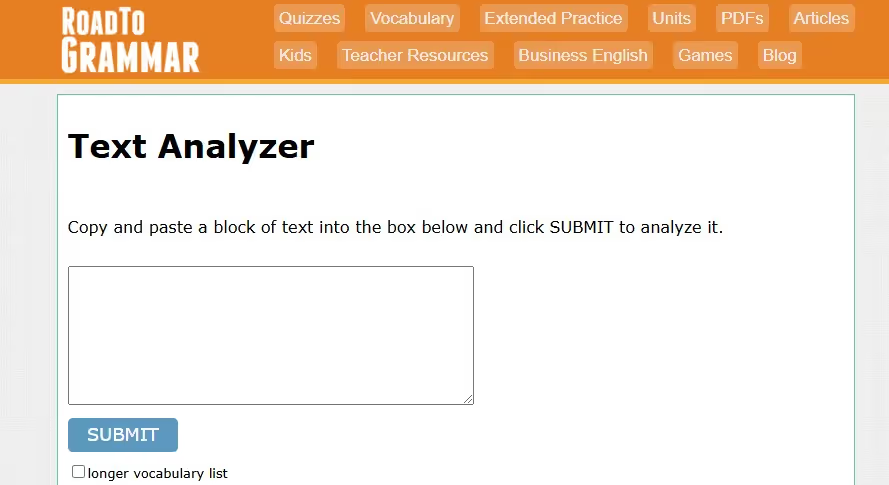
Similar to other readability checkers we’ve reviewed like WordCalc and Datayze Readability Analyzer, RoadtoGrammar’s Text Analyzer offers an online tool to scan the readability of text.
It’s designed to help ESL (English as a Second Language) teachers determine how readable a text is according to the CEFR or Common European Framework
In this article, we’ll be taking an in-depth look at the RoadtoGrammar Text Analyzer.
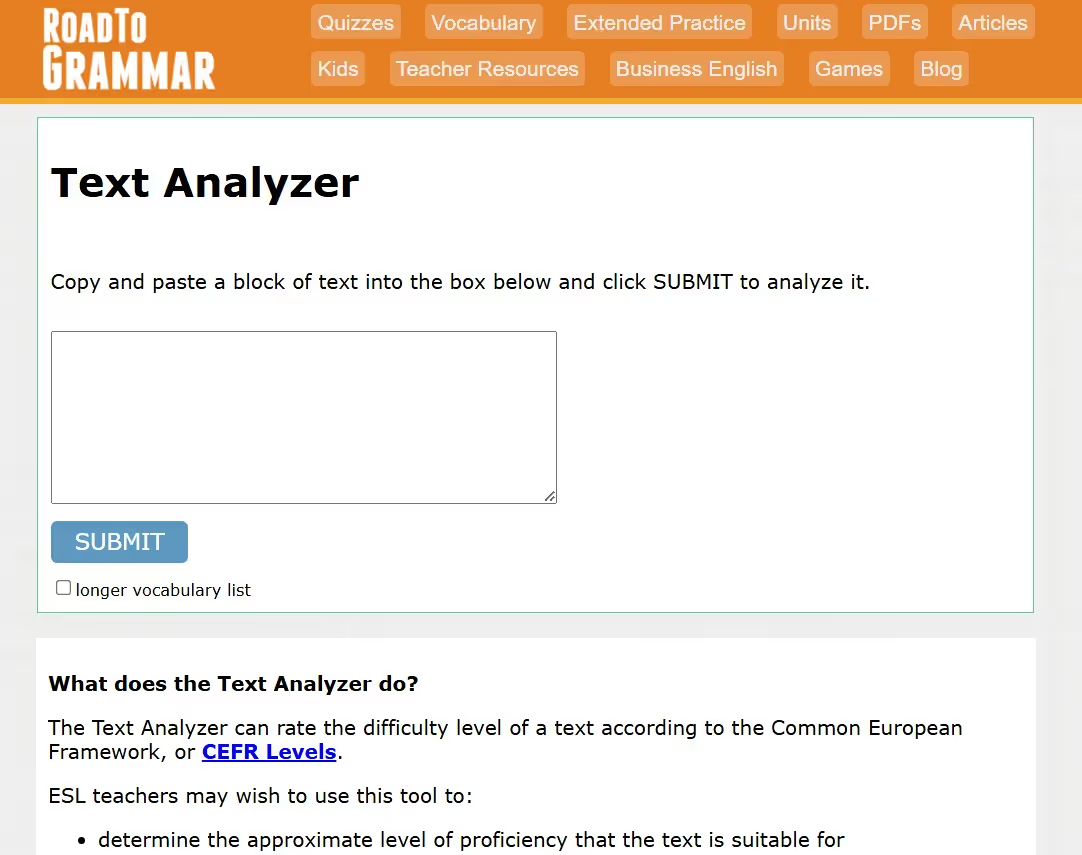
The RoadtoGrammar Text Analyzer is an online platform for teachers of English as a Second Language to determine how appropriate texts are according to their reading level.
Specifically, the tool uses two types of readability metrics — CEFR and IELTS — as the measures of readability.
After pasting and submitting the text, educators or students can see the approximate CEFR level of the content to determine whether it’s suitable.
The RoadtoGrammar Text Analyzer, unlike other popular readability analyzers, doesn’t offer a wide array of readability scores.
Instead, it gauges how readable or understandable a text is based on how it aligns with the CEFR or Common European Framework of Languages and the IELTS (International English Language Testing System).
The British Council’s Learn English guide notes that the CEFR scores language levels are measured as follows:
You can think of A1 as knowing the basics of a language whereas C2 is fluency.
Beyond the CEFR, RoadtoGrammar also analyzes the text according to IELTS.
This scale gauges English language proficiency on a scale of 1-9, where 1 is a user who is unfamiliar with the English language and 9 is an expert user. Read more in our guide on the IELTS.
To review the RoadtoGrammar tool, we tested a section of this article in RoadtoGrammar’s Text Analyzer.
Here are the results:
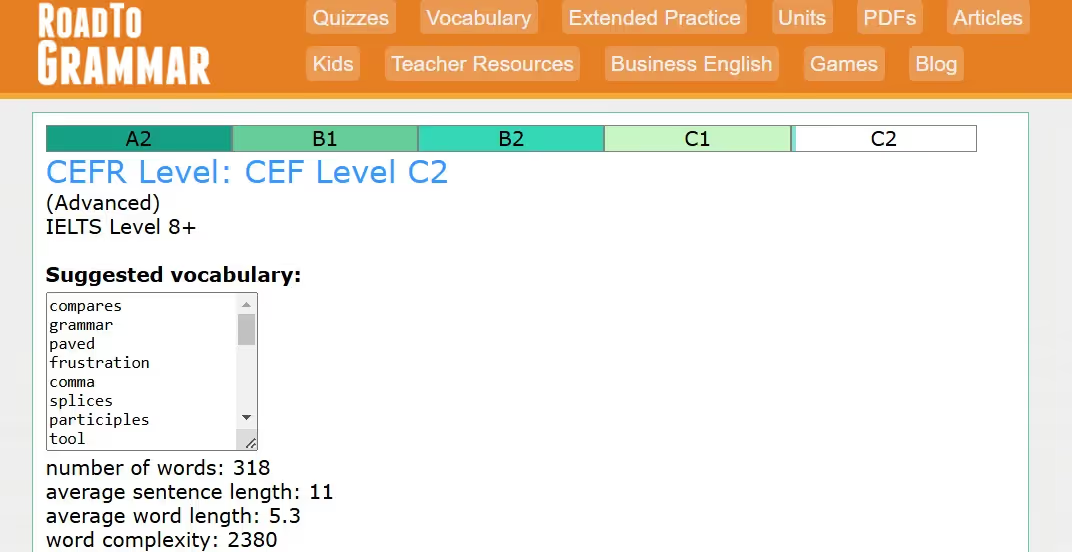
This article scored a level 8+ on the IELTS system and a C2 level on the CEFR.
This means that someone with a high degree of English proficiency should be able to understand the text without issues.
In addition to the CEFR and IELTS levels of the text, RoadtoGrammar also generated a list of suggested vocabulary words for further study and linked to a third-party service to quickly look up the definitions for those words if desired.
Although it gives a handful of stats about the document, Originality.ai’s Readability Checker goes further in terms of text statistics and how the reading difficulty compares across a wider range of readability formulas.
If you’re looking for a quick, user-friendly alternative to the RoadtoGrammar Text Analyzer, look no further than Originality.ai’s Readability Checker.
Designed with content marketers, web publishers, and editors in mind, the Originality.ai Readability Checker offers readability scores according to a number of popular and commonly used readability formulas including:
This gives you the full picture of your content’s readability. Then, it also offers key metrics like word count, letter count, sentence count, average reading time, and more.
Beyond readability, Originality.ai offers a suite of best-in-class publishing tools that include the ability to detect plagiarism, uncover AI content, and check facts to improve the credibility and authenticity of your content.
RoadtoGrammar’s text analyzer is a simple, quick tool to determine the CEFR level and IELTS band of specific content to be able to fit it into an English lesson plan or activity. It’s also helpful for creating vocabulary lists and quickly sourcing definitions for the words.
However, in terms of overall features, Originality.ai offers a broader range of readability metrics with its Readability Checker, as well as additional publishing tools such as an industry-leading Plagiarism Checker and AI Detector.
Get more insight on how to boost readability with our resources:
The Rix readability formula (often mentioned alongside a similar formula known as the Lix readability formula) is a readability formula that’s based on letter counting. Rather than being based on syllables like other formulas, Rix tackles the approach differently. Measuring readability based on syllables can be difficult in languages other than English, and both Rix and Lix are better optimized to work with foreign languages> In order to understand the Rix readability formula though, we have to take a step back to the original formula, known as Lix.
The Linsear Write Readability Formula was developed by Edward Fry and Richard Linsear and is specifically designed to measure how readable a text is. Like Flesch-Kincaid and other readability tests, it estimates the grade level needed in order to comprehend the text by analyzing the number of simple and complex words within it. But how well does it work in practice and are there any limitations to be aware of? Let’s take a closer look in this detailed article on the Linsear Write Readability formula and how it measures readability.

AI & Plagiarism Detector for Serious Content Publishers
Originality.ai
64 Hurontario St
Collingwood, Ontario
L9Y 2L6