AI Checker
Plagiarism Checker
Grammar Checker
Content Quality
Guideline Checker
Readability Checker
Fact & AI Hallucination Checker

Extensions

More than half of all sitting MPs have read likely AI-written remarks at least once this year.
On June 9, 2026, Bill Oliver, a Progressive Conservative MLA in New Brunswick, unwittingly recited an AI-generated prompt in one of his speeches in the province’s Legislature. The video clip eventually went viral, as many onlookers mocked Oliver for not realizing what he was reading, even as he said aloud, “Here’s a more natural-flowing version of that section that reads like legislative speech rather than a series of short points.”
But is it really so uncommon for politicians to use large language models (LLMs) in preparing their remarks?
We at Originality.ai wanted to investigate the issue on a larger scale. So we downloaded the entirety of Hansard—the largely verbatim record of what Members of Parliament say in Ottawa’s House of Commons—dating back from January 2020 to the most recent sitting in June 2026, before their summer recess. The dataset comprised nearly 200,000 turns.
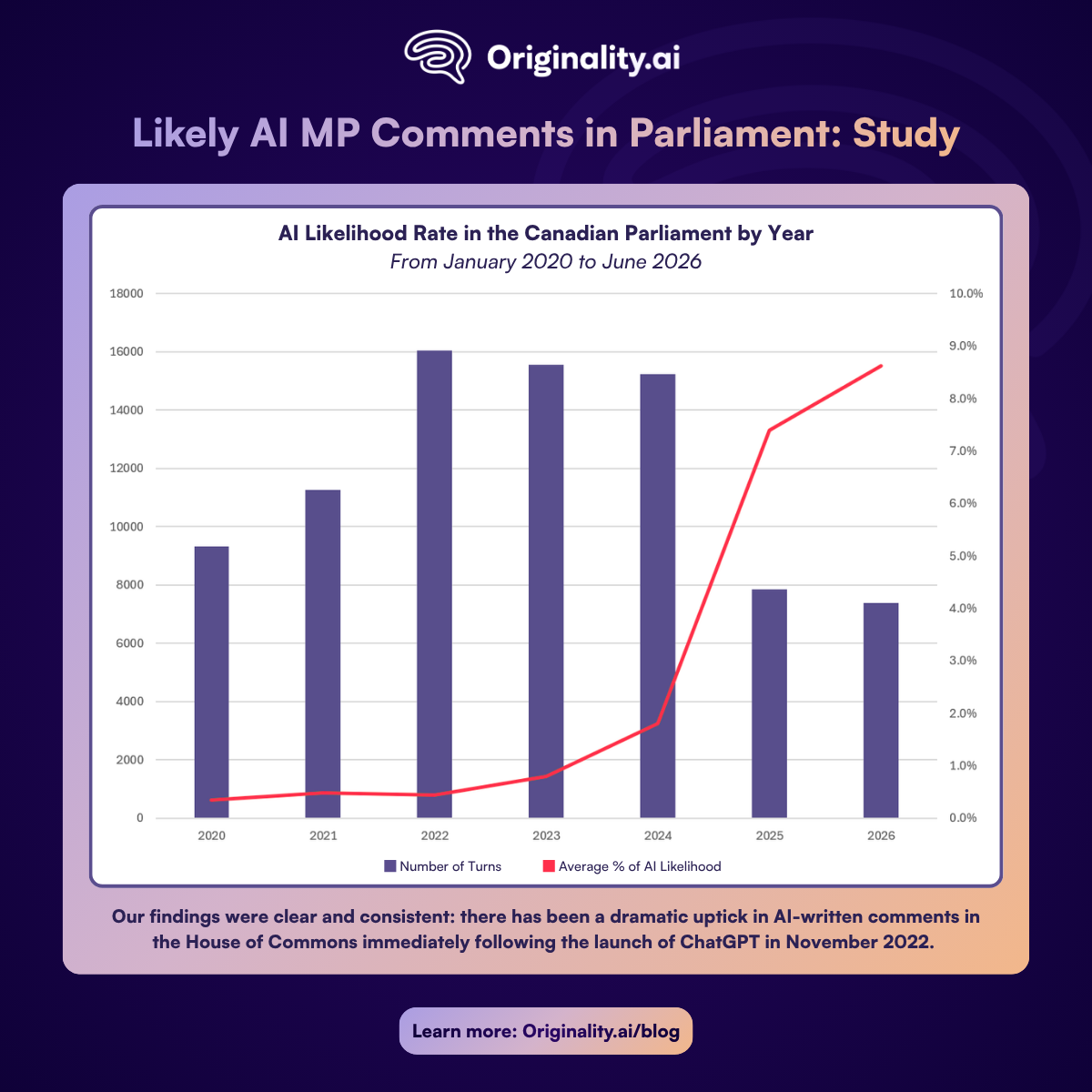
Our findings were clear and consistent: there has been a dramatic uptick in AI-written comments in the House of Commons immediately following the launch of ChatGPT in November 2022.
We scanned 198,971 turns, broadly categorized as one of five types: statements, debates, questions, answers and interjections. In addition to the total verbatim text, each turn also included a date, parliamentary session, unique intervention ID, language, and word counter, as well as each speaker’s name, unique member ID and political party.
After downloading the full Hansard data, we ran the whole dataset through Originality.ai’s latest AI detection model, AI Allowance. This model has tested at 99%+ accuracy when set to “15% allowance”, meaning the model allows for light AI content, reducing the number of false positives. Turns came back with an AI likelihood score, which determines the model’s certainty that the text was AI-generated. If a turn scored over 50%, it was flagged as “Likely AI”.
We then proceeded to clean up the dataset in two significant ways.
Because Originality.ai’s model requires at least 100 words per scan, we removed 89,464 turns that fell below that threshold, which came back N/A.
We also omitted French turns entirely. There is no published dual-language Hansard that blends English and French; the English-language Hansard, by default, includes French remarks translated into English, as reviewed by a team of professional translators. (The French Hansard is 100% French.) Because the French-to-English turns are not verbatim to what French-speaking MPs wrote or said, we deemed them ineligible to be scanned. As a result, the Bloc Quebecois is not represented in this dataset at all, as nearly 100% of their turns are in French.
Looking at the data, there is an unavoidable conclusion that AI likelihood has grown every year since the launch of ChatGPT in November 2022.
We looked at historical data reaching back to 2020 to give a strong four-year runway of what AI likelihood looked like before the rise of LLMs. Our AI detection model returned consistently minor false positives, showing less than 1% AI use from 2020 to 2023.
The average AI likelihood rises above 1% for the first time in 2024, showing a clear upward trajectory with each passing quarter.
The most significant spike happens in Q2 2025, about tripling to 6% AI likelihood from 2.3% in Q4 2024. (There is no data for Q1 2025 because former prime minister Justin Trudeau prorogued Parliament on Jan. 6, leading to a spring election and subsequent House dissolution until May 26.) Since Q4 2025, the AI likelihood of all turns has hovered consistently between 8-9%.
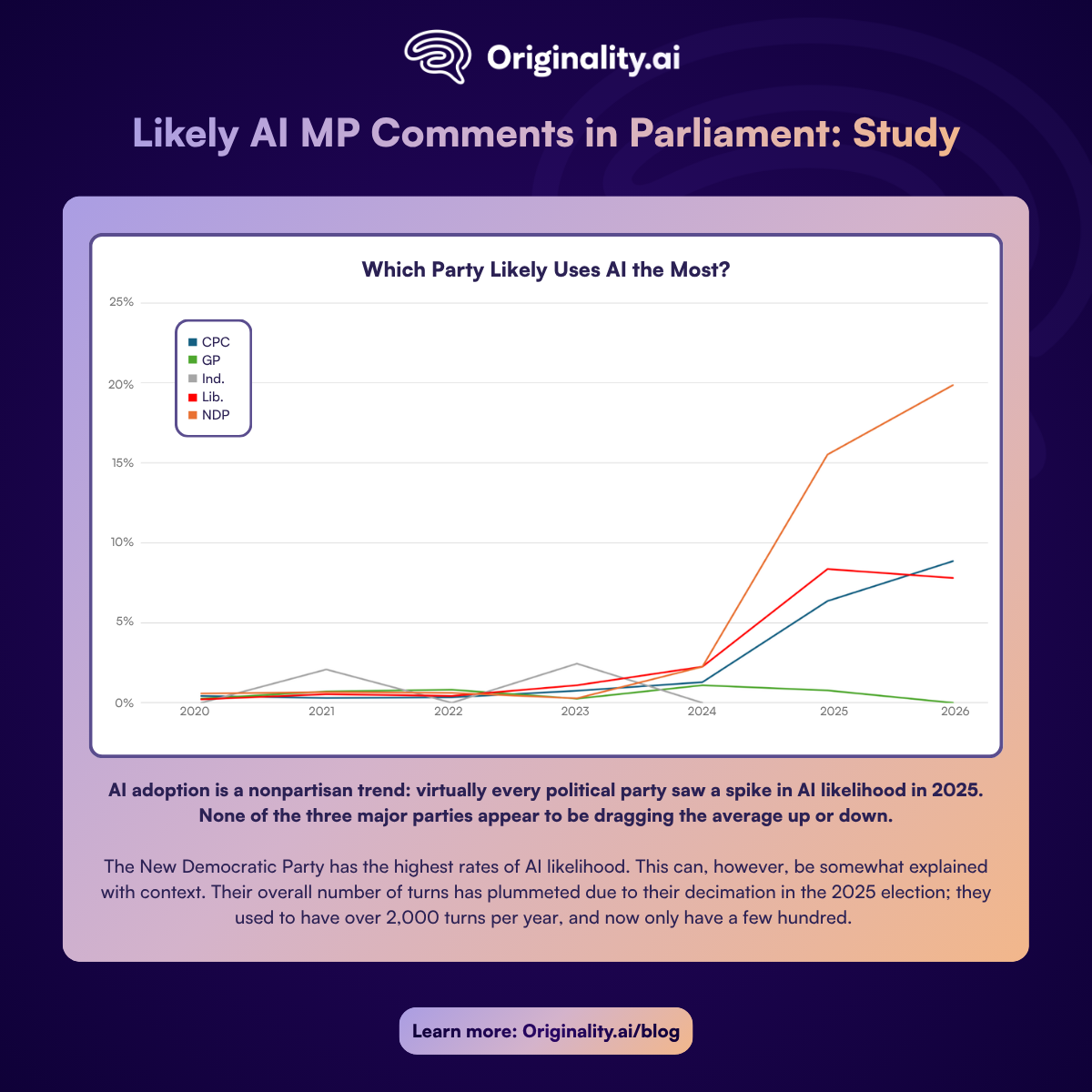
AI adoption is a nonpartisan trend: virtually every political party saw a spike in AI likelihood in 2025. None of the three major parties appear to be dragging the average up or down.
The New Democratic Party has far and away the highest rates of AI likelihood, with 15.5% of their turns flagged in 2025, and 19.9% so far in 2026. This can, however, be somewhat explained with context. The empirical amount of their turns flagged as likely AI-generated has remained consistent since 2024, when just 2.2% of their turns were likely AI-written. But their overall number of turns has plummeted due to their decimation in the 2025 election; they used to have over 2,000 turns per year, and now only have a few hundred.
This anomaly does not hold true for the Liberals or Conservatives, whose annual turns remained consistent throughout the dataset. Rather, the empirical amount of turns flagged as likely AI grew fairly consistently over time.
The Liberals’ growth rate nearly quadrupled over the last four years, ballooning from 67 in 2023 to 241 in 2026. Notably, the Liberal spike happened in 2024—136 turns from that year were flagged as AI, doubling the amount from the year before—proving them to be somewhat early adopters, though they’ve plateaued over the last two years.
Across the aisle, the Conservatives have a similar adoption rate. Unlike the Liberals, their big leap happened in 2025—more than tripling their total number of likely AI-written turns within a single year from 81 (2024) to 273 (2025). The Conservatives also have the highest empirical number of AI turns in 2026 of any party, with 341 turns flagged—100 more than the Liberals.
Only the Greens remained relatively flat, and were the only party whose AI likelihood score declined in 2026. (Of their 152 qualified turns this year, zero were flagged as likely AI-generated.)
By anonymizing the data and combining all parties’ AI turns per year, we can clearly see an increasing number of individual Members of Parliament likely using AI each year.
So far, in 2026 alone, 173 individual MPs have read likely AI-generated text at least once. That’s slightly more than 50% of all seats (343 total).
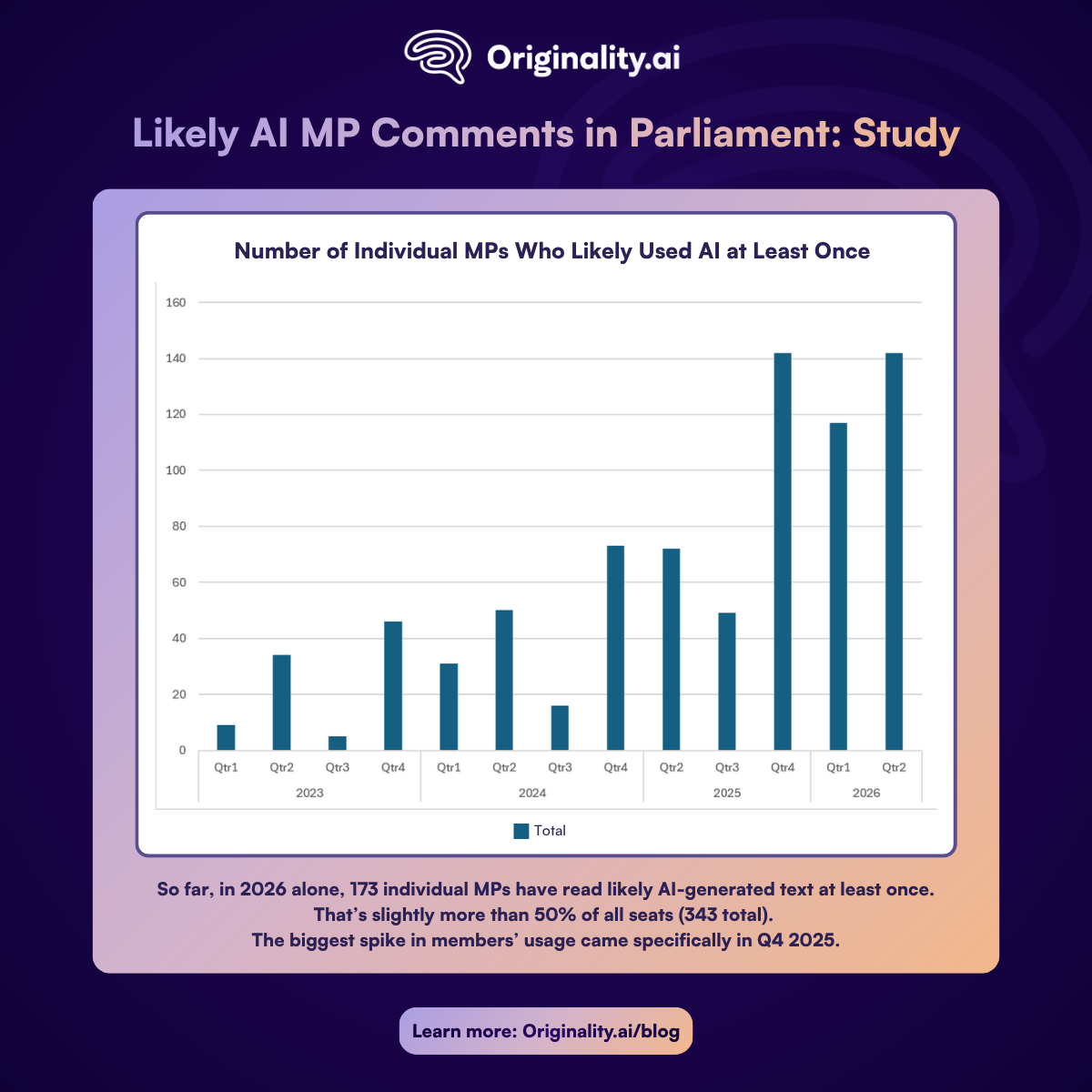
The biggest spike in members’ usage came specifically in Q4 2025. The number of MPs who read likely AI-written text nearly tripled from 49 in Q3 to 142 in Q4—the first time the number broke triple digits.
Drilling down per quarter from 2023-26, we see a clear upward trend of likely AI adoption among parliamentarians, even at a slower rate. When we filtered this data to only look at Liberals or Conservatives, the trendlines still held true.
Each turn came marked with a type, including debates, statements, questions, answers and interjections.
When checking for AI likelihood among those categories, perhaps unsurprisingly, pre-written statements were far and away more likely to be AI-written—slightly more than 20% of all statements read in the House have been likely AI-written since 2025. Debate turns came second, hovering around 12-13% since 2025.
Both types of turns were in the single-digit percentages in 2024 and earlier.
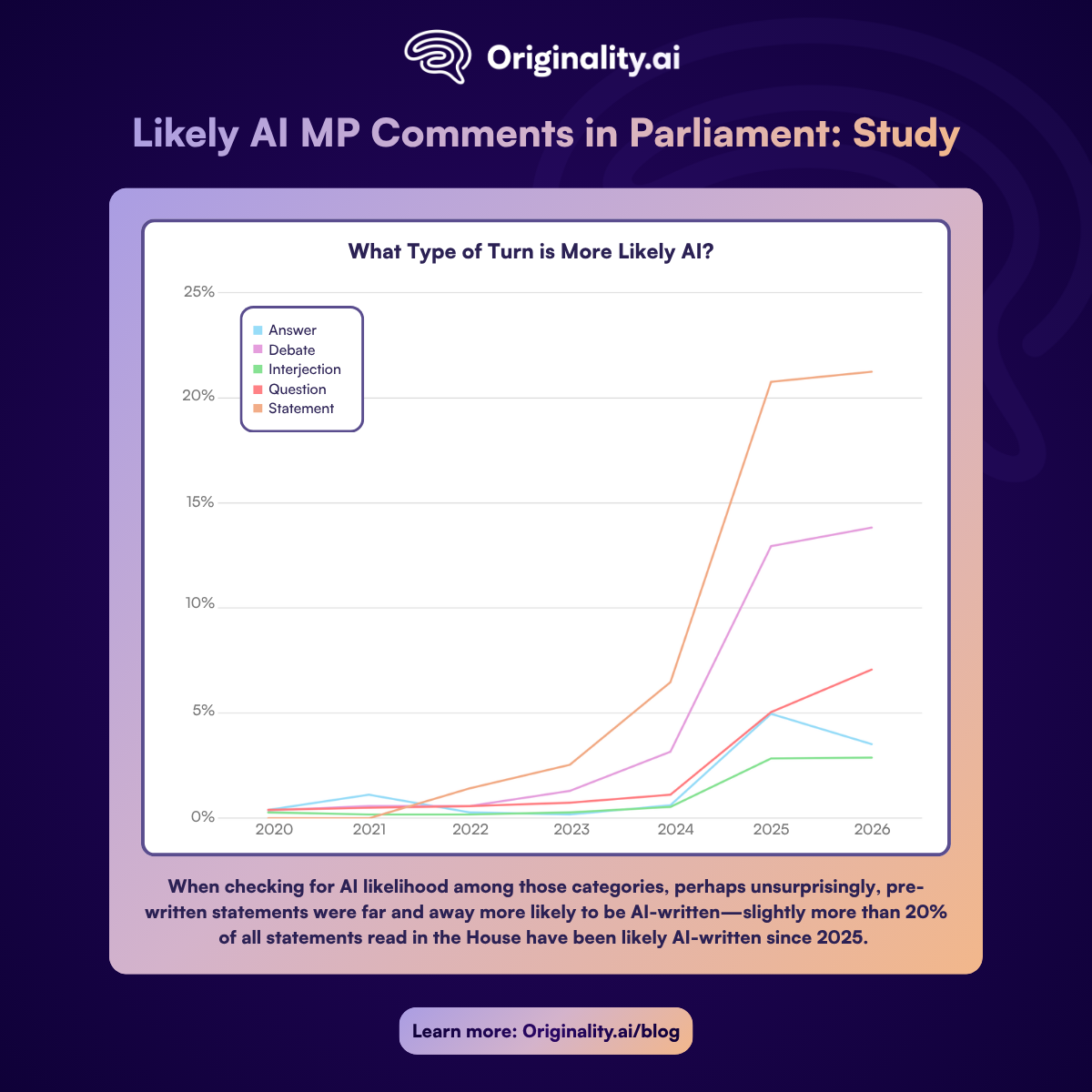
The other three types of turns, which we can categorize as “spontaneous” rather than “prepared” remarks, all lingered in the mid-single digits. They also saw a jump in 2025, but it was not as dramatic, leaping from about 1% (or less) from 2020-23 to 5% (or slightly less) up to about 7% in 2025-26.
When a politician does read AI-written aloud in a government forum, as New Brunswick MLA Bill Oliver did, there’s no guarantee that anyone will notice. It was only a month later that someone happened to catch Oliver’s slip-up and the clip went viral. That delay is a testament to the fact that we are playing catch-up by only even looking at this retrospectively in 2026, after clear AI adoption has already taken place.
In most of the charts we reviewed, 2025 was the year when AI likelihood jumped the most. We haven’t seen another major rise since then, even drilling down to quarterly results. This may indicate that AI adoption among parliamentarians is beginning to plateau—people may have tried the technology and learned how to implement it into their workflows. It’s impossible to say whether we’ll see continued growth among AI likelihood rates, or whether it will flatline in years to come.
Notably, it may not necessarily be the MPs themselves turning to LLMs for help writing their remarks. Office staffers often write their boss’s statements or provide pre-written questions. As far as we can tell, there are no universal House rules governing whether MPs can use LLMs to write their parliamentary remarks. Party policy may differ. Regardless of these rules, MPs, like all workers integrating AI into their workflows, should be bound by the rules of transparency and accountability when it comes to AI adoption.
Canadians have a right to know whether the ideas being presented in their House of Commons do indeed belong to their representatives—or to a robot that’s simply been trained to think like them.
This study analyzed speeches and interventions delivered in the Canadian House of Commons to examine changes in the prevalence of text classified as likely AI-generated. Parliamentary transcript data was collected from the federal Hansard Index, text was scanned using Originality.ai, and results were analyzed in Microsoft Excel.
The dataset covered House of Commons proceedings from Jan. 27, 2020, through June 18, 2026, spanning parts of the 43rd, 44th and 45th parliamentary sessions. The raw dataset included the date, Parliament and session, sitting number, speaker, party affiliation, intervention type, floor language, word count, transcript text and source URL, where available.
A custom Python 3 pipeline was used to retrieve and structure the Hansard data. The pipeline separated proceedings into individual turns and recorded available metadata for each entry. In total, 198,971 turns were collected.
The raw dataset was then put through a custom-built tool to scan every turn independently with the latest AI detection model from Originality.ai, called “AI Allowance”. The AI Allowance rate was set at 15%, meaning it allowed 15% of submitted text to be AI-generated, reducing the likelihood of false positives. Eligible texts received an AI probability score from 0 to 100, being classified as “Likely AI” (score ≥ 50) or “Likely Human” (< 50). Turns that fell below Originality.ai’s minimum threshold of 100 words were classified as N/A and excluded from calculations of AI-likelihood rates, totalling 89,464 ineligible turns. From the remaining 109,507 turns, all 26,878 French-language turns were also filtered out, due to the lack of verbatim accuracy of the language spoken in the House.
As a result, percentages reported in this study represent the share of 82,629 scannable English-language turns, rather than the share of every turn recorded in Hansard.
AI-likelihood rates were calculated as the percentage of scannable interventions classified as “Likely AI.” Results were compared over time and across political parties, distinct speakers, and intervention types.
Originality.ai scores should not be interpreted as definitive evidence that an MP, staff member or other individual used generative AI. Parliamentary remarks may be drafted, edited or prepared by multiple people. The study therefore measures AI likelihood as assessed by Originality.ai, rather than confirmed AI use. Observed differences between years, parties or types of parliamentary intervention are presented as patterns in detector classifications and not as proof of authorship or misconduct.

AI & Plagiarism Detector for Serious Content Publishers
Originality.ai
64 Hurontario St
Collingwood, Ontario
L9Y 2L6