AI Checker
Plagiarism Checker
Grammar Checker
Content Quality
Guideline Checker
Readability Checker
Fact & AI Hallucination Checker

Extensions
MCP

On Oct. 6, 2026, Zimbabwean writer Simbarashe Steyn Kundizeza won the Caine Prize for African Writing for The Blue Fighter, a short story about a family struggling through financial hardship. But just five days later, The Atlantic reported that the story was likely AI-generated. Kundizeza denied the allegation, saying the story drew on his personal experiences.
It’s not the first time a literary prize winner has been accused of using AI.
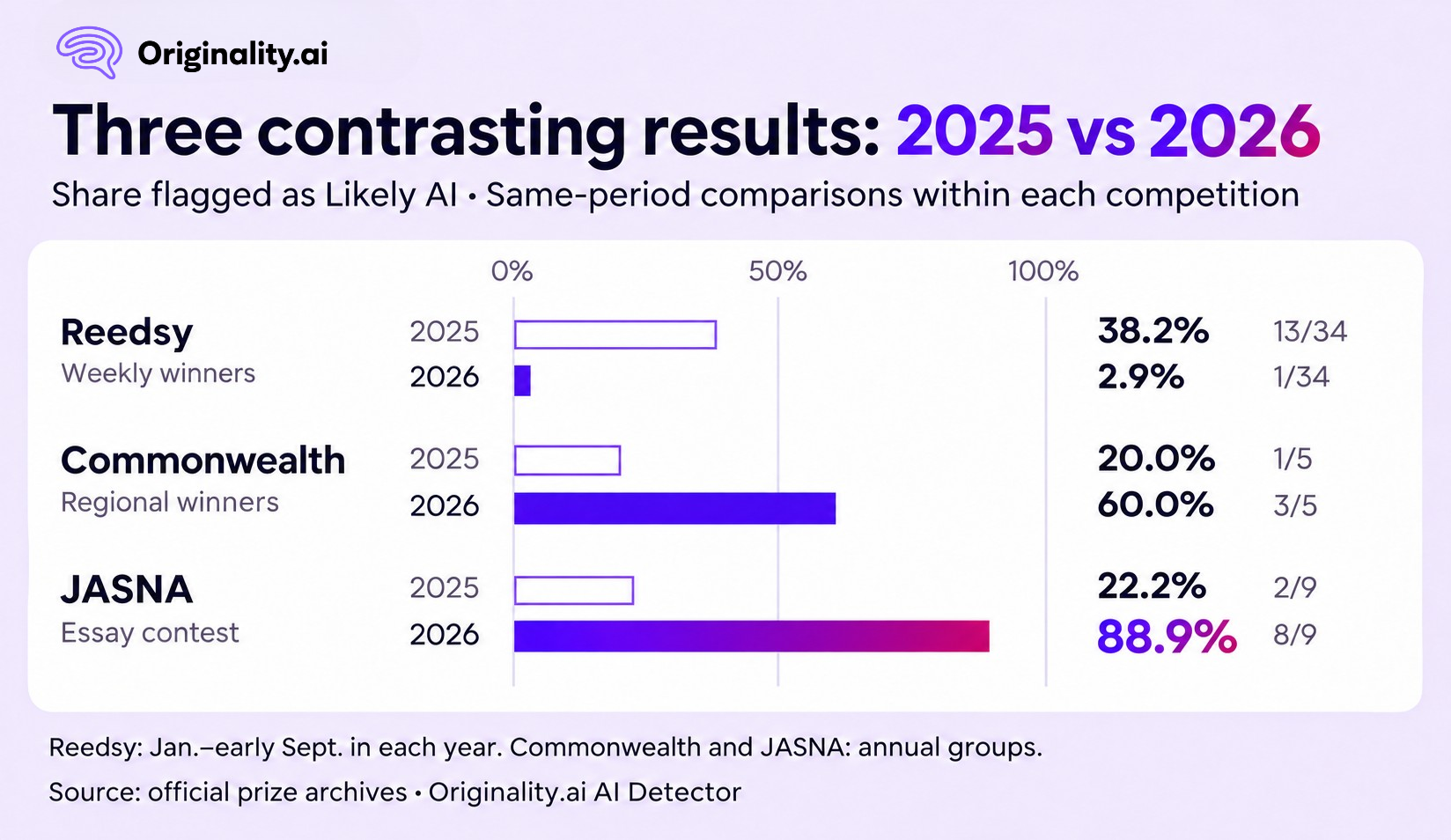
Earlier this year, three of the five regional winners of the Commonwealth Short Story Prize were flagged as likely using AI to write their submissions, prompting a month-long investigation; the Commonwealth Foundation ultimately upheld their initial results after speaking with the authors and examining their drafts and time-stamped notes. (That the Foundation disagreed with the AI detector wasn’t enough for the literary magazine Granta, which ended its publishing partnership with the prize as a result of the fiasco.)
Later, in October—Haitian-Canadian novelist Thélyson Orélien was removed from the Prix Goncourt longlist following allegations of AI use and separate revelations of plagiarism in his older work. He denies using AI to write the novel.
All these situations call for further clarity into the key question: How widespread is AI usage among the stories and essays that are winning literary awards?
We at Originality.ai wanted to find out. We collected 1,493 published stories and essays that were “recognized”—either coming in first, second, or third place, or else receiving an honourable mention or runner-up nod—from 20 different writing competitions between 2020 and Sept. 1, 2026, and scanned each one using Originality.ai’s AI detector. The dataset included anywhere from 186 to 296 per calendar year.
Our findings: More than a quarter of all recognized pieces in 2026 were flagged as likely AI-written. The figure among outright winners was even higher.
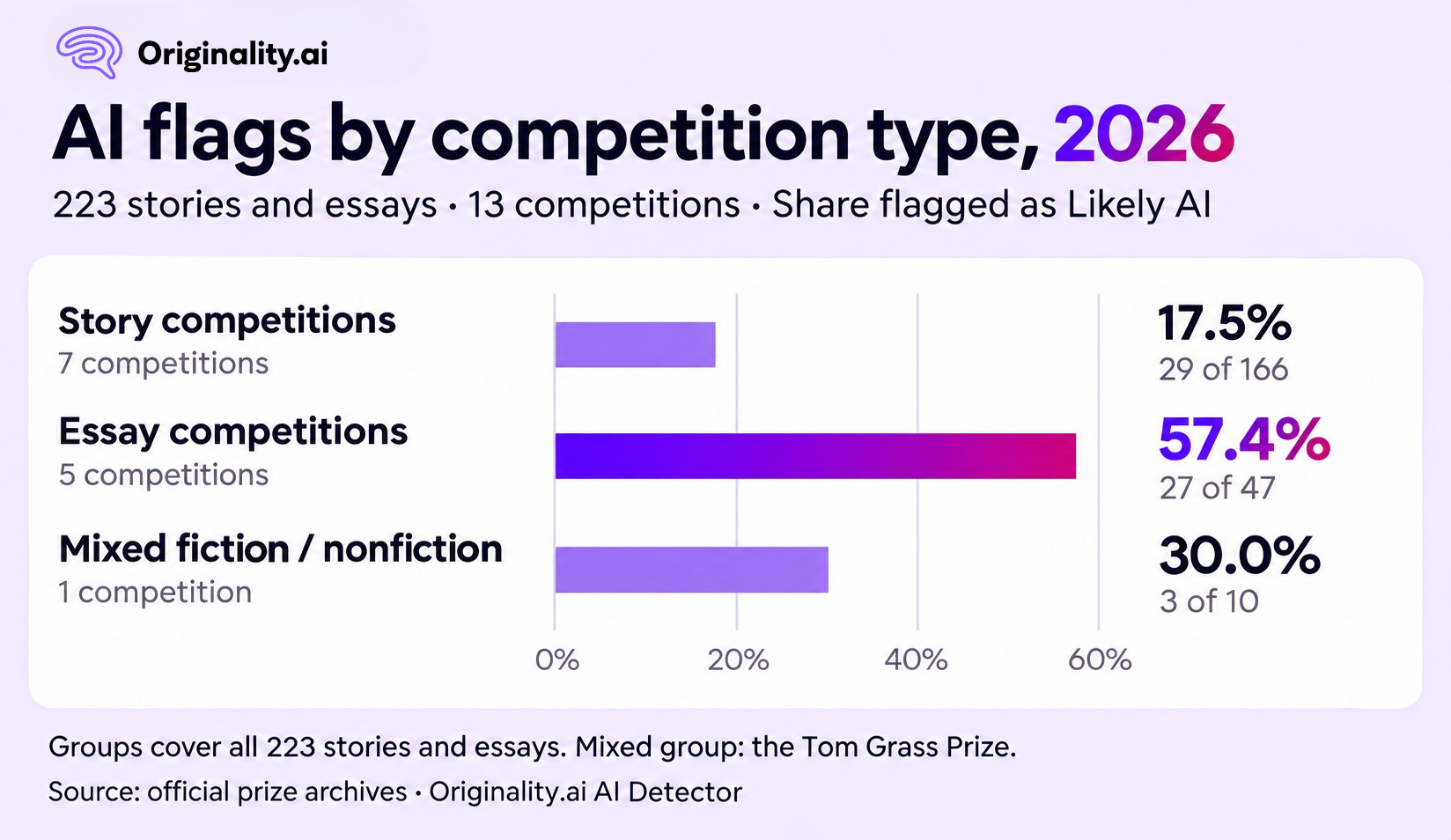
Honing in on 2026 (the year with the highest percentage of likely AI-written submissions), the sharpest divide between likely AI- and likely human-written content is between essays and fiction.
Of the 166 entries we scanned from seven short-story competitions, we flagged just 29 (17.5%) as likely AI-written. But looking at the admittedly smaller sample size of 47 entries from five essay competitions, all of 27 (57.4%) were flagged. (One prize, the Tom Grass Prize, mixed fiction and nonfiction; three of its 10 shortlisted entries were flagged).
In other words, essay competitions accounted for just 21% samples in our 2026 dataset, but nearly 46% of the likely-AI flags.
One of the most striking examples is the Jane Austen Society of North America (JASNA), which invites students to write essays about Austen’s novels. In 2026, the competition asked students to analyze male figures in Austen’s books. The society says they received 675 submissions from students across 46 countries, ultimately recognizing nine first-, second- and third-place essays across high school, undergraduate and graduate divisions.
Of those nine published essays, eight were flagged as likely AI-written by Originality.ai. Compare that to 2025, when just two of nine were flagged, or 2024, when zero were.
In the Association for Women in Mathematics’ student essay competition, seven of 11 recognized essays in 2026 were flagged (63.6%), up from four of eight (50%) in 2025. At the NISOD Student Essay Contest, all three recognized entries were flagged in both 2025 and 2026; while three essays per year is a small sample size, the consistency is noteworthy.
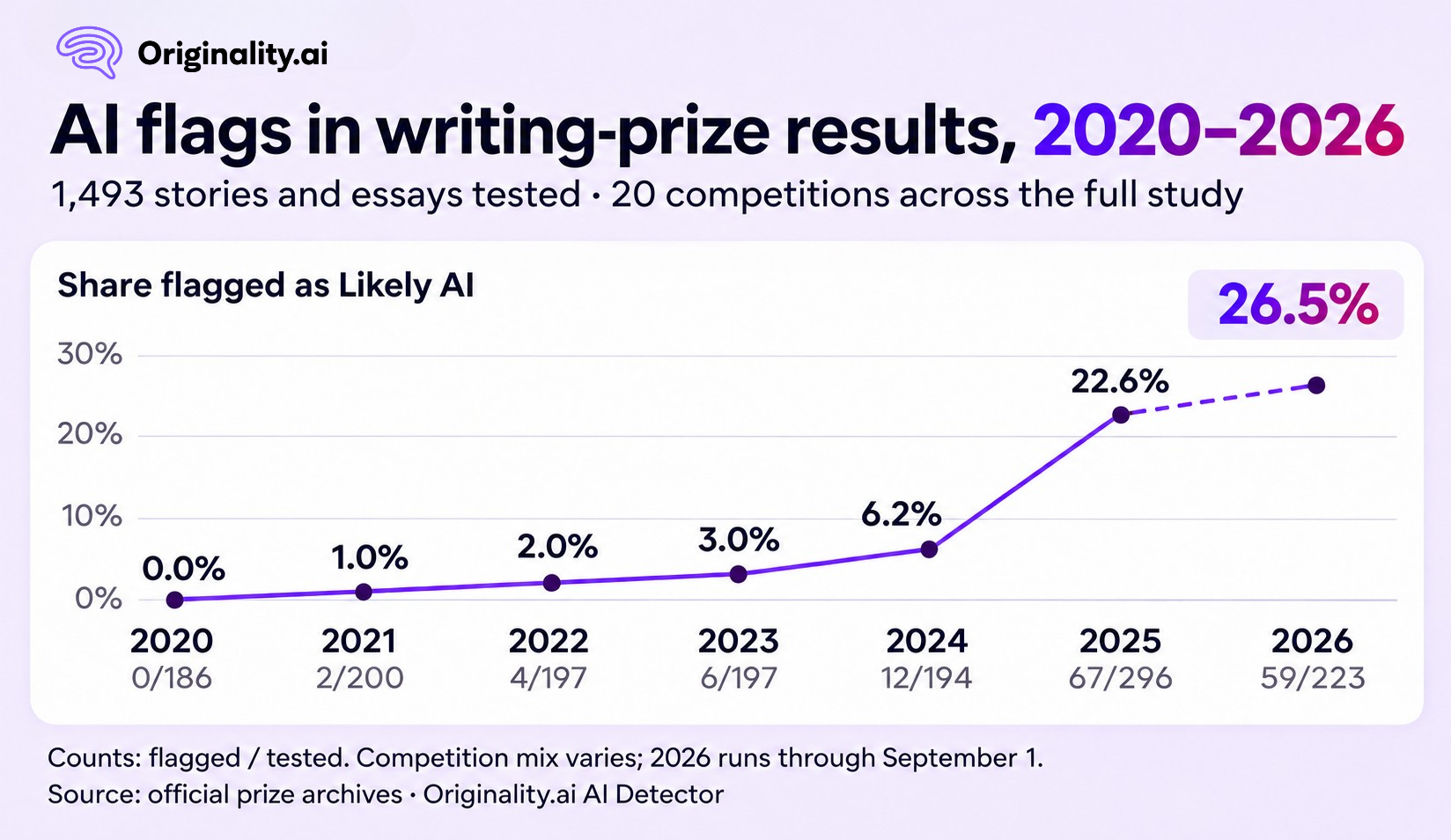
To understand a baseline of the trend, we scanned published entries dating back to 2020.
Absolutely none of the 186 entries in 2020 were flagged as likely AI-written. That crept up to 2% in 2022—the year ChatGPT launched—then 6.2% in 2024, before jumping to 22.6% in 2025 and 26.5% in 2026.
When looking strictly at the 85 identifiable first-place recipients from 12 competitions in 2026, 25 (29.4%) were flagged as likely AI—an even higher ratio.
But not every competition hosted an award in each of those years. For a more consistent look, we isolated the 13 competitions that published results in both 2025 and 2026. The result is almost a tie: 51 of 195 entries (26.2%) were flagged in 2025, versus 59 of 223 (26.5%) in 2026.
So while 2026 undeniably had the highest number of recognized entries flagged as AI-generated, individual competitions have moved in different directions, with judges and organizers taking note of the trend.
Reedsy is a publishing platform that hosts a weekly short-story competition with a US$250 prize. Its official rules explicitly ban applicants from using generative AI to “create, draft, or revise stories.”
During the first eight months of 2025, Originality.ai flagged 13 of its 34 weekly winners (38.2%) as likely AI-generated. During the equivalent period in 2026, it flagged just one of 34 (2.9%). That’s a 35-percentage-point drop in a single year—the largest decline among the competitions we compared.
We don’t know if Reedsy tightened its screening, started using AI detectors or cultivated a community of writers who are independently moving away from AI usage. But the shift is undeniable.
Compare that to Kingsmead’s Young Writers’ Competition in South Africa. While Kingsmead says in their 2026 competition results that they “looked for human generated stories, and entries that did not pass our AI tests were disqualified,” we still found 13 of its 68 recognized entries (19.1%) flagged as likely AI-generated in 2026, up from two out of 53 (3.8%) in 2025.
What stands out is not simply that LLMs can write award-winning literary stories. Rather, what’s fascinating is how the same short story (or essay) can provoke completely different reactions in different people: a judge might give it an award, while the other thinks it reeks of AI.
Those critical of AI may hold the impression that LLM-generated writing is bland, formulaic, or simply inhuman on some level that they can’t quite put into words. Reading it just feels “off”, like it’s a facsimile of genuine human creativity. But then how did the winners of the Caine Prize, the Commonwealth Short Story Prize and the Prix Goncourt all win for stories that simultaneously felt suspicious to someone in the general public? After all, they weren’t flagged as likely AI-generated until a skeptic popped them into an AI detector. How can two people read one story and walk away with such vastly different conclusions?
The answer is: it’s murky. We don’t know. The line between what’s AI-generated and what’s human-written is blurring. LLMs are getting better at sounding more human, and humans, perhaps unwittingly, could be beginning to sound more like AI in a world where so much daily content is produced by robots.
There’s no putting the genie back in the bottle; AI is here to stay. Human language—more than AI’s applications in math, science, and coding—appears to be the first front of this battle between man and machine. Perhaps literary-award panels must diversify to include more judges who are skeptical of AI. If the panels don’t already use AI detectors, they should probably start. Maybe including notes (time-stamped drafts, handwritten journal entries, etc.) along with finished manuscripts will become a requirement for proof of humanity. Maybe writing competitions will shift to handwritten entries only.
Or maybe nothing will change—at least not in the near future—and writers will continue in this murkiness for years to come.
Regardless of the route taken, literary-award organizations must be vigilant about the clear rise of AI-written entries and be aware of the outrage that can ensue afterwards.
We collected 1,493 complete stories and essays from 20 writing competitions, covering 2020 through Sept. 1, 2026. The sample included first-, second- and third-place winners, finalists, runners-up, honourable mentions and other recognized entries. Poetry, excerpts and texts shorter than 100 words were excluded for falling beneath Originality.ai’s minimum word-count threshold (100 words).
All texts were collected from official competition websites and publicly accessible archives. We looked for contests with public results that would be best suited for a longitudinal study, and included as many as we could find. The intention was to look at writing competitions broadly, rather than professional literary prizes or essay contests alone, and parse the data from there.
The 20 competitions analyzed were as follows:
The CBC Nonfiction Prize was also included, bringing the total to 20 competitions.
Each eligible text was scanned using Originality.ai’s AI detector. Texts receiving an AI-confidence score of 50% or higher were classified as “Likely AI.” The same settings were applied to every text, and results were compiled and analyzed in Microsoft Excel.
The number of competitions represented in each year varied depending on when results were published and whether full texts were available. Some competitions had not announced their 2026 results by the study's Sept. 1 cutoff, while others operate on a rolling weekly or quarterly schedule.
The percentages refer to the proportion of tested, recognized texts that the detector flagged—not the proportion of all entries submitted to these competitions. We define “recognized texts” as entries that received a first-, second- or third-place ranking, an honourable mention or runner-up distinction, or selection as an officially published finalist or shortlisted entry.

AI & Plagiarism Detector for Serious Content Publishers
Originality.ai
64 Hurontario St
Collingwood, Ontario
L9Y 2L6