No AI detector is perfect. In AI detection, that means it can produce false positives.
These false positives can be very painful for anyone who creates original content. Whether you are a student who has been wrongly accused of using ChatGPT or a writer who has received a false positive, this article is meant to help.
In this article:
How accurate are AI detectors, and what is a false positive?
What do you do if falsely accused of AI use as a student or writer
How to avoid false positives
How should AI detectors be used?
The importance of AI detection tools even if they aren’t 100% perfect
This article provides a brief overview of common questions about AI content detector false positives that may help if you have been accused of using AI.
For a deeper discussion on each topic, view the recommended reading links within the sections.
Key Takeaways (TL;DR)
False positives happen when an AI detector incorrectly identifies original, human-written content as Likely AI.
Originality.ai has a high 99%+ accuracy rate; however, no AI detection tool is perfect, and there is a risk of false positives (even if exceptionally low at Originality.ai).
AI detection scores should be treated as a signal, and not proof of misconduct.
If you are falsely accused of using AI as a writer or student, follow the tips in this guide, such as providing proof of research, working notes, and showing a replay of your writing process in Google Docs with our Browser Extensions for Chrome and Firefox.
How Accurate Are AI Detectors and What Is a False Positive?
AI Detectors are NOT 100% accurate and never will be. Our latest models, Originality.ai 5.0 and 5.0 Max, have 99%+ accuracy.
However, even with exceptionally high accuracy, AI Detectors can produce false positives.
False positives are when an AI detector incorrectly flags original, human-written content as AI-generated. Rates can vary by brand and AI detection model.
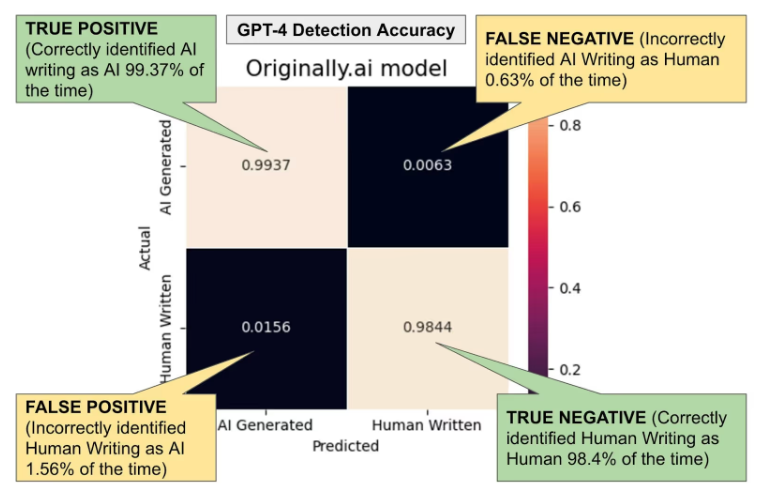
True Positive: AI detector correctly identified content as AI.
False Negative: AI detector incorrectly identified AI content as Human.
False Positive: AI detector incorrectly identified human content as AI.
True Negative: AI detector correctly identified human content as human.
This confusion matrix from a legacy Originality.ai model run on GPT-4 shows the metrics a confusion matrix tracks.
What Do You Do if Falsely Accused: As a Student
If you created a content piece without AI involvement (so it is entirely human-written), and you are being accused of generating it with AI, here are some steps you can take:
Take your time: A knee-jerk reaction can often make the situation worse. Take the time you need to evaluate the situation, and gather the history of your creation process.
Review your school’s academic integrity policy as it relates to the use of AI.
Collect relevant information, like notes you used to research, document or version history, and create a writer replay with the Originality.ai Extensions (Chrome & Firefox) if your essay was written in a Google Doc. Essentially, gather what shows you put a lot of effort into the work.
Check your previously submitted work to show your current work is similar to previously submitted work.
Have empathy for your professor: they need to maintain the academic integrity of their institution, as reports of students using AI for homework have risen since the launch of ChatGPT and haven’t slowed down. A KPMG report as recently as September 2026 notes that 75% of Canadian students now use AI for schoolwork.
Send a polite response to your teacher: communicate the information you have compiled in a polite/respectful way to show that you are confident this is a case of a false positive.
Discuss the issue with your institution’s administration if not resolved with your teacher.
What Do You Do if Falsely Accused: As a Writer
If you are a writer and you have been falsely accused of having AI create content, you can:
Gather relevant information to show your writing process. Similar to the recommendations above for students, collect your research notes, version history, and create a writer replay of your writing process with the Originality.ai Extensions (Chrome & Firefox) if it was written in a Google Doc.
Review your writing agreement and project AI policies on AI use.
Check if a certain AI detection score and tool were agreed to (not a recommended way to manage the misuse of AI).
Find previously submitted or similar work and show how this work is similar and original.
Here are tips to help prevent and resolve false positives.
Review what an AI Score means. AI detectors present scores differently. Familiarize yourself with how the AI detection tool you’re using presents the score. Learn more about AI scores at Originality.ai.
Write in Google Docs whenever possible so that you can use the Originality.ai Browser Extensions to help you PROVE your content is Original.
Consider hybrid human-AI content creation. Since the launch of ChatGPT, writing has increasingly become hybrid. Use Originality.ai to see the percentage of AI involvement in writing and whether it’s Likely AI, Mixed, or Original (human-written). Read about AI scores.
Strange formatting can reduce the accuracy of some detector tools, causing an increase in false positives or false negatives.
The shorter the text, the less accurate the detection score. We recommend that at least 100 words be checked.
Our hope is that this article will help people understand the limitations of detection tools and share strategies on their appropriate use and how to prove your work's Originality.
How Should AI Detectors Be Used?
So, in a world where the rate of false positives isn’t (nor will ever be) 0%, how should AI detectors be used?
AI detection does not provide a provable output for each piece of text — meaning no AI detector can say with provable certainty that this is how we KNOW that your content was created with AI.
Therefore, it is best…not to have a HARD rule that every piece of content MUST meet a certain threshold. AI scores should be treated as a signal, not as proof of misconduct. Read more about how to interpret AI Scores.
If Detection Scores Aren’t Perfect, Why Bother With Detection Tools At All?
Some might question if it is responsible to have an AI detection tool if it is not perfect.
At Originality.ai, we are confident in the accuracy rates of our tests and the additional steps we have taken to try to reduce and manage false positives.
In a world where AI content runs wild and unchecked, the impact on many of us would be significant.
For Web Publishers: If you are concerned about staying on the right side of Google’s guidance with AI-generated content, then using AI detectors can help you transparently identify AI content on your site.
“Using automation—including AI—to generate content with the primary purpose of manipulating ranking in search results is a violation of our spam policies.” (Google, 2023),
“However, using generative AI tools or other similar tools to generate many pages without adding value for users may violate Google's spam policy on scaled content abuse.” (Google, 2026)
For Writers, Editors, and Content Marketing Agencies: Without AI detection tools, it’s challenging for writers, editors, and agencies to communicate with clients that their work is authentically created and complies with project guidelines.
For Academia (Students/Professors/Educational Institutions): Student AI use is already rising; AI detection tools like Originality.ai support students and teachers in maintaining transparency and helping students to show their writing process with features like Writer Replay in our Browser Extensions.
ChatGPT and other AI tools are here —there is no going back. Everyone involved with writing needs to adapt to this new world.
Final Thoughts
The Originality.ai AI Detector has 99%+ accuracy as proven in our studies.
However, as there is still a risk of false positives (even if very low), we advise that AI detection scores should be used as guidance or a signal, not as a final verdict or proof of misconduct.
If you are a student or writer who has been incorrectly accused of AI use, follow the tips outlined in this guide to help demonstrate the authenticity of your work.
As a best practice, AI policies should be clearly defined at the beginning of a project, assignment, or even at the school level to help everyone stay on the same page.
This depends on which brand and model of AI detector you use. At Originality.ai, an AI Detection Score shows the percentage of AI involvement in text and whether it is Likely AI, Mixed Writing, or Original (human-written). Learn more about AI Scores.
Are AI Detectors easy to trick?
At Originality.ai, our machine learning engineers have tested Originality.ai on many humanizing and paraphrasing tools and have found that it is still highly accurate. So no, the Originality.ai AI detector is not easy to trick.
Should AI editing be treated as AI or Original?
This is a tricky question and one that is still being debated as the use of AI continues to increase. Whether the edited content returns a score of Likely AI, Original, or Mixed depends on the extent of AI editing used. For example, a very light AI edit, such as catching a missing comma or punctuation mark, will produce a different level of AI involvement than rephrasing entire sections.
Jonathan Gillham is an engineer, inventor, and entrepreneur. He is the founder and CEO of Originality.ai, an AI content integrity platform that launched the first commercial AI detector in November 2022, just three days before ChatGPT launched. Before founding Originality.ai, Jon worked as an engineer, built and exited two companies. His early work with generative AI in 2020 and 2021 gave him a firsthand view of the coming wave of AI-generated content and the need for technology that could bring transparency and trust to written content. Today, he leads Originality.ai’s work in AI detection and content integrity and is a named inventor on two U.S. patents covering AI detection technology. Jon’s expertise and research have been featured in WIRED, Business Insider, The Register, Global News, The Guardian, Entrepreneur, and The Washington Post, among others.